Marcionism was an early Christian dualist theology founded by Marcion of Sinope around 144 CE in Rome. Marcion taught that the God of the Old Testament — the creator of the material world — was a different, inferior deity from the supreme God of love who sent Jesus. He created the first known Christian biblical canon (rejecting the entire Old Testament), and his church survived for centuries. Whether Marcionism is truly Gnostic is debated — it shares dualism and Demiurge theology but lacks the emphasis on secret knowledge (gnosis).
Who Was Marcion?
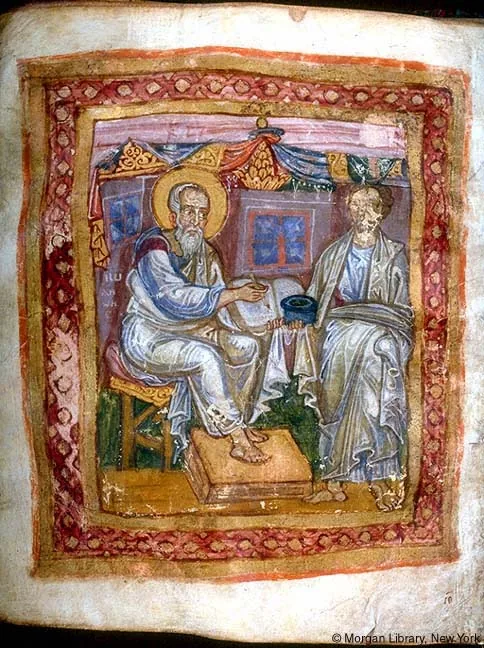
Marcion of Sinope (c. 85–160 CE) was the son of a bishop from Sinope on the Black Sea coast of Pontus (modern northern Turkey). A wealthy shipowner, he arrived in Rome around 140 CE and made a substantial financial donation to the Roman church — a donation reportedly returned to him when he was excommunicated around 144 CE following a dispute over his theological views.
Marcion was not a mystic or an intellectual in the Valentinian mould. He was a practical theologian with a single, radical insight: the God described in the Old Testament — violent, jealous, inconsistent, demanding blood sacrifice — was simply not the same God who sent Jesus. The God of the Hebrew Bible was a just but limited creator-god; the God of the New Testament was a supreme being of pure love and grace, previously unknown to humanity. Jesus came not to fulfil the Law but to reveal an entirely different God.
The Two Gods
Marcion's theology rested on a strict dualism between two divine principles:
- The Creator God (Demiurge / Just God): The God of the Old Testament — the maker of the material world. Just, wrathful, and bound by law. He had the right to rule his own creation but was not good in the supreme sense. Marcionites sometimes called him the Demiurge or the "God of this world."
- The Supreme God (Father of Jesus / Good God): A being of pure love and mercy, previously unknown to humanity, who sent Jesus to reveal a higher reality and rescue souls from the creator-god's world.
This was not the sophisticated Gnostic dualism of the Valentinians — with their Pleroma of 30 Aeons and Sophia's fall. Marcion had no interest in cosmological mythology. His dualism was ethical and scriptural: the Old Testament God behaved in ways incompatible with the God of love revealed by Jesus, therefore they must be different beings.
Marcion's Canon — The First Biblical Canon
Marcion's most historically significant act was creating what is widely considered the first Christian biblical canon — a fixed list of authoritative scriptures. His canon consisted of eleven books:
- The Gospel of Marcion — a version of the Gospel of Luke, edited to remove what Marcion considered Jewish interpolations (including the birth narrative and much of the Hebrew Bible quotation material)
- Ten Pauline epistles — Galatians, 1&2 Corinthians, Romans, 1&2 Thessalonians, Ephesians (called Laodiceans by Marcion), Colossians, Philemon, Philippians
He rejected the entire Old Testament, all four canonical Gospels (not just Luke), and the Pastoral Epistles (1&2 Timothy, Titus). He considered Paul the only true apostle of Jesus — the others had misunderstood the gospel by contaminating it with Judaism.
The historical irony is considerable: Marcion's provocative canon creation may have accelerated the orthodox Church's own process of fixing a biblical canon as a counter-measure. Bart Ehrman, among others, has argued that the existence of Marcion's canon was one of the pressures that forced proto-orthodox Christians to define their own.
The Marcionite Church
Marcion did not just teach — he built a church. The Marcionite church had its own bishops, clergy, liturgy, and communities across the Roman Empire. It used Marcion's edited canon, celebrated a version of baptism and eucharist (with water substituted for wine in some communities), and admitted women to the priesthood. By the late 2nd century it was considered Christianity's most dangerous rival — more dangerous than the Valentinians precisely because of its church structure and popular appeal.
Tertullian wrote five books against Marcion (Adversus Marcionem, c. 208 CE) — the longest anti-heretical work in early Christian literature — which is now our main source for Marcionite theology. The Marcionite church survived in some form until at least the 5th century in the West and possibly the 10th century in the East (Syria, Mesopotamia), where it eventually blended into Manichaean communities.
Is Marcionism Gnostic?
The classification of Marcionism as Gnostic is genuinely disputed. It shares several Gnostic features: a creator-god distinct from the supreme God, Docetic Christology (Jesus's body was not real matter but spiritual appearance), and rejection of the material world as the product of an inferior deity. But it lacks the defining Gnostic feature: the emphasis on gnosis — secret, experiential knowledge as the mechanism of salvation. For Marcion, salvation came through faith in the gracious God revealed by Jesus, not through special knowledge or initiation. Most modern scholars treat Marcionism as a distinct early Christian theology influenced by dualism rather than a Gnostic sect properly speaking.
Legacy
The Marcionite question — whether the God of the Old Testament is the same as the God of Jesus — has never entirely gone away. It recurs in every generation of Christian theology, most recently in the work of scholars like Paul Tyson and in popular discussions prompted by the problem of evil. Adolf von Harnack's landmark study Marcion: The Gospel of the Alien God (1921) argued that Marcion was essentially right — that Christianity required a clean break with the Old Testament — and that the Church's decision to include the Hebrew Bible was a historical error. Harnack's argument remains controversial but influential.
Frequently Asked Questions
Is Marcionism the same as Gnosticism?
Not exactly. Marcionism shares Gnostic features — two gods, Docetic Christology, rejection of the Old Testament God as a lesser creator. But classical Gnosticism centres on gnosis (secret experiential knowledge) as the path to salvation, with elaborate cosmological mythology. Marcion had no interest in cosmological mythology or secret initiation. Most scholars classify Marcionism as a distinct early Christian dualist theology with overlapping features, rather than a Gnostic sect.
What happened to Marcionite Christianity?
The Marcionite church survived for several centuries. In the West it largely disappeared by the 5th century under orthodox pressure. In the East — particularly in Syria and Mesopotamia — Marcionite communities persisted longer, some apparently blending into Manichaean communities by the 7th–10th centuries. Marcion's writings were all destroyed; we know his theology only through his opponents, primarily Tertullian's Adversus Marcionem.
Did Marcion create the Bible?
Marcion created the first known fixed Christian biblical canon — his list of 11 books (edited Luke + 10 Pauline epistles), rejecting the Old Testament entirely. He did not "create the Bible" in the sense of the 27-book New Testament — that canon was not fixed until the 4th century, partly in response to the Marcionite challenge. Marcion's provocative canon may have accelerated the orthodox Church's own canonisation process.