The divine spark is the fragment of true divine light — pneuma — that certain human beings carry within them. It came from the Pleroma (the divine realm), entered humanity through an accident in the Gnostic creation myth, and is the real self: ontologically divine, untouched by the Archons, and capable of returning to its source through gnosis.
Of all the concepts in Gnostic thought, the divine spark is the most personal. The Demiurge is theology. The Archons are cosmology. The divine spark is about you — specifically, whether there is something inside you that does not belong to this world.
The Gnostics believed there was. They gave it a precise name, a precise origin story, and a precise account of what it is capable of. This page lays out that account in full.
What the Divine Spark Actually Is
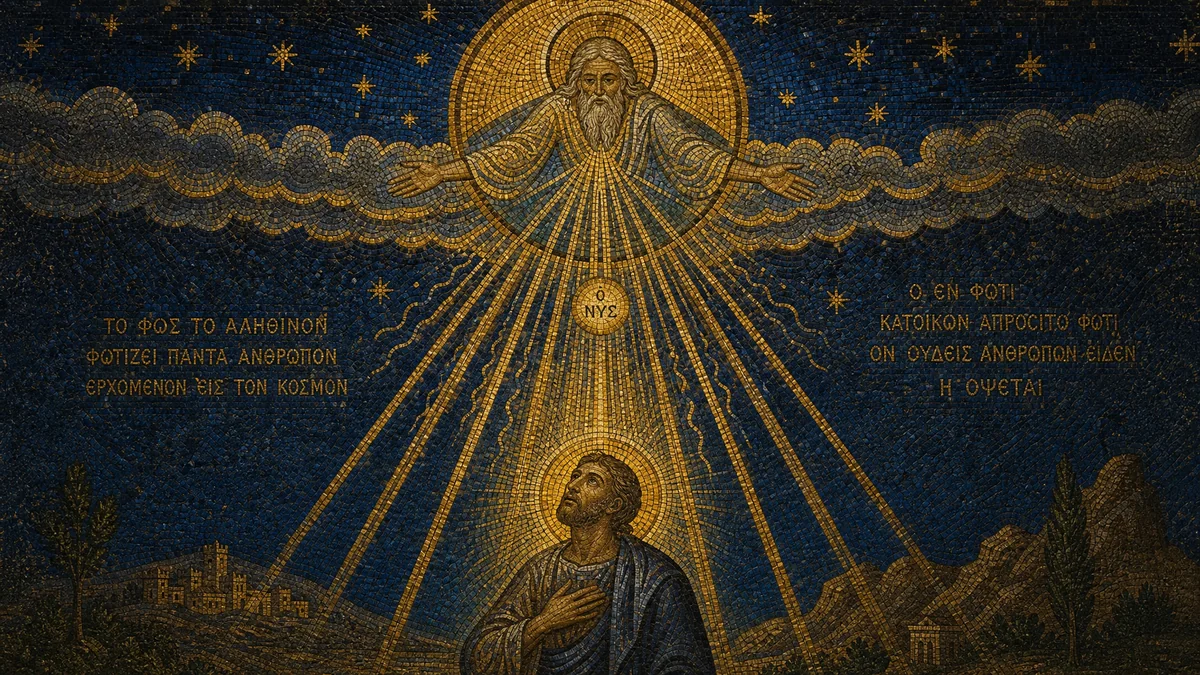
The divine spark goes by several names in Gnostic texts — pneuma, sperma, spinter — but all refer to the same thing: a fragment of the true God's substance, qualitatively identical to it, enclosed inside a human body.
Also called: spinter (the Valentinian teacher Heracleon's term for the spark), sperma (seed of light — used in several Sethian texts), scintilla (Latin: spark — used by later Christian mystics drawing on the same tradition).
The most important thing to understand about the divine spark is what it is not. It is not the soul. The soul (psyche) is an intermediate substance — it can be influenced, elevated, or degraded by the Archons and by material experience. The pneuma is not intermediate. It is fully and ontologically divine — a piece of the true God, not a created thing but a fragment of the uncreated.
Hans Jonas, in The Gnostic Religion (1958), put it plainly: "The pneuma is not something the Gnostic acquires through merit or practice. It is what he is — or rather, what is most essentially him." The body was made by the Archons. The soul was shaped by the planetary spheres. The pneuma came from the Pleroma and belongs to it still.
How the Spark Got Into Humanity — The Secret Book of John's Account
The divine spark did not enter humanity by design — it entered by accident, through the Demiurge's inadvertent act of self-betrayal.
The Secret Book of John tells the story with dramatic precision. After the Demiurge (Yaldabaoth) and his Archons had constructed Adam's body — bone, sinew, flesh, sensation, all assigned to specific Archons in a clinical sequence — the result could not move. Adam lay inert, unable to rise. The Archons had built the cage but could not animate it.
What happened next is the hinge of the entire Gnostic myth:
And he breathed into his face, and the first ruler took some of the power of his mother and breathed it into him — and he did not know this, for he exists in ignorance. And the power of the mother went out of the ruler into the natural body, which they had fashioned, and it moved, and it became powerful, and it was luminous.
Yaldabaoth breathed into Adam to animate him — but the power he used came from his mother Sophia's light, which he had absorbed without understanding. In the act of blowing life into his creation, he transferred a fragment of Pleroma light into the very thing he was trying to own. He did not know this. The divine spark entered humanity as an act of inadvertent self-betrayal by the creator who was supposed to be its prison warden.
This is the Gnostic rewriting of Genesis 2:7 — "Then the Lord God formed a man from the dust of the ground and breathed into his nostrils the breath of life." The text is the same. The interpretation is reversed: the breath of life was not a gift from a loving God — it was a theft from a confused one. And what was stolen is something the Demiurge never had any right to possess.
The Spark vs. The Soul — A Critical Distinction
One of the most important distinctions in Gnostic anthropology is also one of the most frequently missed: the divine spark is not the soul.
| Component | Greek term | Origin | Archon influence | Fate after death | Capacity for gnosis |
|---|---|---|---|---|---|
| Divine spark | Pneuma | Pleroma — fragment of true divine light | None — the Archons cannot corrupt it, only obscure it | Returns to Pleroma when recognised | Full gnosis — this is what gnosis recognises |
| Soul | Psyche | Shaped by the seven planetary spheres on descent | Significant — soul carries planetary garments, can be elevated or degraded | Ascends through spheres (if gnosis achieved) or reincarnates | Partial — can approach gnosis but cannot produce it |
| Body | Hyle / Sarx | Constructed by the Archons from matter | Total — the body is the Archons' primary tool | Returns to matter — not preserved or resurrected | None — the body is the obstacle, not the vehicle |
The practical consequence of this distinction is significant. The soul's condition matters — whether it has been elevated by gnosis or dragged down by material attachment affects its fate after death. But the pneuma's condition does not change. It cannot be improved or degraded. It can only be recognised or forgotten. Gnosis is not the process of making the divine spark more divine — it is the process of the divine spark becoming aware of what it already is.
Who Has It — The Pneumatic Election
The divine spark, in Gnostic thought, is not universally distributed — and this is where the tradition becomes most uncomfortable.
Pneumatics — those who carry an active divine spark — are capable of full gnosis and ultimate return to the Pleroma. Psychics carry souls but not pneuma; they can be spiritually elevated but are not ontologically divine. Hylics are entirely of matter; no gnosis is possible for them. The categories are not moral — they are ontological. You cannot earn the divine spark through virtue or lose it through sin. You either have it or you do not.
The Valentinians, to their credit, pushed back on the strictest reading. Valentinus himself held that psychics could be elevated through sustained engagement with Gnostic teaching — that the boundary between psychic and pneumatic was not absolutely fixed. Sethians were less generous.
The internal Gnostic debate on this point was genuine and unresolved. What all schools agreed on was the basic structure: the divine spark is a specific thing, not everyone has it in active form, and gnosis is what activates rather than creates it.
The Archons' Fear — Why They Built the Body
The moment the divine spark entered Adam, the Archons faced a problem they had not anticipated: something inside their creation was superior to them.
The Secret Book of John states it without equivocation: "Adam was more intelligent than the creators and the first ruler. When they realised that Adam was enlightened and could think more clearly than they, they took him and threw him into the lowest region of the whole material realm." The Archons' response to Adam's gnosis-potential was not to celebrate it — it was to bury it.
The entire Archon system — the seven planetary spheres, the water of forgetfulness, the cycle of reincarnation — functions as a suppression mechanism aimed at one target: a fragment of the true God, loose in a domain where it does not belong and which its very presence threatens. Every time the divine spark begins to stir — every time a pneumatic begins to feel the alienation that signals awakening — the Archons' system of distraction, desire, and material attachment activates to pull attention back to the surface.
The Gnostic cosmological structure makes the stakes explicit: the Archons are not omnipotent. They are afraid. And what they are afraid of is exactly what you carry.
The Spark in the Primary Texts
The Gnostic texts return to the divine spark again and again — from different angles, in different registers, always circling the same recognition.
The Gospel of Philip distinguishes carefully between the soul and the spirit, insisting on their different natures:
The soul of Adam came into being by means of a breath. The partner of his soul is the spirit. His mother is the thing that was given to him. His soul was taken from him and replaced by a spirit. When he was united, he spoke words incomprehensible to the powers. They envied him — a spiritual union — for they had no union with one another.
The Book of Thomas the Contender states the epistemological consequence of the spark most directly — self-knowledge and cosmic knowledge are the same thing, because the self that is known is itself a piece of the cosmos's deepest reality:
Those who have not known themselves have known nothing, but those who have known themselves already have acquired knowledge about the depth of the All.
The Gospel of Thomas frames the same recognition as a spatial statement — the kingdom (the Pleroma) is not somewhere else; it is inside and outside simultaneously, because the divine spark is already there:
If your leaders say to you, "Look, the kingdom is in the sky," then the birds of the sky will precede you. If they say to you, "It is in the sea," then the fish will precede you. Rather, the kingdom is inside of you, and it is outside of you. When you know yourselves, then you will be known, and you will understand that you are children of the living Father.
The Same Idea in Other Traditions — Four Parallels
The Gnostic divine spark is not an isolated idea — the same concept, named differently, appears in several other major spiritual traditions.
| Tradition | Term | Key figure | Date | Core claim |
|---|---|---|---|---|
| Gnosticism | Pneuma / divine spark | Valentinus, Sethian authors | c. 100–400 AD | A fragment of divine light, accidentally placed in human beings by the Demiurge, capable of returning to the Pleroma through gnosis |
| Lurianic Kabbalah | Nitzotzot (נִיצוֹצוֹת) — divine sparks | Isaac Luria (the Ari) | 16th c., Safed | When the divine vessels shattered (shevirat hakelim), sparks of divine light fell into matter. Human spiritual practice (tikkun olam) gathers them back. |
| Christian mysticism | Scintilla animae — spark of the soul | Meister Eckhart | c. 1300, Germany | The innermost part of the soul is a spark untouched by sin or time — it is identical with God. Condemned as heretical by Pope John XXII in 1329. |
| Neoplatonism | The soul's undescended portion | Plotinus | c. 250 AD, Rome | The soul retains a portion of divine Intellect even at its lowest point of material descent — it never fully loses contact with the One. |
| Jungian psychology | The Self | Carl Jung | 20th c. | At the centre of the psyche lies the Self — the ordering principle that transcends the ego. Individuation is the process of the ego recognising and orienting to the Self. |
Meister Eckhart's case is particularly striking. Writing in 14th-century Germany, with no known direct access to the Nag Hammadi texts (not discovered until 1945), Eckhart described the scintilla animae in terms that match the Gnostic pneuma almost exactly: a spark at the soul's innermost point, untouched by sin, identical with God, uncreated. Pope John XXII condemned twenty-eight of Eckhart's propositions as heretical in 1329. The condemnation reads, in part, like a replay of Irenaeus attacking the Valentinians eleven centuries earlier.
Isaac Luria's nitzotzot theory in 16th-century Kabbalah is structurally identical to the Gnostic account of scattered divine sparks requiring recovery — with one significant difference: Luria's sparks were scattered into all matter, not just into pneumatic human beings, and recovering them is a communal ethical project (tikkun olam — repair of the world) rather than an individual gnostic one.
What It Feels Like — The Phenomenology of the Spark
The Gnostic texts are unusual among ancient religious literature in that they describe, in precise terms, what it feels like to carry the divine spark.
The dominant phenomenology is alienation. The pneumatic — the person in whom the divine spark is active — experiences the material world as foreign. Not merely unpleasant or unjust, but wrong at a structural level: the wrong place, the wrong kind of existence, a life that does not match an unnamed interior standard.
The Gospel of Thomas makes this alienation mutual — not just the pneumatic rejecting the world, but the world being revealed as unworthy of the pneumatic: "Whoever has come to know the world has discovered a corpse, and whoever has discovered a corpse, of that person the world is not worthy" (Saying 56).
Other phenomenological markers in the texts:
- The sense of sleep: Several texts describe ordinary material life as a kind of sleep or intoxication — the pneumatic is "waking up" while everyone around them remains asleep. The Demiurge's water of forgetfulness is experienced as the somnolence of ordinary life.
- The inner recognition that cannot be fully articulated: Gnosis, when it comes, is described as recognition rather than discovery — as if remembering something that was always known but suppressed.
- The sense of having come from somewhere else: The Gospel of John (1:10–11) — used by Gnostics alongside their own texts — captures it: "He was in the world, and the world came into being through him; yet the world did not know him. He came to what was his own, and his own people did not accept him."
For the Gnostics, these experiences are not pathological. They are epistemological. The pneumatic feels alien because they are alien — cosmologically, ontologically, by origin. The feeling of not belonging is not a disorder; it is accurate perception of a fact about one's nature.
The Spark and Salvation — What Gnosis Does to It
Gnosis does not create the divine spark — it finds it.
The spark was always there. It entered with the Demiurge's breath, before birth, before memory. The water of forgetfulness covered it. The body enclosed it. The seven planetary garments obscured it. But it did not diminish. It cannot diminish — it is a piece of the true God, and the true God does not diminish.
What gnosis does is remove the obscuration. The moment the pneuma recognises itself — recognises that it is divine, that it does not belong to the material world, that the Archons have no legitimate claim on it — the process of return begins. This is why the Gnostic texts consistently describe salvation as waking up rather than becoming good. The spark does not need to become more divine. It needs to become aware of its own divinity.
After death, the pneumatic soul — the soul carrying the recognised divine spark — ascends through the seven Archon spheres, shedding the planetary garments acquired on the way down, passing each gate by demonstrating the gnosis that the Archons cannot counter. At each gate it presents not credentials but self-knowledge: I know what I am, I know where I came from, I know where I am going, and you have no claim on me.
The Pleroma, when the spark returns, does not receive something new. It receives something back. The divine spark was always part of it. The entire journey — descent, enclosure, forgetting, awakening, ascent — is, from the Pleroma's perspective, a temporary exile of its own light. When the spark returns, the Pleroma is, in the language of the Gospel of Truth, "filled" — made complete again. The spark's return is not the soul's gain alone. It is the divine realm's.
Frequently Asked Questions
What is the divine spark in simple terms?
The divine spark is a fragment of the true God's light — called pneuma in Greek — that certain human beings carry within them. It entered humanity through an accident: when the Demiurge (the flawed creator of the material world) breathed life into Adam, he inadvertently transferred a piece of the divine light he had absorbed from his mother Sophia. The divine spark is the real self — not the body, not the personality, but the innermost core that is ontologically identical with the true divine realm (the Pleroma). Gnosis — direct spiritual recognition — is what enables the spark to remember its origin and begin its return.
Does everyone have a divine spark?
In classical Gnostic thought, no. The Gnostic trichotomy divides humanity into pneumatics (those with an active divine spark, capable of full gnosis), psychics (those with souls but not an active pneuma, capable of partial spiritual development), and hylics (those entirely of matter, with no capacity for gnosis). The election is ontological — it is not earned by virtue or lost by sin. Valentinian Gnostics were somewhat more inclusive, holding that psychics could be elevated through sustained engagement with Gnostic teaching. Sethians were stricter. All schools agreed that not everyone is capable of full gnosis.
What is the difference between the divine spark and the soul?
The soul (psyche) and the divine spark (pneuma) are distinct in Gnostic anthropology. The soul is an intermediate substance, shaped by the seven planetary spheres on its descent into matter — it carries planetary influences, can be elevated through gnosis, or dragged down by materialism. The divine spark is not intermediate — it is fully and ontologically divine, a fragment of the Pleroma's light. The Archons can manipulate the soul; they cannot corrupt the pneuma. They can only obscure it through the body's weight and the water of forgetfulness. Gnosis does not improve the divine spark — it reveals what was always already there.
Where does the divine spark go after death?
For a pneumatic who has achieved gnosis, the divine spark ascends after death through the seven Archon-ruled planetary spheres. At each gate, the soul demonstrates gnosis — self-knowledge of its divine origin — and the Archon cannot detain it. As it passes each sphere, it sheds the planetary "garment" acquired on its descent. Stripped of all material accretion, the spark arrives at the Pleroma — the divine realm — and is received back into the fullness from which it came. For those who have not achieved gnosis, the soul may be reincarnated, remaining in the cycle of material existence until gnosis is attained.
Is the divine spark the same as the Holy Spirit?
They share vocabulary — both use pneuma (spirit/breath) — but the concepts differ substantially. In orthodox Christian theology, the Holy Spirit is the third person of the Trinity, shared by the whole Christian community through baptism and sacrament. In Gnostic theology, the divine spark (pneuma) is an individual fragment of divine light carried by specific pneumatic human beings — not conferred by any external authority or sacrament. The Gnostics explicitly rejected the idea that baptism could transmit the divine spark: the Gospel of Philip describes people who "go down into the water and come up without having received anything." If you have the spark, you were born with it. If you do not, baptism will not give it to you.