Gnostic meditation is the set of contemplative practices through which Gnostics sought direct experiential knowledge (gnosis) of the divine — not belief, but encounter. The core ancient practices were: the ascent vision (mentally tracing the soul's journey through the seven heavens), contemplation of Gnostic texts (especially the Gospel of Thomas), prayer using texts from the Nag Hammadi Library, and chanting of hymns like Thunder, Perfect Mind. All are attested in 2nd–4th century texts and accessible to modern practitioners today.
What Is Gnostic Meditation?
Gnostic meditation is not a technique — it is a goal: the direct, experiential knowledge of the divine spark within you and its origin beyond the material world. The Greek word gnosis does not mean intellectual knowledge. It means the kind of knowing that changes you — the recognition of your own divine origin, felt rather than reasoned, experienced rather than believed.
Meditation is the method by which this recognition was sought. Across Gnostic texts from the 2nd to 4th centuries, a consistent three-stage model appears: first, concentration — fixing attention completely on a single point; then meditation — the boundary between the observer and the observed begins to dissolve; then contemplation — direct, non-dual awareness, beyond thought, beyond image. This is structurally identical to what Patanjali called dharana → dhyana → samadhi, and what Christian monks called lectio → meditatio → contemplatio. Gnosticism did not invent these stages. It drew on the same late-antique contemplative toolkit as Neoplatonism, early Jewish mysticism, and Egyptian monasticism — and gave each stage a specific Gnostic cosmological meaning.
The Ascent Vision — Travelling the Seven Heavens
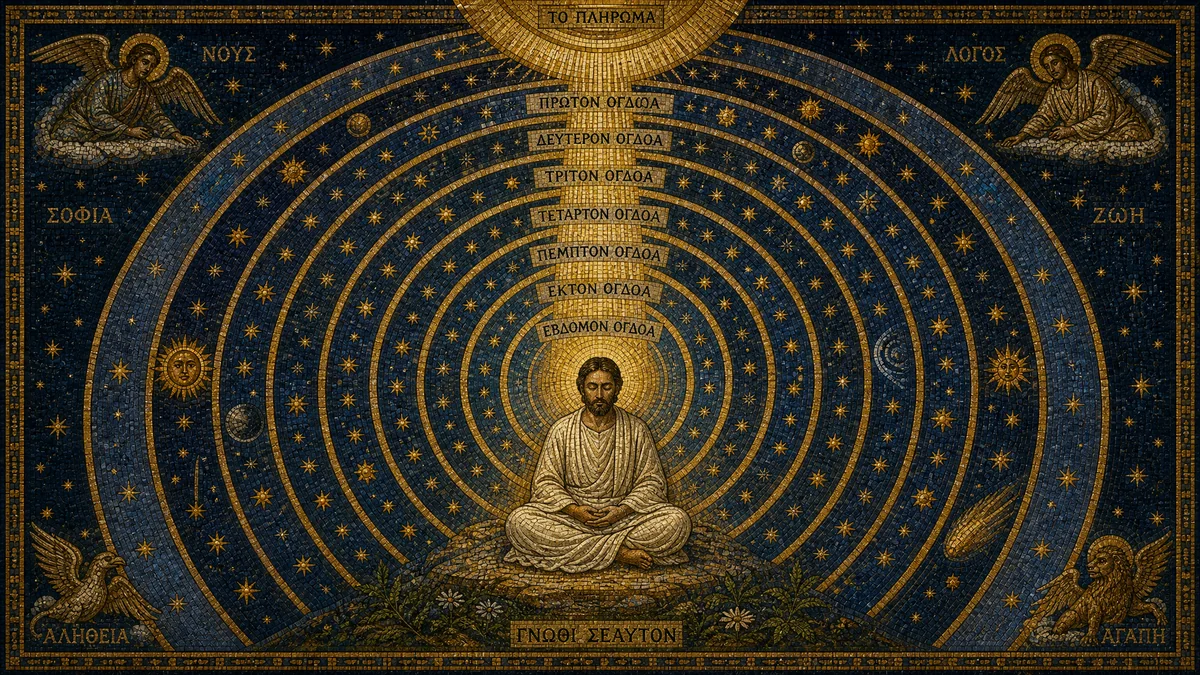
The most distinctively Gnostic meditation practice was the ascent vision — a guided mental journey through the seven heavens, past each Archon's gate, toward the Pleroma. It was both a preparation for death (the soul must know the Archon names to pass the gates after dying) and a form of living gnosis: the practitioner rehearsing the return to the divine while still alive.
The practice is attested in multiple Nag Hammadi texts. The Secret Book of John provides the full cosmological map: seven heavens, each ruled by one of the seven Archons (Yaldabaoth, Adonaios, Astaphaios, Iao, Sabaoth, Eloaios, Oraios), each corresponding to one of the seven classical planets. The Apocalypse of Paul (NHC V,2) narrates Paul's ascent through these seven heavens, then beyond, to the tenth heaven where he encounters the divine fullness. The same practice appears in Jewish merkabah mysticism of the same period — though in the Jewish version the celestial gatekeepers are guardians, not obstacles.
Contemplating the Gospel of Thomas
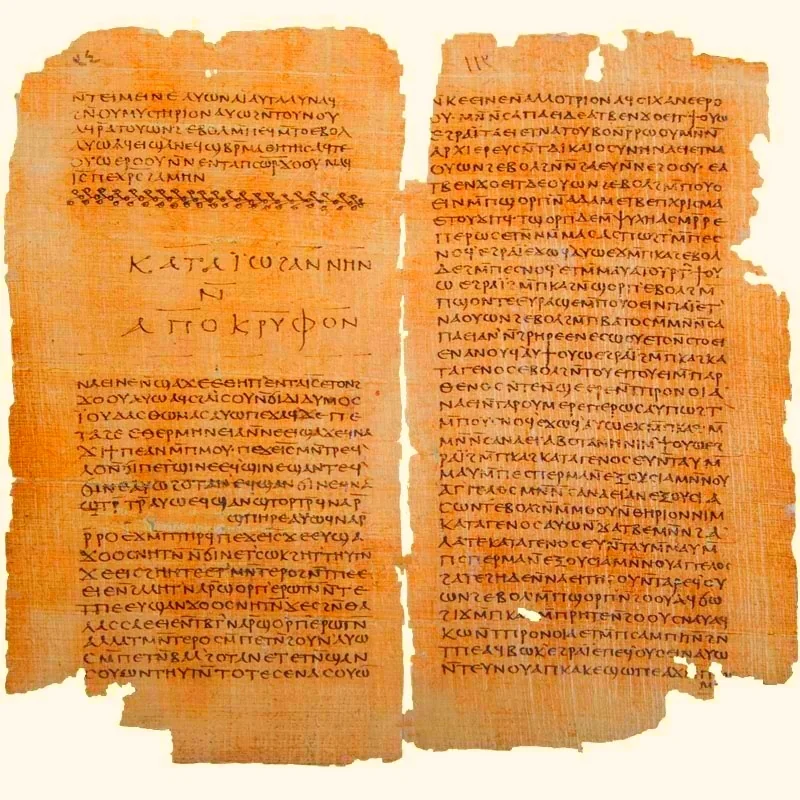
The Gospel of Thomas was not written to be read — it was written to be contemplated. Its 114 sayings are not a narrative, not a theology, not an argument. They are objects for sustained reflection — each one to be held, turned over, and allowed to yield meaning through direct insight rather than analysis. Elaine Pagels argues in Beyond Belief (2003) that Thomas was designed for exactly this: the same contemplative reading that Christian monks called lectio divina, but aimed at the recognition of the divine within rather than the contemplation of external scripture.
Saying 3 is the clearest invitation:
If your leaders say to you, "Look, the kingdom is in the sky," then the birds of the sky will precede you. If they say to you, "It is in the sea," then the fish will precede you. Rather, the kingdom is inside of you, and it is outside of you. When you know yourselves, then you will be known, and you will understand that you are children of the living father.
Many Thomas sayings function as koans — paradoxes that resist logical resolution and can only be resolved through direct experience. Saying 22: "When you make the two one... when you make the male and the female into a single one... then you will enter the kingdom." Saying 70: "If you bring forth what is within you, what you have will save you. If you do not have that within you, what you do not have within you will kill you." These are not puzzles to be solved by thinking. They are thresholds to be crossed by stopping thinking. The full text is freely available at gnosis.org.
The Prayer of the Apostle Paul
The oldest complete Gnostic prayer text is twenty lines long — and it reads like a meditation instruction. The Prayer of the Apostle Paul occupies the flyleaf of Codex I in the Nag Hammadi Library (the Jung Codex) — the very first pages of the collection. It is addressed to the "Light of the Lights," the "God of the Aeons," and the "true God." It asks for illumination, for gnosis, for the grace to know what cannot be taught.
Grant what no angel eye has seen and no archon ear has heard, and what has not entered into the human heart, which came to be angelic and modelled after the image of the psychic God... Grant me the light! Grant grace!
Used as a meditation anchor — repeated slowly, paused over, allowed to resonate — this prayer functions as an invocation before any contemplative practice. Unlike the ascent vision, which requires knowledge of the cosmological framework, or Thomas contemplation, which requires sustained text engagement, the Prayer of the Apostle Paul is accessible as an immediate starting point. Its core request — for direct, unmediated knowledge of the divine — is the request at the heart of every Gnostic practice.
The Bridal Chamber — Valentinian Spiritual Union
For Valentinian Gnostics, the highest meditation was the Bridal Chamber — not a physical place but an inner experience of the soul reuniting with its divine counterpart.
The Gospel of Philip describes three sacraments, but elevates the Bridal Chamber above all others, calling it "the Holy of Holies." In Valentinian theology, every human soul has a divine twin — its angelic counterpart, which remained in the Pleroma when the soul fell into matter. The Bridal Chamber is the experience of their reunion: the fallen soul recognising and merging with its unfallen other half. This is gnosis in its most intimate form — not just knowing that you are divine, but experiencing the reunion.
As a contemplative practice, the Bridal Chamber involved sustained inward attention: recognising within oneself the presence of a deeper awareness — the divine counterpart — and resting in that recognition rather than continuing to identify with the material self. It is structurally similar to Tibetan Buddhist practices of recognising rigpa (pure awareness), or the Christian mystical practice of union with God in the "ground of the soul" (Meister Eckhart).
Hymns and Chant — Thunder, Perfect Mind
Thunder, Perfect Mind is not a doctrinal text — it is a chant. Read it aloud and the paradoxes stop being riddles and start being doors.
I am the first and the last.
I am the honoured one and the scorned one.
I am the whore and the holy one.
I am the wife and the virgin.
I am the mother and the daughter.
Chanted slowly — one line at a time, with a pause between each — the collision of opposites in Thunder, Perfect Mind produces a specific cognitive effect: the ordinary categorising mind cannot hold "I am the whore and the holy one" as a logical statement. It either refuses the paradox or drops into a different mode of awareness. That drop is the point. The text is one of the most striking in the entire Nag Hammadi Library, and one of the most effective as a chanting meditation.
The Pistis Sophia preserves multiple hymns attributed to Mary Magdalene — sung as acts of repentance and ascent. Valentinian hymns were documented by Tertullian, who noted that Valentinus composed psalms as a central part of community practice. Chanting was not peripheral to Gnostic spirituality; it was one of its primary technologies of altered consciousness.
How to Begin — A Simple Gnostic Practice
You don't need to join a Gnostic church, study Coptic, or own a copy of the Nag Hammadi Library to begin a Gnostic-inspired contemplative practice. The following four-step sequence draws directly on attested ancient practices and requires nothing but time and silence.
1. Silence (5 min) — Sit still. Observe thoughts without following them. Try to find the observer behind the thoughts — the awareness that watches. Gnostics called this the divine spark.
2. Text (5–10 min) — Read one saying from the Gospel of Thomas. Read it once, then sit with it. Do not analyse. Let it rest in your attention like a stone in water.
3. Ascent (10 min) — Eyes closed, visualise rising through seven layers of light. At each layer, release one identification: body, emotions, thoughts, opinions, memories, desires, ego. At the top, rest in open awareness.
4. Return (2–3 min) — Descend slowly back to ordinary awareness. Note what, if anything, shifted.
Frequently Asked Questions
Is Gnostic meditation the same as regular meditation?
The mechanics overlap — both involve stilling the mind, concentrating attention, and moving toward a state of expanded awareness. What differs is the cosmological frame. In Gnostic meditation, the inner silence is understood as contact with the divine spark — a literal fragment of divine light trapped in matter. The ascent through layers of consciousness has a specific map: the seven heavens, the Archons, the Pleroma. This framework is not required to practice, but it gives the practice a distinctive meaning and direction.
Do I need to believe in Gnosticism to practice Gnostic meditation?
No. The practices work whether or not you adopt Gnostic cosmology literally. The ascent vision is a visualisation technique. Gospel of Thomas contemplation is a form of meditative reading. The Prayer of the Apostle Paul is an invocation. None of them require belief in the Demiurge or the Archons as literal entities — they require only willingness to engage seriously with the inner life. The Gnostic framework is an interpretive map, not a prerequisite.
What Gnostic texts are best for meditation?
For contemplation: the Gospel of Thomas (114 sayings, each works as a single meditation object). For prayer: the Prayer of the Apostle Paul (flyleaf of NHC Codex I). For chanting: Thunder, Perfect Mind (NHC VI,2). For the ascent practice: the Secret Book of John (for the seven Archon structure). All are available free at gnosis.org/naghamm/nhl.html.
Is Gnostic meditation dangerous?
The practices described here — contemplative reading, visualisation, prayer, and chanting — carry no special risk beyond those of any serious meditation practice. The ascent vision is a guided visualisation, not a dissociative technique. As with any deep contemplative practice, people with a history of psychosis or dissociation should approach intensively altered-state practices with care. The Gospel of Thomas contemplation and the Prayer of the Apostle Paul are entirely safe starting points for anyone.
What is the difference between ancient Gnostic practice and modern neo-Gnostic traditions?
Ancient Gnostic practice (2nd–4th century) is attested in texts: the Nag Hammadi Library, the Pistis Sophia, the Acts of John, and the Gospel of Philip. Modern neo-Gnostic traditions — particularly the school of Samael Aun Weor (active since the 1950s, with centres like Chicago Gnosis) and the Sophian Gnostic tradition — have developed their own practices that blend Gnostic cosmology with Kabbalah, Tantra, Theosophy, and other traditions. These are not ancient practices; they are modern spiritual systems inspired by Gnostic ideas. Both are legitimate paths — but they are different things.