Overview — What Is This Text?
If there is one text that stands at the centre of Gnostic Christianity, it is the Secret Book of John. It is the text Irenaeus felt most compelled to attack. It survived in four separate manuscript copies when most Gnostic writings were destroyed entirely. It contains the most complete account of Gnostic cosmology that exists — from the unknowable true God, through Sophia's fall and the creation of the Demiurge, to the trapping of divine light in human beings and the path of gnosis back to God.
The text frames itself as a private revelation delivered by the risen Christ to his apostle John after the crucifixion — a vision of everything John needed to understand but had not been told. Its scope is extraordinary: it covers the nature of the divine before creation, the entire sequence of events that produced the material world, the origin of the human soul, and the mechanics of spiritual liberation. No other Gnostic text covers as much ground.
It was written within the Sethian Gnostic tradition — the oldest and most "classic" of the Gnostic schools. Modern scholars consider it the foundational document for understanding Sethian theology, and arguably for understanding Gnosticism as a whole.
Historical Background — When, Where, and How It Survived
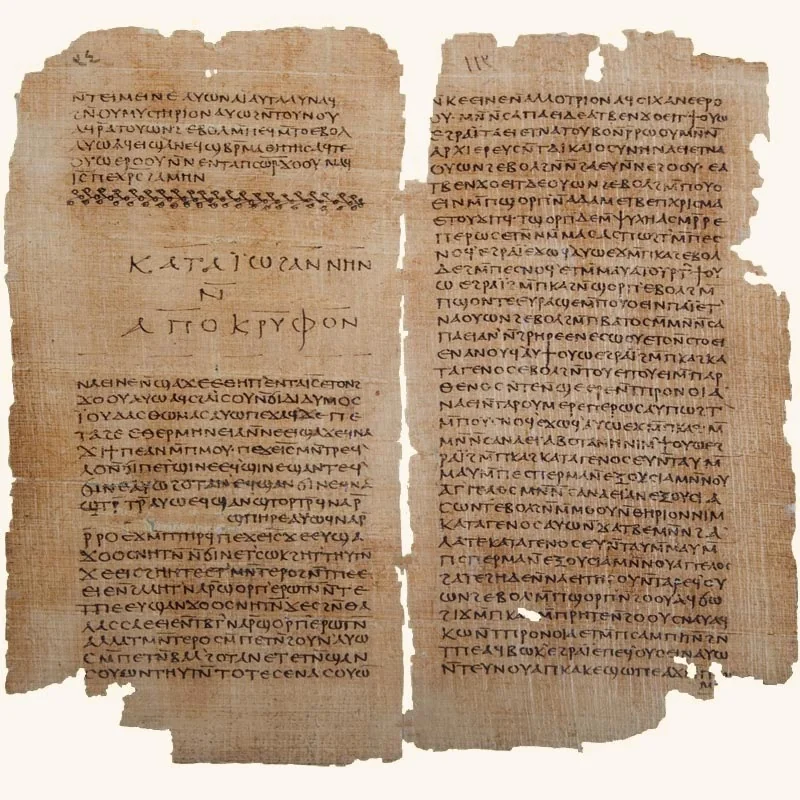
The Secret Book of John survived by accident — four times over.
Four surviving copies of a single Gnostic text is extraordinary. Most Gnostic writings are known from a single manuscript; many are known only from their enemies' descriptions. The Secret Book of John's survival in four copies — two "long" versions (NHC II and IV, which include a lengthy "Book of Zoroaster" interpolation) and two "short" versions (NHC III and the Berlin Codex) — speaks to how widely it circulated and how highly it was valued. Frederick Wisse, who translated it for the standard Nag Hammadi Library edition, notes that "the Apocryphon of John was still used in the eighth century by the Audians of Mesopotamia" — five centuries after the main Gnostic period.
Summary — What the Text Actually Says
The Secret Book of John opens in grief.
John, the son of Zebedee, has just left the Temple after the crucifixion. A Pharisee named Arimanios stops him and taunts him: the Nazarene deceived you, closed your mind, turned your back on your ancestors. John flees to the desert, overwhelmed with questions he cannot answer: Who is the Father who sent Jesus? What is the eternal realm we're promised? Why didn't Jesus explain it fully?
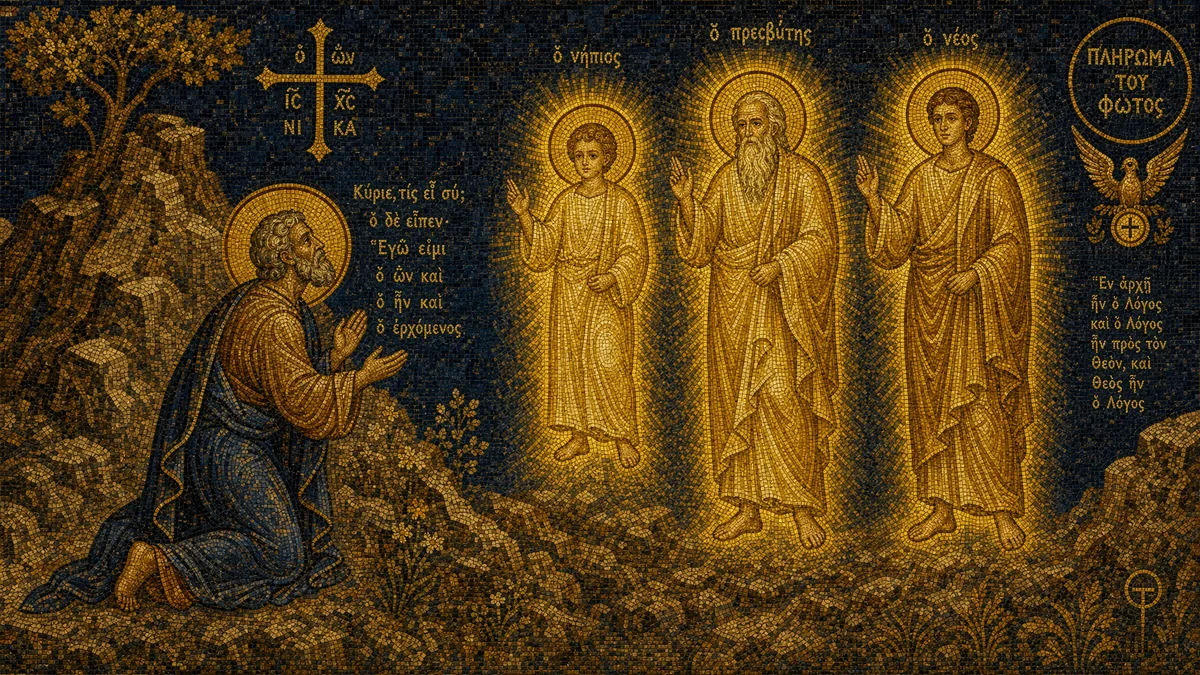
Then the sky opens. A figure of light stands before John — and as John watches, it shifts: a boy, then an elderly man, then a youth. All three visible simultaneously. The figure speaks: "I am the Father, I am the Mother, and I am the Son. I am the one who is with you always." This is Christ, returned not to comfort John but to teach him. What follows is the revelation.
The One (the True God). Christ begins with the highest principle — a being so perfect that any description of it falls short. The Secret Book of John uses a technique theologians call "negative theology": describing God by what God is not. He is unlimited, unfathomable, immeasurable, invisible, eternal. He does not even properly "exist" in the way other things exist, because he is beyond the category of existence itself. He simply is — perfect, boundless, self-sufficient.
Barbelo and the Pleroma. From the Father's reflection in luminous spiritual water arises Barbelo — the first thought, the Mother-Father, the divine feminine principle. She is simultaneously the Holy Spirit, the first human, and the womb of the Fullness (Pleroma). From the union of Father and Barbelo, Christ is born. Other Aeons follow: Foreknowledge, Incorruptibility, Eternal Life, Truth. The Pleroma is complete and perfect.
Sophia's fall. The last Aeon to arise is Sophia — Wisdom. She wants to create without her partner, without consent. What emerges is Yaldabaoth: hideous, powerful, and ignorant of everything above him. Sophia casts him into a void and conceals him in a cloud. Yaldabaoth, alone, believes he is God. He creates twelve Archons and then — using the fragment of Sophia's power still within him — the material world.
The creation of Adam. The Archons, glimpsing an image of humanity reflected from the Pleroma on the waters below, try to create a human body. But the body they make lies lifeless. Emissaries from the Pleroma then trick Yaldabaoth: breathe your spirit into the face of Adam, and the body will come to life. He does — and Sophia's divine power floods out of him into Adam. Adam rises, immediately wiser than every Archon who made him.
Eve, the Tree, and the Counterfeit Spirit. The Archons, terrified by Adam's superiority, extract his "Epinoia" — his inner divine reflection — and create Eve to house it. Christ, entering the Garden as a luminous figure, urges them to eat from the Tree of Knowledge. Yaldabaoth responds by implanting a "counterfeit spirit" — a false imitation of the divine spark — to distract humanity from its real nature. He also forces Adam, Eve, and Seth to drink the water of forgetfulness. The divine capacity for gnosis is now dormant — but not destroyed.
The question of salvation. The text closes with John asking Christ a series of questions: who is saved? what happens to those who don't achieve gnosis? Christ explains that he himself descends repeatedly into the material world to stir the dormant sparks to wakefulness. Those who receive his revelation — who remember their divine origin — are sealed "with five seals" and spared from the cycle of reincarnation. The text ends: "Jesus Christ, Amen."
Key Passages
This is what the Savior taught, and the mysteries that he disclosed — things that are shrouded in silence, but which he uncovered for his disciple John.
I am the Father, I am the Mother, and I am the Son. I am the one who is with you always. I am the one who is without any corruption or defilement. Now I have come to you to teach you about what is, what was, and what will be.
It is unlimited, because there was never anything that could limit it; unfathomable, because there was never anything that could fathom it; immeasurable, because there was never anything that could measure it; invisible, because it has never been seen; eternal, because it has always existed and always will exist; ineffable, because no one has ever understood it well enough to describe it.
Because of his foolishness, he was wicked and ignorant of his ancestry. He belligerently proclaimed: "I am God and there is no other god beside me."
Themes and Theology — The Central Ideas
The Secret Book of John is not just a story — it is a complete theological system compressed into a narrative frame. Five ideas run through the entire text.
1. Negative theology. The true God cannot be named or described. Every positive statement falls short. The Secret Book of John develops this into its opening set-piece — the description of "the One" — with a precision that influenced later Christian mystical theology (including the Cappadocian Fathers and Pseudo-Dionysius the Areopagite, who may never have known their source).
2. The divine feminine. Barbelo — the first emanation, the "womb of the Fullness" — is the Mother as well as the Father. She is described as simultaneously male and female, "the thrice-male, the triple power, the three-named androgynous being." Long before modern scholarship began recovering female figures in early Christianity, the Secret Book of John placed a divine feminine principle at the center of the cosmos.
3. The counterfeit spirit. One of the most original concepts in the entire Gnostic corpus. After Adam gains the divine spark, Yaldabaoth creates a fake imitation — a "counterfeit spirit" — and implants it alongside the real divine spark. This counterfeit spirit generates passions, desires, and attachments that distract the soul from its true nature. The Gnostic task is to distinguish the real spark from the counterfeit — which is exactly what gnosis accomplishes.
4. Gnosis as salvation. The text has no interest in faith, sacraments, or moral behavior as mechanisms of salvation. The Gnostic is saved by remembering — by waking up to the knowledge (gnosis) of their divine origin. Christ's role is to be the instrument of that remembering: he descends repeatedly into the material world to "stir" the dormant sparks to wakefulness.
5. Christ as revealer, not sacrifice. The crucifixion is not mentioned in the body of the text. Christ appears not on the cross but in radiant light, teaching. His mission is not to die for sins but to reveal the truth that Yaldabaoth's counterfeit spirit has suppressed. The text frames itself explicitly as a continuation of John's Gospel — but the Jesus of the Secret Book of John does not come to save through suffering. He comes to teach.
Scholarly Debates — What Experts Disagree On
Three questions about the Secret Book of John remain actively contested among scholars.
Dating and provenance. The 90–180 AD window is established by the Gospel of John's composition date and Irenaeus's attack. Within that window, Birger Pearson (*Ancient Gnosticism*, 2007) argues for the early 2nd century. Karen L. King suggests the text reached its current form through multiple stages of composition and revision. Most scholars accept Alexandria as the probable origin, given the text's synthesis of Jewish wisdom theology, Platonic cosmology, and Egyptian religious imagery.
Jewish vs. Platonic origins. Gilles Quispel argued that the Secret Book of John draws primarily from Jewish mystical traditions — particularly Merkabah mysticism and the divine "image of Adam" theology. Others, including Hans Jonas, emphasized the text's Platonic structure. The current scholarly consensus, as represented by Karen L. King's work, is that both streams were present and consciously integrated.
Where to Read It Free
For a print edition, the standard academic translation is in Marvin Meyer's The Nag Hammadi Scriptures (HarperOne, 2007). Karen L. King's The Secret Revelation of John (Harvard University Press, 2006) provides both translation and extensive scholarly commentary — the best single book for serious study.
Frequently Asked Questions
What is the Secret Book of John about?
The Secret Book of John is a vision of the entire Gnostic cosmos, revealed by the risen Christ to his apostle John. It describes the unknowable true God; the divine realm (Pleroma) and its Aeons including Barbelo and Sophia; Sophia's fall and the creation of the Demiurge Yaldabaoth; the creation of the material world and humanity; the trapping of divine sparks inside human bodies; and the path to salvation through gnosis. It is the fullest account of Gnostic theology that survives.
How old is the Secret Book of John?
The text was written between approximately 90 AD (when the Gospel of John was composed — the Secret Book presents itself as a supplement to it) and 180 AD (when Irenaeus of Lyons attacked it in Against Heresies). Most scholars date it to the early-to-mid 2nd century AD. The surviving manuscripts are 4th-century Coptic translations of the original Greek text.
Why is it called "secret"?
The word "apocryphon" is Greek for "secret book" or "hidden book." In the Gnostic tradition, secrecy indicated that the text contained esoteric knowledge — gnosis — not available to ordinary Christians. The text itself says it contains "the mysteries that he disclosed — things that are shrouded in silence." It was intended for members of the Gnostic community who had been initiated, not for general circulation. Its secrecy also protected it from the orthodox authorities who were destroying Gnostic texts.
Who wrote the Secret Book of John?
The text attributes itself to John the Apostle — John the son of Zebedee, brother of James. This is pseudepigraphical: nearly all scholars agree the actual author is unknown and that the attribution to John was a literary device to give the text authority. It was written within the Sethian Gnostic tradition, probably in Alexandria, Egypt. The use of John's name also positions the text as a direct extension of the Gospel of John.
How many copies of the Secret Book of John exist?
Four. Three were found in the Nag Hammadi Library in 1945: in Codices II, III, and IV. A fourth — the Berlin Codex (BG 8502) — was purchased in Cairo in 1896. Two are "long" versions (NHC II and IV, which include an additional "Book of Zoroaster" section) and two are "short" versions (NHC III and the Berlin Codex). Four copies is extraordinary given that most Gnostic texts survive in only one manuscript — it indicates the Secret Book of John was among the most widely read and valued texts in the ancient Gnostic world.
Is the Secret Book of John in the Bible?
No. The Secret Book of John was never part of any biblical canon. It is a Gnostic text that deliberately positions itself as a supplement to the Gospel of John — but it was excluded from the emerging New Testament canon precisely because its theology was incompatible with what became orthodox Christianity. Irenaeus of Lyons explicitly attacked it around 185 AD as a forged and heretical text. The Secret Book of John's cosmology — with its Demiurge, Archons, and salvation through gnosis rather than faith — contradicts foundational orthodox Christian theology.