Gnostic beliefs centre on one idea: the material world is a prison made by a flawed lesser god, and the way out is direct spiritual knowledge — gnosis — of your own divine origin. Salvation is not earned through faith or ritual. It is recognised through inner awakening.
Dozens of distinct Gnostic schools flourished across the Mediterranean world between roughly 100 and 400 AD. They disagreed on details — violently, sometimes. But beneath the disputes, a common architecture of belief held. Pull any Gnostic text from the shelf and you will find the same structural elements: a transcendent God no one made, a lesser god who made the world badly, human beings carrying fragments of divine light they have forgotten, and a path out through knowledge rather than obedience.
This page maps those core beliefs — what they were, where they came from, and how they fit together as a coherent system.
The 7 Core Gnostic Beliefs at a Glance
Across the dozens of Gnostic schools and texts that flourished in the 2nd century AD, seven beliefs appear consistently enough to be called core. They form a logical chain: each one follows from the previous.
1. A true, perfect God exists beyond this world →
2. A lesser, flawed god made the material world →
3. Humans carry a fragment of the true God inside them →
4. A divine being's fall triggered this whole situation →
5. The way out is gnosis — direct recognition of your divine origin →
6. Christ came to teach gnosis, not to die for sin →
7. The Archons actively work to prevent you from achieving gnosis
Each belief is examined below. Together, they form not a random collection of doctrines but a precise diagnosis of the human condition — and a specific prescription for what to do about it.
Belief 1 — The True God Is Hidden and Unknowable
The Gnostic supreme God has no name that sticks — every name limits, and the true God is beyond all limits.
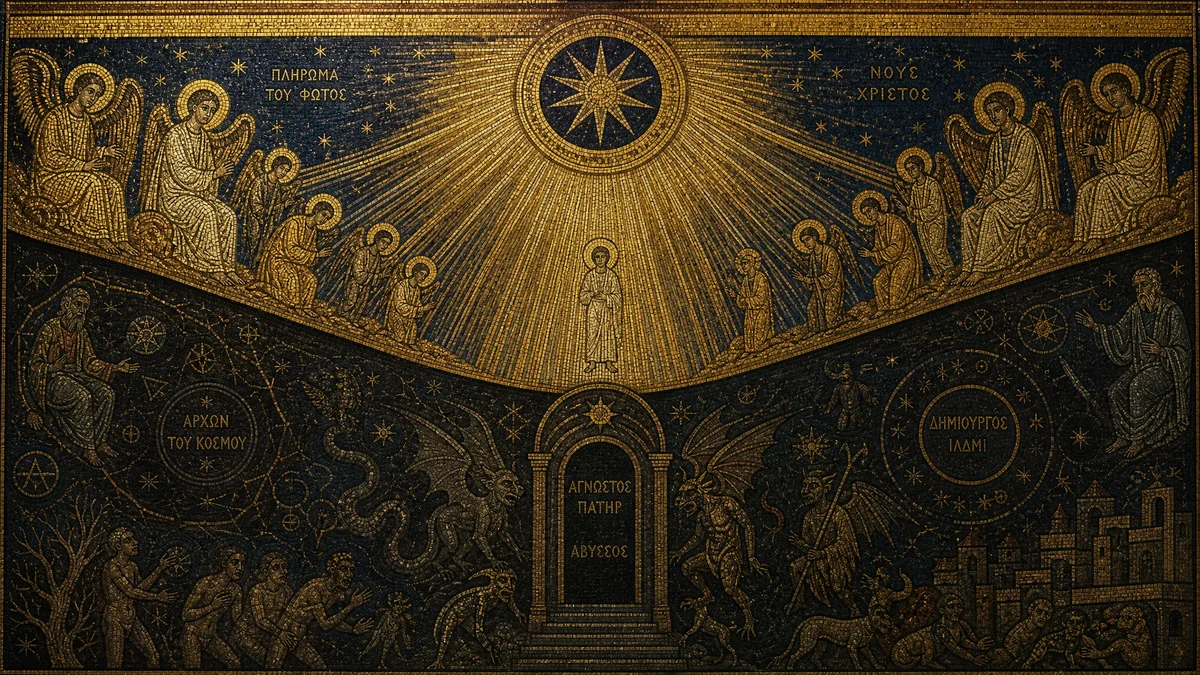
In Gnostic theology, the highest divine being is sometimes called the Monad (the One), the Father of All, or the Invisible Spirit. The Secret Book of John — the most systematic Sethian Gnostic text — opens with an extended description of this being that proceeds almost entirely by negation:
He is immeasurable light, which is pure, holy, and immaculate. He is ineffable, being perfect in incorruptibility. He is not in perfection, nor in blessedness, nor in divinity, but he is far superior. He is not corporeal nor is he incorporeal. He is neither large nor small.
This is apophatic theology at its most extreme: defining God by what God is not, because any positive description would be a reduction. The Monad did not create the material world and has no direct relationship with matter. It is not the God of Genesis — that is a different, inferior being entirely.
From this transcendent God, a series of divine beings — called Aeons — emanate outward like light from a source, forming the Pleroma (the "Fullness" of divine reality). The material world exists far below and outside this realm, a pale and broken echo of what the Pleroma actually is.
Belief 2 — The Material World Was Made by a Flawed Creator
The god who made the material world — the god of floods, plagues, and "thou shalt have no other gods before me" — is not, in Gnostic theology, the true God.
He is the Demiurge: a lesser, derivative being who came into existence through an accident in the divine realm (see Belief 4 below). The Demiurge created the cosmos, but he did so without access to the true God's perfection, wisdom, or light. The result is a world that reflects his own limitations.
The world came into being through a mistake. For he who created it wanted to create it imperishable and immortal. He fell short of attaining his desire.
Different Gnostic schools characterised the Demiurge differently:
Sethians (named for the biblical Seth, son of Adam): the Demiurge — called Yaldabaoth — is arrogant and actively hostile. He declares "I am a jealous God, there is no other God beside me," not knowing he is quoting his own ignorance back at himself.
Ophites / Naassenes: the Demiurge is identified directly with Yahweh, the God of the Hebrew Bible, who is recast as a false, lesser deity.
What all traditions agreed on: this world was not the true God's intention, and its creator is not worthy of worship. Hans Jonas, in The Gnostic Religion (1958), described this as the defining feature of Gnostic thought — the material world as "not the essence of God, but its negation and cancellation." For more on the Demiurge and his role, see The Demiurge — The False Creator God in Gnosticism.
Belief 3 — Humans Carry a Divine Spark
Inside each pneumatic — each spiritually constituted human being — there is a fragment of divine light that does not belong to this world.
This is the divine spark (pneuma in Greek, meaning breath or spirit). In the Sethian account, it entered humanity when Sophia — one of the Aeons of the Pleroma — accidentally breathed divine light into the Demiurge's creation. The Demiurge shaped the human body, but it was animated by something he did not put there and cannot control.
Not every human being carries the spark in an active form. The Gnostic trichotomy divided humanity into three classes:
- Pneumatics (spirit-people) — carry an active divine spark; capable of full gnosis
- Psychics (soul-people) — capable of partial spiritual understanding through faith and practice
- Hylics (matter-people) — entirely bound to the material world; no capacity for gnosis
The Secret Book of John describes the moment the divine spark entered Adam: "Adam was more intelligent than the creators and the first ruler. When they realised that Adam was enlightened and could think more clearly than they, they took him and threw him into the lowest region of the whole material realm." The Archons recognised the spark — and feared it.
Belief 4 — The Fall of Sophia Set Everything in Motion
The material world exists because of a mistake made in heaven — and the being who made that mistake was Sophia, the divine embodiment of Wisdom.
In the Pleroma, the divine realm of the true God, the Aeons exist in paired consorts, each complementing the other. Sophia — the youngest Aeon — acted alone, without her consort, driven by an autonomous desire to know the Father directly. This act of unilateral will produced something unexpected: a defective being, formless and ignorant, who would become the Demiurge.
Sophia was horrified by what she had inadvertently produced. She cast the Demiurge away, below the Pleroma, concealing him in a cloud. He grew up alone, knowing nothing of the divine realm above him. When he declared "I am God, and there is no other," he was not lying — he genuinely did not know there was anything above him.
This myth is not merely cosmological. It is an explanation of why evil exists without blaming the true God. The Gnostic creation myth places the origin of material existence in a failure of wisdom — which is why the recovery of wisdom (gnosis) is also the cure. For the full account of Sophia's role, see Sophia — Wisdom, the Fall & the Divine Feminine in Gnosticism.
Belief 5 — Salvation Comes Through Gnosis, Not Faith
Every other form of early Christianity offered salvation through something external — a sacrament, a creed, a church hierarchy. The Gnostics said the only thing that saves is internal.
That internal thing is gnosis: direct, experiential recognition of your own divine origin. Not belief that the divine spark exists — recognition that you are the divine spark. The Valentinian teacher Theodotus defined this recognition as answering four questions:
Who we were, what we have become, where we were, where we have come to be placed, where we are tending, what birth is, and what rebirth.
These are not theological questions to be answered by a catechism. They are existential recognitions to be achieved through direct experience. When a person achieves gnosis, they are not saved in some future sense — they are saved now, in the present, regardless of what happens to the body.
The Gospel of Philip was blunt about baptism without gnosis: people "go down into the water and come up without having received anything." The external rite without the internal recognition was empty. The Treatise on the Resurrection made the same point positively: "Leave the state of dispersion and bondage, and then you already have resurrection." Resurrection is not an event after death — it is what gnosis feels like from the inside.
Belief 6 — Christ Was a Revealer, Not a Sacrificial Victim
In Gnostic theology, Christ did not come to die — he came to teach.
The Gnostic Christ is an emissary from the true God, sent into the material world to impart gnosis and awaken the divine spark in those who carry it. He is not primarily a sacrifice whose death atones for sin. He is a messenger whose teachings, properly understood, produce the recognition that is salvation.
This led many Gnostic sects to a doctrine called docetism — from the Greek dokein, "to seem." If Christ was a divine being from the Pleroma, he could not have truly suffered in a material body, because the material world is the domain of the Demiurge, not the true God. Therefore, many Gnostics held that Christ only appeared to have a physical body, and only appeared to suffer on the cross.
The Gospel of Judas — recovered from the Tchacos Codex and published in 2006 — takes this furthest: Christ laughs when the disciples pray over the bread and cup, because he knows the god they are worshipping is the Demiurge, not the true Father. The First Apocalypse of James presents Christ providing James with specific passwords and responses to use when the Archons challenge the ascending soul — practical gnosis for the journey after death.
What Gnostics rejected was not Christ — they revered him deeply. What they rejected was the interpretation that his death was the mechanism of salvation. In the Gospel of Philip, the ultimate Gnostic achievement is stated this way: the successful Gnostic "is no longer a Christian, but a Christ."
Belief 7 — The Archons Keep Humanity Trapped
Between the trapped soul and the divine realm stand the Archons — planetary rulers who serve the Demiurge and actively work to prevent gnosis.
The Archons are not abstract forces. In Gnostic cosmology, they are specific beings who govern the seven planetary spheres between earth and the Pleroma. Each sphere has its own Archon with its own name and character. The soul, ascending after death, must pass through each sphere in sequence — and at each gate, the relevant Archon challenges it.
Gnosis is what enables the soul to pass through. Some texts — particularly the First Apocalypse of James and certain Sethian texts in the Nag Hammadi Library — provide specific passwords, responses, and formulas for each Archon gate. This is not magic: it is the Gnostic equivalent of knowing who you are well enough to answer the challenge. The soul that knows its divine origin cannot be detained by a planetary ruler who governs only matter.
For the full account of the Archons — their names, their spheres, and their role — see The Archons — Rulers of the Material World in Gnosticism.
What Varied Between Sects — Not All Gnostics Agreed
The seven beliefs above describe the shared skeleton of Gnostic thought — but different schools put very different flesh on those bones.
| Sect | Demiurge | Christ's nature | Can psychics be saved? | Key text |
|---|---|---|---|---|
| Sethians | Yaldabaoth — arrogant, hostile, identified with Yahweh | Fully divine; docetic | Debated; generally no | Secret Book of John |
| Valentinians | Ignorant but not evil; sincerely tried to do good | Divine but took on a real body | Yes — through sustained practice | Gospel of Philip, Gospel of Truth |
| Ophites | Identified with Yahweh; the serpent in Eden was the hero | Heavenly emissary | No | Described by Irenaeus |
| Marcionites | Just God of the OT — not evil, but inferior and strict | Fully docetic — no real body at all | Yes — through faith in Christ | Marcion's edited Paul + Luke |
| Basilidians | One of 365 Archon-rulers; not supreme | Did not die; Simon of Cyrene was crucified instead | Complex hierarchy | Described by Irenaeus & Hippolytus |
The differences mattered enormously to the people involved. Valentinians considered Sethians too pessimistic about the material world and too exclusive about who could be saved. Sethians considered Valentinians too accommodating. Marcionites rejected the entire Hebrew Bible and most of what would become the New Testament. Each school considered itself the correct interpretation of the Gnostic insight.
How Gnostic Beliefs Differ from Orthodox Christianity
Gnosticism is not a heretical variation of Christianity — it is, in several fundamental respects, its mirror image.
| Dimension | Gnostic belief | Orthodox Christian belief |
|---|---|---|
| The creator god | The creator of this world is a lesser, flawed being — not the true God | The creator of this world is the one true God |
| Human nature | Original innocence — humans carry divine light; Adam and Eve were victims, not sinners | Original sin — Adam and Eve's fall corrupted human nature |
| Salvation | Through gnosis — direct inner recognition of divine origin | Through faith in Christ's atoning death and resurrection |
| Christ's role | Revealer and teacher of gnosis; did not truly suffer | Redeemer; his physical death and resurrection are the mechanism of salvation |
| The material world | Evil or deeply flawed — a prison to escape | God's good creation — fallen, but redeemable |
| Afterlife | The divine spark returns to the Pleroma; the body does not rise | Bodily resurrection of the dead at the end of time |
Irenaeus of Lyon, writing his five-volume Against Heresies around 180 AD, understood the stakes. He did not argue that Gnostics had minor doctrinal errors — he argued that their entire framework was an inversion of true Christianity. On the creator god, on human nature, on salvation, on the body: the Gnostic position was, in each case, the opposite of what the proto-orthodox church taught.
A Scholarly Caveat — "Gnosticism" Is a Modern Label
There is one thing virtually all modern scholars of Gnosticism agree on: ancient people did not call themselves "Gnostics" in the way we use the term today.
The word "Gnosticism" was coined in 1669 by the English philosopher Henry More, who used it to describe a specific heresy mentioned in the Book of Revelation. The ancient groups we now call Gnostic called themselves Sethians, Valentinians, Basilidians, or simply Christians — each group had its own name and largely did not recognise the others as part of a shared movement.
Karen King, in What Is Gnosticism? (2003), argued similarly: the category was invented by heresiologists like Irenaeus who needed a single label for their enemies, and modern scholars have inherited their taxonomy uncritically. The groups we call Gnostic were far more diverse — in origin, belief, and practice — than any single label suggests.
The label persists because it is useful. The structural features described in this article — the Demiurge, the divine spark, gnosis as salvation — do appear consistently enough across a recognisable set of texts and traditions to justify a common term. But any serious study of "Gnostic beliefs" must hold the category lightly, knowing that what looks like one movement from the outside was, from the inside, a contested and pluralistic collection of schools, each convinced the others had got it wrong.
Frequently Asked Questions
What are the main Gnostic beliefs in simple terms?
The core Gnostic beliefs are: (1) The true God is transcendent and had nothing to do with creating the material world. (2) The material world was made by a lesser, flawed god called the Demiurge. (3) Human beings carry a fragment of divine light — the divine spark — trapped inside them. (4) The way to liberation is gnosis: direct, experiential recognition of your divine origin. (5) Christ came as a teacher of gnosis, not primarily as a sacrificial victim. These beliefs form a coherent system in which the human problem (being trapped in matter) and the solution (gnosis) are precisely matched.
Did Gnostics believe in the devil?
Not in the conventional sense. In most Gnostic systems, the role that orthodox Christianity assigns to Satan — the adversary, the tempter, the source of evil — is occupied by the Demiurge and the Archons. Evil in the Gnostic view is not a fallen angel who rebelled against God; it is the structural condition of a world made by an ignorant or malevolent lesser creator. Some Sethian texts mention demonic beings called Archons who correspond to specific negative qualities, but there is no single supreme evil being equivalent to the Christian Satan.
What did Gnostics believe about the afterlife?
After death, the soul ascends through the seven planetary spheres, each governed by an Archon. The soul that has achieved gnosis — that knows its divine origin and can answer the Archons' challenges — passes through each gate and returns to the Pleroma, the divine fullness. The physical body does not rise again; Gnostics rejected bodily resurrection entirely. The divine spark, stripped of its material prison, returns to the true God. Souls without gnosis may be reincarnated, or remain in intermediate states under the governance of the Archons.
Are Gnostic beliefs still practiced today?
Mandaeism — practiced by roughly 60,000–70,000 people, primarily in Iraq, Iran, and the diaspora — is the only ancient Gnostic tradition that has survived continuously to the present day. Modern Gnostic churches also exist, most notably the Ecclesia Gnostica founded by Stephan Hoeller in Los Angeles, which draws on Valentinian and Jungian traditions. The broader influence of Gnostic beliefs on Western esotericism, Jungian psychology, and contemporary spirituality is substantial, though these are adaptations rather than direct continuations.
What is the difference between Gnostic beliefs and New Age spirituality?
They share vocabulary — divine spark, inner knowledge, spiritual awakening — but the underlying frameworks differ sharply. New Age spirituality tends toward optimism about the material world: nature is sacred, the body is a temple, the universe is fundamentally benevolent. Gnosticism is anticosmic: the material world is a prison, the body is a trap, and the creator of the cosmos is not worthy of reverence. New Age belief typically holds that anyone can awaken; classical Gnosticism held that only those who carry the divine spark (pneumatics) are capable of gnosis. The surface similarities conceal a fundamental disagreement about the nature of reality.