The Gnostic universe has two fundamental realms: the Pleroma (divine fullness) above, and the Kenoma (material deficiency) below. Between them stand seven planetary spheres, each ruled by an Archon. The soul descends through these spheres at birth, losing its memory of divine origin — and must ascend back through them, armed with gnosis, to return home.
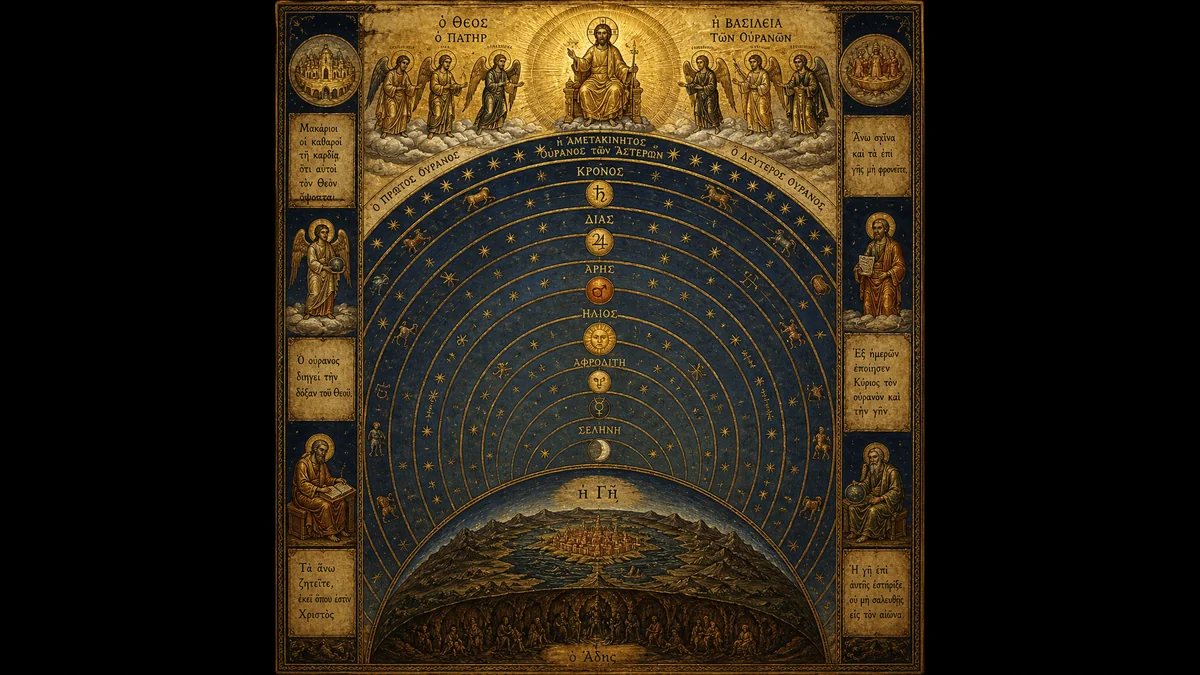
Most people approach Gnostic cosmology and quickly get lost in unfamiliar names — Pleroma, Aeons, Kenoma, Archons, Yaldabaoth — without a clear sense of how they relate spatially. The Gnostic universe has a precise vertical structure. Once you see the map, every name falls into place.
This page builds that map from top to bottom: the divine realm, the intermediate spheres, the material world, and the soul's journey through all of it.
The Two Fundamental Realms — Pleroma and Kenoma
Every Gnostic cosmological map begins with the same fundamental split — not between good and evil, but between fullness and emptiness.
Kenoma (Greek: κένωμα) — "Emptiness" or "Deficiency." The material realm: the absence of true divine fullness. The Kenoma is not a second, equal realm — it is what happens when the Pleroma's light is absent. Matter is deficiency made solid.
This distinction is more radical than it first appears. The Kenoma is not simply a lesser realm that exists alongside the Pleroma — it is a privation, a lack, a space defined by the absence of what the Pleroma has. The Gospel of Truth describes the Kenoma as a kind of nightmare: "It is within Unity that each one will attain himself; within knowledge he will purify himself from multiplicity into Unity, consuming matter within himself like fire, and darkness by light."
The Gospel of Philip makes the same point from the inside: "What is innermost in a person is the Fullness (Pleroma), and there is nothing further within." The divine realm is above — and for those who carry the divine spark, it is also within. Gnostic cosmology is simultaneously a map of the external universe and a map of the inner self.
The Pleroma — The Divine Realm at the Top
At the top of the Gnostic universe sits the Monad — the true God, unnamed and unnameable — from whom all divine reality emanates outward like light from a source.
The Monad does not create by intention or effort. Divine beings — called Aeons — emanate from it passively, the way light radiates from the sun without the sun deciding to shine. Each Aeon is an extension of the one divine reality, a specific aspect of the Father's infinite being that becomes, in some degree, a distinct entity.
The divine triad at the centre of the Pleroma — shared by virtually all Gnostic traditions — consists of:
- The Father / Monad — the ultimate, unknowable source
- Barbelo — the first emanation, the Mother, often identified with the Holy Spirit; the "first thought" of the Father
- Christ — the divine Son, the active principle of gnosis and revelation
From this triad, further Aeons emanate. The Valentinian school — founded by Valentinus in Rome around 136 AD — gave the most systematic account: thirty Aeons arranged in four groups.
Sophia — the final, youngest Aeon — occupies a structurally significant position: she is the outermost edge of the Pleroma, the Aeon furthest from the Father's centre. This positional distance corresponds to her greater capacity for autonomous action — and for error.
The Fall — How the Kenoma Came to Exist
The Kenoma — the material realm of deficiency — did not exist until something went wrong in the Pleroma.
Sophia, acting without her consort and without the Father's consent, produced a being from her own autonomous desire. The result was formless, ignorant, and defective — a being who would become the Demiurge. Horrified, Sophia cast this being outside the Pleroma, into the void below. There, surrounded by nothing, the Demiurge grew alone, knowing nothing of the divine realm above him.
The space the Demiurge inhabited and subsequently shaped into a structured cosmos is the Kenoma. It was not planned. It came into existence as the consequence of an accident in the Pleroma — which means the material world is, at its root, an unintended side effect of imperfect desire. For the full narrative, see Sophia — Wisdom, the Fall & the Divine Feminine and The Gnostic Creation Myth.
The Demiurge and His Domain
Below the Pleroma, the Demiurge — in Sethian texts named Yaldabaoth — inherited the raw material of Sophia's fall and shaped it into a structured cosmos.
The Demiurge's defining characteristic is his ignorance of what lies above him. In the Secret Book of John, Yaldabaoth declares: "I am a jealous God, there is no other God beside me." The Gnostic texts treat this as the most revealing statement he could have made: only someone who suspects there might be other gods declares himself jealous. His very claim to supremacy proves he knows, on some level, that he is not supreme.
The Demiurge proceeds to create seven Archons — his offspring and deputies — assigning each one a sphere of the cosmos to govern. He then creates the material earth at the base of this structure, and eventually the human body, as a vessel designed to contain and conceal the divine spark that Sophia's fall had scattered into matter. For the full account, see The Demiurge — The False Creator God in Gnosticism.
The Seven Planetary Spheres — The Archon Gates
Between the material earth and the divine Pleroma stand seven planetary spheres — each one a gate, each gate a test.
The seven spheres correspond to the seven classical planets of ancient astronomy: Moon, Mercury, Venus, Sun, Mars, Jupiter, Saturn. This was not arbitrary. Ancient cosmology, from Plato onward, understood the planetary spheres as the structural layers of the cosmos. The Gnostics took this framework and populated it with named Archons — the Demiurge's deputies, each governing his assigned sphere.
The Secret Book of John provides the most complete list of Archon names and their appearances:
| Sphere | Planet | Archon name (Sethian) | Appearance | Quality ruled |
|---|---|---|---|---|
| 1st (innermost) | Moon | Athoth | Sheep-faced | Goodness (corrupted) |
| 2nd | Mercury | Harmas | Eye of flame | Providence (corrupted) |
| 3rd | Venus | Kalila-Oumbri | Hyena-faced | Divinity (corrupted) |
| 4th | Sun | Yabel | Seven-headed serpent | Lordship (corrupted) |
| 5th | Mars | Adonaiou | Serpent-faced | Kingdom (corrupted) |
| 6th | Jupiter | Sabaoth | Dragon-faced | Zeal (corrupted) |
| 7th (outermost) | Saturn | Sabbataios | Flaming fire | Understanding (corrupted) |
Each Archon's quality is a corruption of a divine virtue — goodness becomes possessiveness, providence becomes manipulation, zeal becomes hostility. The Archons are not creating evil from nothing; they are distorting what was originally divine. This is the Sethian expression of the Gnostic claim that the material world is not independently evil but derivatively deficient — a broken copy of something that was whole.
The First Apocalypse of James provides specific passwords — verbal formulas — for the soul to use at each gate. Knowing the Archon's name and responding correctly to his challenge is the practical application of gnosis: self-knowledge that functions as cosmological navigation. For the full account of the Archons' role and hierarchy, see The Archons — Rulers of the Material World.
The Material World — Earth at the Bottom
At the base of the Gnostic cosmos sits the material earth — the point of maximum distance from the Pleroma and maximum density of matter.
The Secret Book of John describes the construction of the human body in clinical detail: each component — bone, sinew, flesh, marrow, blood, skin, hair, sensation — is assigned to a specific Archon or sub-Archon who shaped it. The body is not a vessel that happens to exist; it is a purpose-built containment structure, designed to keep the divine spark trapped and unrecognised.
The final mechanism of entrapment is the "water of forgetfulness":
The human beings were made to drink water of forgetfulness by the first ruler, so that they might not know where they had come from. Thus the seed remained for a while, assisting, in order that when the Spirit comes from the holy realms the Spirit will raise it up and heal it of its deficiency.
The Human Being — A Cosmological Battlefield
The human being, in Gnostic cosmology, is not a resident of the cosmos — it is a replica of it.
The three components of the human being map directly onto the three-layer cosmological structure:
| Human component | Greek term | Cosmological layer | Nature | Potential |
|---|---|---|---|---|
| Spirit | Pneuma | Pleroma | Divine spark — fragment of the true God's light | Full gnosis; return to Pleroma |
| Soul | Psyche | Seven spheres | Intermediate — shaped by planetary influences on descent | Partial elevation; depends on tradition |
| Body | Hyle / Sarx | Kenoma / Earth | Archon-constructed containment — returns to matter at death | None — not preserved or resurrected |
The paradox at the centre of Gnostic anthropology: the Archons constructed the body to trap the divine spark — and in doing so, created beings who carry, within their Archon-built shells, a fragment of light superior to any Archon. The Secret Book of John notes: "Adam was more intelligent than the creators and the first ruler. When they realised that Adam was enlightened and could think more clearly than they, they took him and threw him into the lowest region of the whole material realm."
The Archons feared what they had inadvertently created. The body is their cage — but the prisoner inside is more powerful than the guards.
The Soul's Descent — How the Spark Gets Trapped
The descent of the soul through the planetary spheres is not a fall in the biblical sense — it is a process of accumulation.
As the divine spark descends from the Pleroma through each of the seven spheres toward earth, it acquires a "garment" — an overlay of that sphere's quality. The Moon-sphere adds one kind of passivity; the Mars-sphere adds another kind of agitation; the Saturn-sphere adds another kind of heaviness. By the time the soul reaches earth and enters a physical body, it carries seven planetary overlays on top of its original divine nature, plus the physical body constructed by the Archons, plus the water of forgetfulness administered at birth.
Marvin Meyer, in The Gnostic Discoveries (2005), describes this process as "the progressive degradation of the soul as it descends through realms increasingly distant from the divine source." The soul does not fall through sin — it accumulates through descent. The mechanism is structural, not moral.
This is the Gnostic explanation for a specific and recognisable human experience: the sense that you are something other than what your surroundings suggest, that the life you are living does not match the life you were meant for. For the Gnostics, this feeling is not neurosis or dissatisfaction — it is accurate perception. You do not belong here. You came from somewhere else.
The Soul's Ascent — The Journey Back Through the Spheres
The ascent of the soul through the seven spheres reverses the descent — and gnosis is the passport.
At each Archon gate, the ascending soul must demonstrate that it knows its own origin. The Archon challenges it: Who are you? Where did you come from? What gives you the right to pass? The soul that has achieved gnosis — that has recovered the memory the water of forgetfulness suppressed — can answer. The soul that has not achieved gnosis cannot pass and is returned to the cycle of rebirth.
At each sphere on the ascent, the soul sheds the garment it acquired on the way down — leaving behind the Mars-sphere's agitation at the Mars gate, the Moon-sphere's passivity at the Moon gate — until it arrives at the Pleroma stripped of all material accretion, carrying only the divine spark it brought from there at the beginning. The Pistis Sophia (a lengthy Gnostic text dated c. 250–300 AD) provides one of the most elaborate accounts of this ascent, describing Sophia herself navigating the spheres upward after her fall.
This is what the Gnostic texts mean when they describe salvation as "return" rather than "arrival." The Pleroma is not a destination the soul has never been to — it is home.
Valentinian vs. Sethian Cosmology — The Two Main Maps
Every Gnostic school shared the basic cosmological architecture — but the details varied, sometimes significantly.
| Feature | Valentinian | Sethian |
|---|---|---|
| Number of Aeons | 30 — in four groups (Ogdoad, Decad, Dodecad) | Variable — often a triad + additional Aeons; some texts name 5, others more |
| Sophia's lower aspect | Achamoth — Sophia's lower self remains outside the Pleroma and becomes the world-soul | No Achamoth; Sophia herself falls and is eventually restored |
| Christ's role | Christ and the Holy Spirit enter the Pleroma to stabilise it; a second Christ is sent to redeem Achamoth | Christ (as the divine Autogenes) is part of the original Pleroma; sent to impart gnosis |
| Demiurge's character | Ignorant but not malicious; genuinely tries to do good | Yaldabaoth — arrogant, hostile; his boast of uniqueness is his defining characteristic |
| Key texts | Gospel of Truth, Gospel of Philip, Tripartite Tractate | Secret Book of John, Gospel of the Egyptians, Three Steles of Seth |
Despite these differences, the soteriological conclusion is the same in both traditions: the divine spark is real, it does not belong to the material world, and gnosis is the mechanism by which it recovers its origin and returns to the Pleroma.
The Cosmology as Psychology — Jung's Reading
Carl Jung read the Gnostic cosmological texts and concluded that the ancient Gnostics had mapped, in mythological form, what he was mapping in psychological form.
In his 1951 work Aion, Jung drew explicit parallels between Gnostic cosmology and his own model of the psyche. The Pleroma corresponded to what he called the collective unconscious — the deepest layer of the psyche, shared by all humanity, containing the archetypes. The Aeons corresponded to archetypal figures: the Anima, the Animus, the Self, the Shadow. The Demiurge corresponded to the ego — the part of the psyche that mistakes itself for the whole, declares "I am the only god," and builds a world-picture that excludes everything it cannot control.
The Archons, in Jung's reading, corresponded to psychological complexes — autonomous sub-systems of the psyche that operate independently of conscious control and obstruct individuation, just as the Archons obstruct the soul's ascent. The soul's ascent through the seven spheres corresponded to the process of individuation: the progressive integration of unconscious contents, the shedding of the persona (the outer garments), and the eventual encounter with the Self at the centre.
Whether or not Jung's reading is historically accurate — and scholars like Gilles Quispel, who brought Gnostic scholarship into dialogue with Jungian psychology, debated this — it demonstrates that the Gnostic cosmological map is not a piece of ancient fantasy but a functional model of inner experience that remains recognisable across two thousand years.
Frequently Asked Questions
What is the Pleroma in Gnostic cosmology?
The Pleroma (Greek: πλήρωμα, "fullness") is the divine realm at the top of the Gnostic cosmos — the totality of divine reality, light, and being. It contains the true God (the Monad/Father), the first emanation Barbelo, Christ, and a hierarchy of divine beings called Aeons. The Pleroma is not just a spatial location above the sky; it is the only realm that truly and fully exists. The material world below is defined by its distance and deficiency relative to the Pleroma. The Gnostic Gospel of Philip notes that the Pleroma is also an inner state: "What is innermost in a person is the Fullness."
How many realms or layers does the Gnostic universe have?
The basic Gnostic cosmological structure has three layers: the Pleroma (divine fullness) at the top, the seven planetary spheres (each governed by an Archon) in the middle, and the material world (Kenoma) at the bottom. Within this structure, the Pleroma itself contains multiple levels — the Father, Barbelo, Christ, and the hierarchy of Aeons. The Valentinian school counted 30 Aeons in four groups. The seven spheres each correspond to one of the classical planets (Moon, Mercury, Venus, Sun, Mars, Jupiter, Saturn). The total number of distinct "layers" depends on how finely you count the Aeons, but the fundamental three-part structure is consistent across all Gnostic schools.
What happens to the soul after death in Gnostic cosmology?
After death, the soul of a pneumatic (someone who has achieved gnosis) begins its ascent through the seven planetary spheres. At each gate, the ruling Archon challenges the soul. The soul that knows its divine origin — that can demonstrate gnosis — passes through, shedding the planetary "garment" it acquired on the way down. After passing all seven gates, the soul arrives at the Pleroma and reunites with the divine realm. The physical body is not preserved or resurrected — it returns to matter. Souls that have not achieved gnosis may be reincarnated, remaining in the cycle of material existence until gnosis is attained.
What is the Kenoma?
The Kenoma (Greek: κένωμα, "emptiness" or "deficiency") is the Gnostic term for the material realm — everything outside the Pleroma. It came into existence as a consequence of Sophia's fall: when she produced the Demiurge and he was expelled from the Pleroma, the space he occupied and subsequently shaped became the Kenoma. The material world is not an independent realm — it is defined by the absence of Pleroma fullness. Every material thing is a deficient echo of a Pleroma reality: matter is what happens when divine light is absent.
How does Gnostic cosmology differ from standard Christian cosmology?
The key differences are: (1) In standard Christian cosmology, one God created the universe and declared it good. In Gnostic cosmology, the material universe was created by a lesser, flawed being without the true God's knowledge. (2) In Christian cosmology, salvation involves the redemption and eventual resurrection of the body. In Gnostic cosmology, the body is discarded — only the divine spark returns to the Pleroma. (3) In Christian cosmology, the soul descends into matter through Adam's sin. In Gnostic cosmology, the soul descends through seven planetary spheres, acquiring garments at each level — sin is not the mechanism, structural cosmology is. (4) Christian cosmology has heaven and hell. Gnostic cosmology has the Pleroma and the seven Archon spheres, which function more as toll-gates than places of reward or punishment.