Gnostic dualism is not a battle between two equal opposing forces. It is anticosmicism — the belief that the material world itself is fundamentally opposed to the divine: not fallen, not neutral, but structurally wrong. It was made by a flawed lesser god, not the true God, and the only appropriate response is to escape it through gnosis.
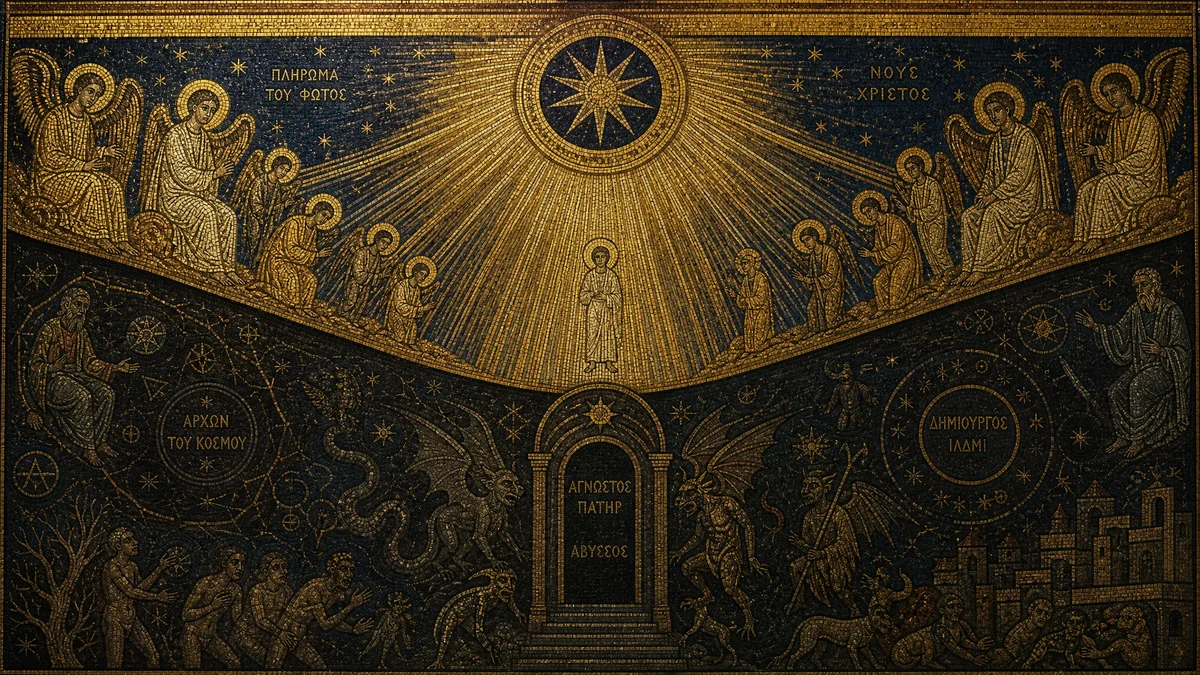
The word "dualism" gets applied to Gnosticism constantly — and almost always imprecisely. Most people assume it means something like Zoroastrianism: a cosmic battle between a good god and an evil god, light versus darkness, equally matched. Gnostic dualism is not that.
It is something more radical, more philosophically specific, and more personally unsettling. The Gnostics did not believe in two gods at war. They believed this entire world — the one you are sitting in, the one that was made — should not exist. Understanding that distinction is the key to understanding everything else about Gnostic thought.
"Dualism" Means Six Different Things — Here's Which One Gnosticism Is
The word "dualism" appears in philosophy, theology, neuroscience, and popular culture — and it means something different in each context. Before examining Gnostic dualism specifically, it helps to know which kind we are talking about.
| Type | The split | Key tradition | Is this Gnosticism? |
|---|---|---|---|
| Moral dualism | Good vs. evil as opposing forces | Christianity (God vs. Satan) | Partially — but Gnosticism locates evil in the creator, not a rebel angel |
| Ditheism | Two equally powerful gods in conflict | Zoroastrianism (Ahura Mazda vs. Angra Mainyu) | No — the true God and the Demiurge are not equal |
| Platonic dualism | Ideal forms vs. imperfect matter | Plato, Neoplatonism | Related but inverted — Plato's cosmos is good; the Gnostic cosmos is not |
| Cartesian dualism | Mind vs. body as separate substances | Descartes (17th c.) | No — Gnosticism is not primarily about mind/body; it is about divine vs. material |
| Ontological dualism | Two fundamental categories of being | Various philosophies | Closest — Gnosticism posits two fundamentally different orders of reality |
| Anticosmicism | The material cosmos itself is opposed to the divine | Gnosticism, Manichaeism, Catharism | Yes — this is the Gnostic form |
Hans Jonas, in The Gnostic Religion (1958), coined the term "anticosmicism" specifically to name what makes Gnostic dualism distinctive. The prefix anti- does not mean "opposed to some aspect of the world" — it means opposed to the cosmos as such. Not "this world has gone wrong" but "this world's existence is the wrongness."
Anticosmicism — The World as Mistake
Most religious traditions hold one of three positions on the material world: it is fundamentally good (mainstream Christianity, Judaism), it is neutral and can be used well or badly (Buddhism), or it is fallen but redeemable (many forms of Christianity). Gnosticism took a fourth position: the world's existence is itself the problem.
The Gnostic creation myth makes the mechanism explicit: the material world was not intended by the true God. It came into existence through Sophia's fall — an accident in the divine realm — and was shaped by the Demiurge, a being who lacked the true God's wisdom, light, and perfection. The result is not a bad version of something that could have been good. It is a category error: matter brought into existence by someone who had no business creating anything.
Two primary texts capture this most sharply:
The world came into being through a mistake. For he who created it wanted to create it imperishable and immortal. He fell short of attaining his desire. For the world never was imperishable, nor, for that matter, was he who made the world. For things are not imperishable, but sons are. Nothing will be able to receive imperishability if it does not first become a son. But he who has not the ability to receive, how much more will he be unable to give?
Jesus said: Whoever has come to know the world has discovered a corpse, and whoever has discovered a corpse, of that person the world is not worthy.
The Gospel of Philip elsewhere supplies an image of stark poetic compression: "Winter is the world, summer is the other Aeon, the eternal realm." This is not metaphor for pessimism — it is a cosmological statement. This world is the cold season. The divine realm is the real one.
How Anticosmicism Differs from Platonic Dualism
Gnosticism borrowed heavily from Plato — but on the most important question, it reversed him.
In Plato's Timaeus (c. 360 BC), the Demiurge is a craftsman who looks at the eternal Forms and fashions the material world in their image, as closely as recalcitrant matter allows. He is benevolent, rational, and genuinely trying to produce something good. The result — the cosmos — is beautiful. It is not the ideal realm of Forms, but it participates in the Good. Plato's student Plotinus, writing in the 3rd century AD, extended this into a complete Neoplatonic system: the cosmos is an emanation of the One, imperfect but still a reflection of divine beauty.
| Dimension | Platonic view | Gnostic view |
|---|---|---|
| The Demiurge | Benevolent craftsman, making the best possible world | Ignorant or malevolent; the world reflects his failure |
| The cosmos | Beautiful — a reflection of divine order | A mistake — a prison for trapped divine sparks |
| Matter | Inferior but participates in the Good | Hostile to the divine — opposed to it by nature |
| Attitude toward world | Reverence — the cosmos is sacred | Rejection — the cosmos is to be transcended |
| Salvation | The soul ascends through philosophy toward the Good | The divine spark escapes matter entirely through gnosis |
This is exactly why Plotinus — a Platonist, not a Christian — wrote his treatise against the Gnostics. He recognised that they had taken Platonic vocabulary and filled it with Platonic-sounding concepts, but had inverted the conclusion that mattered most: where Plato saw the cosmos as worthy of reverence, the Gnostics saw it as worthy of contempt.
Radical vs. Mitigated Dualism — Not All Gnostics Agreed
Within Gnosticism itself, there was a spectrum — from those who saw matter as actively evil to those who saw it merely as deficient.
Mitigated dualism: Matter is inferior and broken, but not evil. The Demiurge is ignorant — he tried to make something good and failed. He does not know the true God exists. The world is pitiable, not demonic. Associated with Valentinians, who also allowed for the possibility that psychics (soul-people) could eventually be saved.
This distinction had real consequences. Radical dualists tended toward stricter asceticism — the body was an enemy to be suppressed. Mitigated dualists (Valentinians especially) could be more accommodating of ordinary life: marriage, food, social participation were not inherently contaminating.
The medieval Cathars of southern France — crushed by the Albigensian Crusade launched in 1209 — were radical dualists. They held that the God of the Old Testament was the evil Demiurge, that Christ had no real body, and that the perfecti (the spiritually advanced) must practise strict celibacy and vegetarianism. Their theology was not identical to ancient Gnosticism, but the structural resemblance is clear enough that scholars from Hans Jonas to Yuri Stoyanov have traced the connection.
Anticosmicism in the Primary Texts
The Gnostic texts do not argue for anticosmicism — they inhabit it, expressing it through myth, poetry, and direct statement.
The Secret Book of John describes the Archons constructing the human body in precise, clinical detail — bone, sinew, flesh, sensation — as a mechanism specifically designed to trap the divine spark more securely. Each component of the body is assigned to a specific Archon or demon. The body is not a vessel for the soul; it is a cage built around it.
The human beings were made to drink water of forgetfulness by the first ruler, so that they might not know where they had come from. Thus the seed remained for a while, assisting, in order that when the Spirit comes from the holy realms the Spirit will raise it up and heal it of its deficiency, that the whole Pleroma may become holy and without deficiency.
The "water of forgetfulness" is the Gnostic explanation for why human beings do not recognise their divine origin. The amnesia is not accidental — it is engineered. The material world is not merely inferior to the divine realm; it is structured to prevent you from remembering that you came from there.
The Two Responses — Asceticism and Libertinism
If the body is a prison built by a hostile creator, there are exactly two logical responses to it.
The first is asceticism: deny the body, suppress its appetites, and weaken the hold the material world has on the divine spark. Most documented Gnostic groups practised some form of asceticism — fasting, celibacy (especially among the spiritually advanced), avoidance of meat and wine. The Valentinians, Sethians, and Thomasine Christians all show evidence of ascetic practice. The logic is straightforward: if the body's desires bind the spark to matter, reducing those desires loosens the bond.
The second response is libertinism: if the body is wholly separate from the spirit, what you do with it is spiritually irrelevant. The spirit cannot be contaminated by physical actions because the two belong to entirely different orders of being. Several Gnostic groups — most notably the Carpocratians — were accused of taking this position.
What Plotinus Said — The Pagan Critique
The most philosophically sophisticated attack on Gnostic dualism came not from a Christian but from a pagan — the Neoplatonist philosopher Plotinus, writing in Rome around 270 AD.
Plotinus dedicated the ninth treatise of his second Ennead to refuting the Gnostics. He gave it two titles: "Against the Gnostics" and — more revealingly — "Against Those Who Say that the Universe and Its Maker Are Evil." His core charge was this:
Plotinus made three specific philosophical objections to Gnostic anticosmicism:
- The cosmos is beautiful. It reflects the divine order — imperfectly, but genuinely. To call it evil or a mistake is to fail to perceive it accurately. Anyone who contemplates the stars, the mathematical regularity of natural phenomena, the complexity of living organisms, and concludes the cosmos is bad has a defective sense of beauty.
- Anticosmicism makes ethics incoherent. If the material world is wholly evil and irrelevant to the spirit, there is no ground for caring how you treat others within it. Plotinus saw this as the libertine danger latent in all Gnostic thought.
- The Gnostics corrupted Plato. They borrowed Platonic vocabulary — the Demiurge, the soul's ascent, the higher and lower realms — and then reversed the conclusion. For Plato, the cosmos was the Demiurge's best work. For the Gnostics, it was his failure. Plotinus found this intellectually dishonest: use Plato's framework, or don't — but don't use it to reach the opposite of Plato's conclusions.
That a pagan philosopher of Plotinus's stature felt it necessary to write a full treatise against the Gnostics is itself significant. By 270 AD, Gnostic schools were intellectually credible enough — and widespread enough — to require a serious philosophical response, not just ecclesiastical condemnation.
What Irenaeus Said — The Christian Critique
For Irenaeus of Lyon, writing his five-volume Against Heresies around 180 AD, the Gnostic view of the creator was not merely wrong — it was the worst possible blasphemy.
Justin Martyr, writing a generation earlier, went further: the doctrine of a malevolent or ignorant creator was, in his view, the single most definitive marker separating authentic Christians from Gnostic imposters. It was not a peripheral disagreement about ritual or church structure — it was a disagreement about the most fundamental theological question: what is the relationship between the God who made the world and the God who sent Christ?
For proto-orthodox Christians, that was the same God. The world is his creation — good in origin, fallen through human sin, but redeemable. Christ came to redeem it. The resurrection of the body — which Gnostics rejected entirely — was the counter-symbol: matter matters, physical existence matters, the body will rise. If the material world is a mistake, the resurrection makes no sense. If the body is a prison, why would God raise it?
The proto-orthodox position was not simply more optimistic than the Gnostic one — it was a coherent alternative cosmology in which creation, fall, redemption, and resurrection formed a single narrative arc. The Gnostic cosmology had a different arc: creation as accident, material existence as trap, salvation as escape.
Why Anticosmicism Matters — The Lasting Influence
Anticosmicism did not die with the ancient Gnostic sects — it reappeared wherever the conditions that produced it reappeared.
The Bogomils of Bulgaria and the Balkans (10th–15th centuries) and the Cathars of southern France (12th–13th centuries) both held theologies of radical cosmic dualism closely related to ancient Gnosticism. The Cathars — also called Albigensians — distinguished between the perfecti (the spiritually liberated, who practised strict asceticism) and the credentes (ordinary believers). Their theology held that the God of the Old Testament was the Demiurge, that Christ had no real body, and that the soul must be freed from the cycle of material rebirth. The Albigensian Crusade, launched by Pope Innocent III in 1209, spent twenty years destroying them. The last Cathar stronghold — the fortress of Montségur in the Pyrenees — fell in 1244.
In the 20th century, the science fiction writer Philip K. Dick — who experienced what he described as a Gnostic revelation in 1974 — wrote in his novel VALIS (1981): "The Empire never ended." The Roman Empire, in his vision, was a metaphor for the Demiurge's permanent control structure: the illusion of time passing, of history progressing, when in fact the same oppressive system endures under different names. It was anticosmicism expressed in the language of paranoid science fiction — and it found a large audience, which perhaps says something about the conditions that make this kind of thought feel true.
Carl Jung, engaging with the Gnostic texts throughout his career, saw anticosmicism as the Gnostics' psychological honesty: their willingness to look at the shadow — the dark, the broken, the painful — without flinching, and to refuse the easy comfort of declaring it all part of God's good plan. Whether or not they were right about the cosmos, they were right that the question needed asking.
Frequently Asked Questions
What is anticosmicism in simple terms?
Anticosmicism is the belief that the material world — the physical universe — is fundamentally opposed to the divine. It was not made by the true God, does not reflect divine goodness, and is not a place where the spirit can flourish. The word comes from the Greek anti- (against) and kosmos (world/order). In Gnostic thought, anticosmicism means the cosmos itself is the problem — not just evil within it, but the cosmos's very existence as a material structure.
Is Gnostic dualism the same as good vs. evil dualism?
No — and this is the most important distinction to make. Good vs. evil dualism (as in Zoroastrianism or mainstream Christian theology) posits two opposing forces — God and Satan, or Ahura Mazda and Angra Mainyu — roughly equal in power, battling for control of the world. Gnostic dualism is not a battle between two equal gods. The true God is infinitely superior to the Demiurge — the Demiurge is not a rebel angel or an evil counterpart. The "dualism" is between two orders of reality: the divine Pleroma (which is real) and the material world (which is a derivative, defective copy of it).
How did Gnostic dualism affect how Gnostics lived?
The dominant practical response was asceticism: if the body belongs to the material world and the material world is opposed to the divine, then reducing the body's appetites — fasting, celibacy, vegetarianism in some groups — loosened matter's grip on the divine spark. Most documented Gnostic communities were ascetic to varying degrees. A minority position (libertinism) argued that since the body was wholly separate from the spirit, physical actions were spiritually irrelevant — but most scholars regard hostile ancient accounts of Gnostic libertinism as exaggerated or fabricated.
What is the difference between radical and mitigated Gnostic dualism?
Radical dualism holds that matter is actively evil — the Demiurge is malevolent, the Archons are hostile enemies, and the body is a deliberate trap. Sethians, Ophites, Marcionites, and later the Cathars held this position. Mitigated dualism holds that matter is inferior and broken, but not evil — the Demiurge was ignorant, not malicious. He tried to make something good and fell short. Valentinians held this position, and it allowed them to be somewhat more accommodating of ordinary life: marriage and social participation were not inherently contaminating, and even psychics (soul-people) might eventually achieve some form of salvation.
Did Gnostic dualism influence any later religions?
Yes — significantly. The Manichaean religion (founded by Mani in 3rd-century Persia) adopted a form of radical cosmic dualism, spreading from Rome to China. The medieval Bogomils and Cathars held theologies closely related to ancient Gnostic anticosmicism and were persecuted as heresies. In the modern period, Gnostic dualism influenced Western esotericism, Theosophy, and certain strands of Jungian psychology. Philip K. Dick's science fiction explored Gnostic themes directly. Mandaeism — the only ancient Gnostic religion still practiced today — preserves its own form of light/darkness dualism in the contrast between the World of Light (alma d-nhūra) and the World of Darkness.