Gnosticism is an ancient religious tradition, most active in the 2nd–4th centuries AD, that taught the material world was created by a flawed lesser god — not the true, transcendent God. Salvation came through gnosis: direct personal knowledge of one's divine origin. Gnosticism was never a single religion; it was a family of related movements that flourished across the Roman Empire before being suppressed by orthodox Christianity.
The One-Paragraph Answer
Gnosticism is a family of ancient religious traditions that taught one radical idea: the world you live in was not made by God. The true God — perfect, unknowable, beyond all creation — never touched matter. The material world was made by a lesser, flawed being called the Demiurge, who didn't know any better. Trapped inside every human is a fragment of divine light, and the purpose of life is to wake up to that fact. That awakening — called gnosis, Greek for "knowledge" — was the Gnostic path to salvation.
Gnosticism was never a single church with a fixed creed. It was an umbrella of movements, texts, and teachers that shared these core ideas while differing on the details. They flourished across the Roman Empire in the 2nd and 3rd centuries AD, claimed Jesus as one of their own, and were eventually condemned as heretics by what became orthodox Christianity. For over a thousand years, most of what we knew about them came only from their enemies' writings. Then, in 1945, a buried jar of ancient books changed everything.
The Core Ideas Every Gnostic Tradition Shared
Different Gnostic groups disagreed on a great deal — some were Christian, some were not; some were ascetic, some were not. But four ideas appear consistently across every tradition:
- The material world was created by a flawed lesser being, not the true God
- Each human carries a divine spark — a fragment of the true God — trapped inside a body
- Salvation comes through gnosis: direct experiential knowledge of one's divine origin
- A divine messenger — in most Gnostic traditions, Christ — came to deliver this knowledge
The True God and the False Creator
In every Gnostic tradition, the god who created the material world — the god of Genesis — is not the true God. He is a lesser being, often called the Demiurge (Greek for "craftsman"), who acted without the true God's knowledge or authority. He is not evil in the way a villain is evil; he simply doesn't know what he doesn't know. He believes he is the only god in existence.
The true God, by contrast, is utterly beyond the material world — so perfect and remote that the material universe is incomprehensible to him. The Secret Book of John, one of the most important Gnostic texts, describes this God as "illimitable, since there is nothing before it to limit it; unfathomable, since there is nothing before it to fathom it; invisible, since nothing has seen it."
The Demiurge's appearance, as described in the same text, is the visual opposite of this purity:
He had the face of a lion and the body of a serpent, and his eyes glowed like lightning.
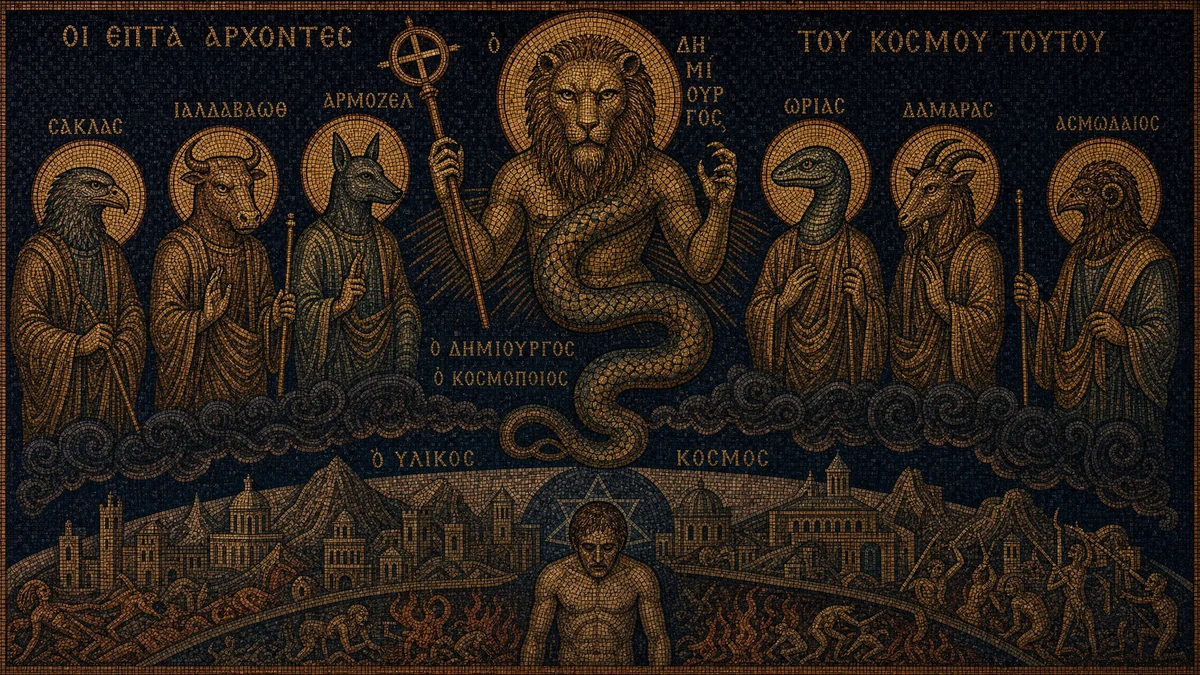
This is the being, Gnostics taught, who said "Let there be light" in Genesis. Not the true God — a pretender who didn't understand what he was doing.
Gnosis — Salvation Through Direct Knowledge
The word gnosis is Greek for "knowledge" — but not the kind you get from reading a book. It refers to direct experiential knowledge, the kind you can't be taught by a priest or earned by following rules. Elaine Pagels, whose 1979 book The Gnostic Gospels brought Gnostic ideas to a mainstream audience, describes gnosis as "self-knowledge" in the deepest sense: recognizing that the divine is not somewhere outside you but within you.
Orthodox Christianity offered salvation through faith, sacraments, and obedience to the Church. Gnosticism offered a different path — one that bypassed institutions entirely. No bishop could give you gnosis. No ritual could manufacture it. It was an inner awakening, and it was available directly.
The Gospel of Thomas captures this idea more clearly than any theological treatise:
If your leaders say to you, "Look, the kingdom is in the sky," then the birds of the sky will precede you. If they say to you, "It is in the sea," then the fish will precede you. Rather, the kingdom is inside of you, and it is outside of you.
The Divine Spark — A Fragment of God in Every Person
Inside every human being, Gnostics believed, is a fragment of the original divine light — trapped in matter like a spark inside a lantern. This fragment is the real "you." The body is temporary housing. The soul may be bound to the material world through repeated reincarnations. But the spark — the pneuma (spirit) — is indestructible and ultimately belongs to the Pleroma, the divine realm.
Not everyone was thought to carry this spark equally. Gnostic thinkers divided humanity into three types: the pneumatics (spiritual people capable of full gnosis), the psychics (soul-driven people who could achieve partial awareness), and the hylics (purely material people, bound entirely to the Demiurge's world). Most Gnostic texts were addressed to the pneumatics.
Where Does the Word "Gnosticism" Come From?
Here is a fact that surprises most people: the ancient Gnostics never called themselves Gnostics. The word "Gnosticism" did not exist in the ancient world.
The Greek word gnosis (γνῶσις) simply meant "knowledge" or "awareness." The adjective gnostikos (γνωστικός) meant "one who knows" or "learned." Plato used it in this ordinary sense. Around 185 AD, the Church Father Irenaeus of Lyons used the phrase he legomene gnostike haeresis — "the heresy called Learned (Gnostic)" — to label the school of Valentinus, one of the most influential religious teachers of the 2nd century.
Modern scholars including Michael Allen Williams (in his 1996 book Rethinking "Gnosticism") have argued that "Gnosticism" groups together traditions that had little in common beyond a few shared ideas. For our purposes, we use it as a convenient shorthand for movements that shared the core ideas described above.
What Gnostics Believed — The Full Picture
The core ideas of Gnosticism came packaged in a detailed mythology — a story that took the familiar narratives of Genesis and the Gospels and turned them inside out. Three elements of this mythology appear repeatedly across Gnostic texts: the Pleroma, the fall of Sophia, and the Archons.
The Pleroma — The Divine Realm of Fullness
Before the material world existed, there was the Pleroma.
The true God did not directly create anything in the Pleroma; his perfection simply overflowed into new beings called Aeons. These included Christ, Sophia (Wisdom), and Barbelo (the divine Mother-Father). Together, the Pleroma was a kind of pre-creation paradise — spiritual, complete, perfect.
The material world exists because something went wrong in the Pleroma. Which brings us to Sophia.
The Fall of Sophia and the Creation of Matter
The creation of the material world was, according to Gnostic teaching, an accident.
Sophia — one of the Aeons, whose name means "Wisdom" — attempted to generate a new being without the true God's participation or consent. What emerged was the Demiurge: malformed, ignorant, and possessing none of the Pleroma's qualities. Sophia, horrified by what she had done, cast him out. Alone in the void, the Demiurge looked around, saw nothing, and declared himself the supreme being. Then he got to work.
He created the material world — a flawed copy of the Pleroma — and populated it with Archons. Most importantly, he trapped fragments of divine light (sparks from the Pleroma, derived from Sophia's original error) inside human bodies. This, Gnostics believed, is the real story behind Genesis. The fall did not happen in the Garden of Eden. It happened in heaven, before the world began.
The Archons — Rulers Who Keep Souls Trapped
The Demiurge did not rule the material world alone. He created seven Archons — rulers, one for each of the seven planets known to the ancient world — to govern existence and keep human souls in ignorance of their divine origin.
The Archons are not simply evil in the way demons are evil. They are agents of ignorance — they keep the divine spark locked in the material cycle of birth, death, and rebirth, not out of malice but because the Demiurge and his creation know nothing else. Gnosis breaks this cycle by giving the pneumatic soul the knowledge it needs to navigate past the Archons after death and return to the Pleroma.
For a deeper look, see the dedicated article on the Archons in Gnosticism.
Gnosticism and Early Christianity — One Movement or a Heresy?
When Gnostics were at their peak — the 2nd century AD — there was no such thing as "orthodox Christianity." The label came later, applied retroactively by the group that eventually won the theological arguments.
Harvard historian of religion Karen L. King describes the period with precision:
In this environment, Gnostics were not heretics deviating from an established norm. They were one Christian movement among many — equally as old as the traditions that later condemned them. Valentinus, the most influential Gnostic teacher of the 2nd century, taught in Rome from approximately 136 to 165 AD and, according to the Church Father Tertullian, nearly became Bishop of Rome. He didn't lose the vote by much.
The "heresy" designation became possible only after Irenaeus of Lyons wrote his five-volume Against Heresies (c. 180 AD) — a systematic attack on Gnostic teachings that became the template for defining what Christianity was and was not. Before that, the boundary didn't exist in the way we assume it did.
Who Were the Gnostics? The Main Traditions
Gnosticism was never a single church or movement — it was a family of related traditions that shared core ideas while differing widely in theology and practice. Here are the five most significant:
| Tradition | Period | Key Feature | Status |
|---|---|---|---|
| Sethians | 1st–4th century AD | Oldest Gnostic tradition; Seth (son of Adam) as divine revealer; produced the Secret Book of John | Extinct |
| Valentinians | 2nd–4th century AD | Most sophisticated Gnostic theology; founded by Valentinus in Rome; produced the Gospel of Philip | Extinct |
| Mandaeans | 1st century AD – present | Only surviving ancient Gnostic religion; revere John the Baptist; practice ritual baptism | Living religion |
| Manichaeism | 3rd–13th century AD | Founded by Mani in Persia; spread from Rome to China; adopted radical light-vs-darkness dualism | Extinct |
| Cathars | 12th–14th century AD | Medieval Gnostic revival in southern France; destroyed by the Albigensian Crusade (1209–1229) | Extinct |
The Sacred Texts — What Did Gnostics Read?
For most of history, we knew about Gnostic texts only through the writings of their enemies. The Church Fathers quoted Gnostic scriptures specifically to refute them — often misrepresenting them in the process. Then, in December 1945, a farmer named Muhammad Ali al-Samman was digging near the Egyptian town of Nag Hammadi when his mattock struck a buried clay jar. Inside were 13 leather-bound codices containing 52 texts — the largest collection of Gnostic writings ever found.
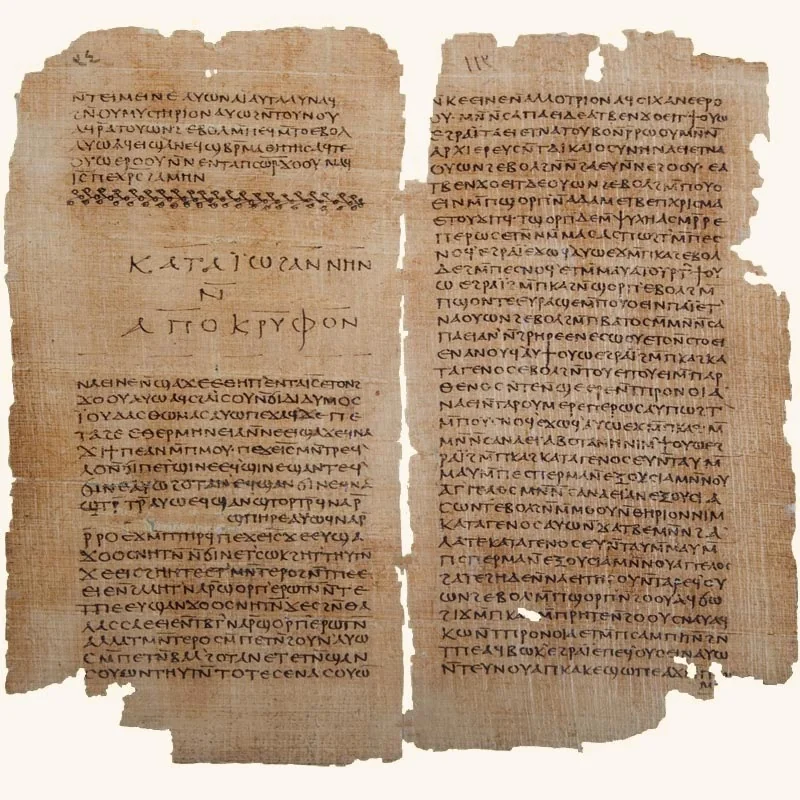
The Nag Hammadi Library, as it became known, included texts that had not been read for over 1,600 years. Among the most significant:
Not all Gnostic texts came from Nag Hammadi. The Pistis Sophia was known from a manuscript found in the 18th century. The Gospel of Judas was rediscovered in Egypt in the 1970s and published in 2006. New discoveries continue to reshape our understanding of how many Gnostic traditions existed and how diverse they were.
A Brief Timeline — When Did Gnosticism Exist?
Is Gnosticism Still Practiced Today?
Yes — Gnosticism is still practiced today, in several different forms.
The clearest continuity with ancient Gnosticism is Mandaeism, a religion with roots in 1st-century Jewish-Christian Gnosticism. Mandaeans do not revere Moses or Jesus as saviors — they center their tradition on John the Baptist and practice a form of ritual baptism as the path to gnosis. They have an unbroken tradition stretching back at least 2,000 years.

Beyond Mandaeism, modern Gnostic churches exist as organized institutions. The Ecclesia Gnostica, founded in Los Angeles in 1959, offers sacraments and liturgy in the Gnostic tradition. The Apostolic Johannite Church and the Ecclesia Gnostica Catholica (the religious arm of the Ordo Templi Orientis) maintain active congregations.
Gnostic ideas also persist in wider culture. The philosopher Philip K. Dick built his entire late body of work — VALIS, The Divine Invasion, The Exegesis — around the Gnostic idea that the material world is a false creation obscuring a hidden divine reality. The Wachowski Sisters drew explicitly on Gnostic mythology for The Matrix: the material world as a simulation, the Agents as Archons, Neo's awakening as gnosis.
Key Gnostic Terms — Quick Reference
| Term | Origin | Meaning in Gnosticism |
|---|---|---|
| Gnosis | Greek γνῶσις | Direct experiential knowledge of one's divine origin — the Gnostic path to salvation |
| Demiurge | Greek δημιουργός (craftsman) | The flawed lesser being who created the material world, ignorant of the true God above him |
| Pleroma | Greek πλήρωμα (fullness) | The divine realm of the true God and the Aeons — the spiritual "fullness" that pre-existed matter |
| Archon | Greek ἄρχων (ruler) | The planetary rulers created by the Demiurge to govern matter and keep souls in ignorance |
| Sophia | Greek σοφία (wisdom) | The divine Aeon whose error generated the Demiurge; the fallen feminine principle seeking redemption |
| Aeon | Greek αἰών (age, eternity) | A divine being emanated from the true God, dwelling in the Pleroma |
| Pneuma | Greek πνεῦμα (spirit, breath) | The divine spark within each person — the fragment of the Pleroma trapped in the material body |
| Kenoma | Greek κένωμα (emptiness) | The void outside the Pleroma — the material world; the opposite of fullness |
Frequently Asked Questions
What is Gnosticism in simple terms?
Gnosticism is an ancient tradition teaching that the material world was created by a flawed lesser god — not the true, transcendent God. Every human carries a fragment of divine light trapped inside a physical body. Salvation comes not through faith or ritual but through gnosis: direct personal knowledge of your divine origin and how to return to it.
Is Gnosticism a form of Christianity?
In the 2nd century, Gnosticism was one of many competing forms of early Christianity — not a deviation from an established norm, but one vision of what Christianity was. Most Gnostic traditions revered Jesus and used Christian scriptures, though they interpreted both radically differently from what became orthodox Christianity. The "heresy" label was applied later, by the group that won. Modern scholars debate whether calling Gnosticism "Christian" is accurate or useful.
What did Gnostics believe about Jesus?
Most Gnostic traditions saw Jesus as a divine messenger who came from the true God to deliver gnosis — not to die for humanity's sins. Many Gnostics held that Christ was purely spiritual and only appeared to have a body (a position called Docetism). The Gospel of Judas presents Judas as Jesus's most trusted disciple, the only one who truly understood his mission. The Second Treatise of the Great Seth claims Christ laughed during the crucifixion because it was a different man dying, not him.
What is the difference between Gnosticism and Christianity?
The central difference is the understanding of creation and salvation. Orthodox Christianity teaches that the God of the Bible created the world and called it good; sin entered through human disobedience, and salvation comes through faith in Christ's atoning death. Gnosticism teaches that the creator god of the Bible is a lesser, flawed being; the material world is intrinsically problematic; and salvation comes through inner knowledge, not institutional faith. Gnostics also rejected the resurrection of the body, regarding the physical form as a prison to escape, not something to redeem.
Is Gnosticism still practiced today?
Yes. Mandaeism — an ancient Gnostic religion centered on John the Baptist — has approximately 60,000–70,000 followers today, primarily in Iraq, Iran, and diaspora communities. Modern Gnostic churches also exist, including the Ecclesia Gnostica (founded in Los Angeles in 1959) and the Apostolic Johannite Church. Additionally, many people draw on Gnostic ideas in a non-institutional way as part of broader spiritual practice.
What are the main Gnostic texts?
The most significant surviving Gnostic texts come from the Nag Hammadi Library (discovered in Egypt in 1945): the Secret Book of John (the fullest account of Gnostic cosmology), the Gospel of Thomas (114 sayings of Jesus), the Gospel of Philip, and the Reality of the Rulers. Outside Nag Hammadi, the Gospel of Judas (published in 2006) and Pistis Sophia (known since the 18th century) are also major texts. Together these number in the dozens — most Gnostic writings were destroyed by the early Church.