
Gnosis — from Greek γνῶσις — is not the knowledge you get from books or logic. It is direct, experiential awareness of your own divine nature: the sudden recognition that you do not belong to the material world but to a higher, divine realm. For the Gnostics, this recognition was not a step toward salvation — it was salvation.
The word gets thrown around — in philosophy courses, in New Age bookshops, in discussions of The Matrix. But most uses flatten it into a synonym for "secret knowledge" or "spiritual wisdom," which misses the point almost entirely.
Gnosis is a specific kind of knowing. It belongs to a tradition stretching from Plato through the mystery religions of Rome to the Gnostic teachers of 2nd-century Alexandria and beyond. Understanding what the word actually means — and what the Gnostics did with it — changes how you read the entire history of early Christianity.
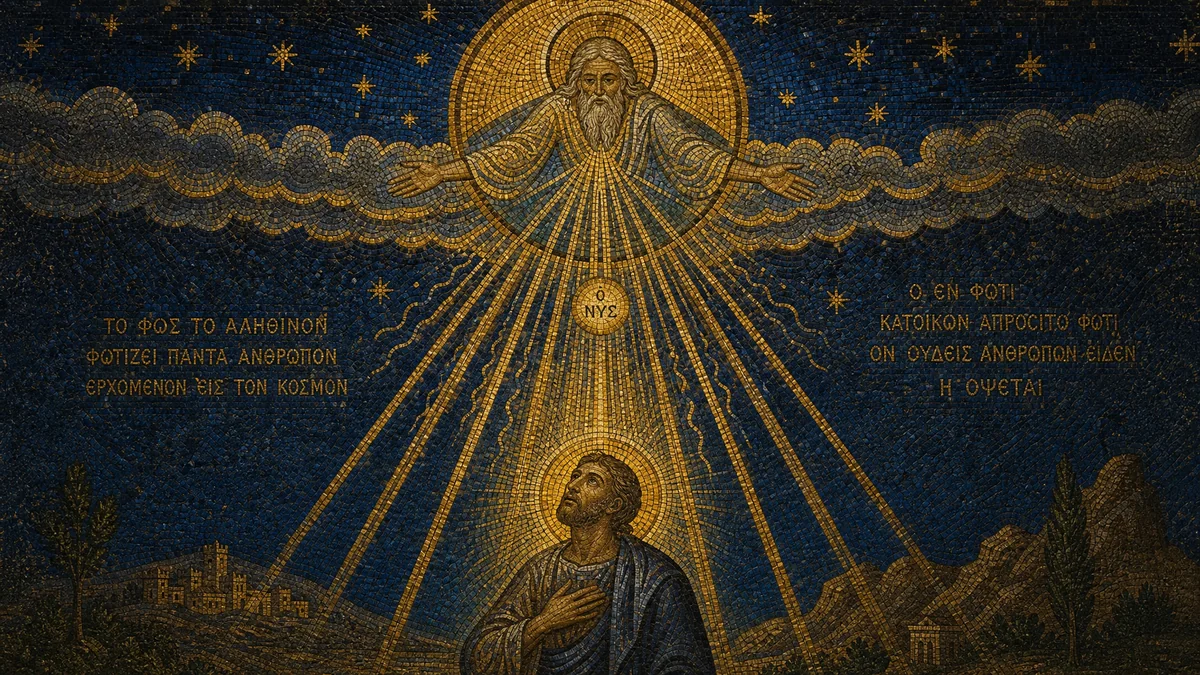
What Gnosis Actually Means (It's Not What You Think)
In classical Greek, γνῶσις (gnōsis) was a feminine noun meaning knowledge — but not all knowledge. The ancient Greeks had several words for knowing, and they did not treat them as interchangeable.
The clearest way to grasp the distinction is through a language comparison. French has two separate verbs for knowing: savoir (to know a fact) and connaître (to know a person or place through direct acquaintance). Spanish makes the same split between saber and conocer. German between wissen and kennen. English collapsed both into the single word "know," which is why the distinction feels unfamiliar to English speakers.
Gnosis belongs to the connaître / conocer side. It is not knowing about something. It is knowing through direct contact — through experience, through recognition, through being changed by what you encounter.
Even in classical philosophy, before any mystical connotations attached to it, gnosis carried this meaning. In Plato's Sophist, the Stranger divides all knowledge into two kinds: praktikos (practical knowledge) and gnostikos (cognitive, intellectual — the kind that perceives the nature of a thing directly). Aristotle used the adjective gnostikos similarly, to describe a kind of higher intelligence — a faculty of direct apprehension rather than step-by-step reasoning.
The word did not mean mystical or secret in Plato's usage. That came later. But the seed was already there: gnosis was always the knowledge that recognized something in its essence, not merely catalogued it.
Gnosis Before the Gnostics — Plato, Mystery Religions, Jewish Wisdom
The Gnostics did not invent gnosis — they inherited it from at least three separate intellectual traditions and pushed it further than anyone before them.
The mystery religions are worth pausing on. These were initiation cults — the Eleusinian Mysteries near Athens, the Mithraic mysteries widespread through the Roman army, Orphic circles from Greece to southern Italy. All claimed to offer their initiates something that ordinary religious practice could not: a direct encounter with divine reality. The word they used for what the initiate received was often gnosis.
What distinguished the Gnostics from these predecessors was the cosmological framework into which they placed this experience. Mystery religions offered gnosis as a gift that elevated initiates. Gnostics offered gnosis as a recognition of what you already were — and what you had forgotten.
The Gnostic Meaning — Knowledge That Saves
When Gnostics spoke of gnosis, they meant something far more radical than spiritual insight.
For the Gnostics, the material world is not the creation of the true God. It was made by a lesser, ignorant — or in some traditions, actively malevolent — deity they called the Demiurge. The true God remains distant, entirely beyond matter, beyond the cosmos, beyond comprehension by ordinary human faculties. And yet each human being carries within them a fragment of that true God — the divine spark, trapped in matter like a jewel in mud.
Gnosis is the moment you recognize this. Not an intellectual conclusion — a direct awakening to your own nature.
Hans Jonas, whose 1958 work The Gnostic Religion remains one of the most important scholarly treatments of the subject, described gnosis as "not a natural condition." This is the key phrase. Normal human perception, normal reasoning, normal religious observance — none of these could produce gnosis. It required transcending the world entirely. The heavenly spirit within you — not your ordinary mind — was the only faculty that could receive it.
The Valentinian Gnostic teacher Theodotus, writing in the mid-2nd century AD, gave the most precise definition gnosis has ever received:
It is not baptism alone that makes free, but knowledge: who we were, what we have become, where we were, where we have come to be placed, where we are tending, what birth is, and what rebirth.
This is gnosis in full. Not a doctrine to be believed. A set of recognitions to be achieved — about origin, displacement, destination, and transformation.
What Gnosis Feels Like — The Phenomenology
The Gnostic texts rarely describe gnosis as a vision or a voice. They describe it as recognition — the way you recognize a face you have not seen in years, or the way a forgotten language suddenly reasserts itself. Something already inside you is activated.
The Book of Thomas the Contender, a Sethian text from the Nag Hammadi Library, states it as directly as possible:
Those who have not known themselves have known nothing, but those who have known themselves already have acquired knowledge about the depth of the All.
Self-knowledge and cosmic knowledge are the same thing. To know what you truly are — a fragment of divine light trapped in matter — is simultaneously to know the structure of the entire universe, because the drama that placed you here is the same drama that generated the cosmos.
The Gospel of Philip, a Valentinian text also found at Nag Hammadi, makes a practical claim about this state:
Those who say they will die first and then rise are in error. If they do not first receive the resurrection while they live, when they die they will receive nothing.
Gnosis happens while you are alive, or it does not happen at all. The Treatise on the Resurrection makes the same point: "Leave the state of dispersion and bondage, and then you already have resurrection." This is not a promise about the afterlife — it is a description of what gnosis does to the living person who receives it.
Who Could Receive Gnosis — The Three Classes
Not everyone, in the Gnostic view, was equally capable of gnosis.
Most Gnostic systems — particularly the Valentinian and Sethian schools — divided humanity into three classes based on their spiritual constitution:
| Class | Greek term | Nature | Capacity for gnosis | Ultimate fate |
|---|---|---|---|---|
| Pneumatics | πνευματικοί | Carry the divine spark; spirit-dominated | Full gnosis — their birthright | Return to the Pleroma (divine realm) |
| Psychics | ψυχικοί | Soul-dominated; capable of faith but not direct gnosis | Partial — can approach gnosis with effort | An intermediate realm; some Valentinians allowed eventual elevation |
| Hylics | ὑλικοί | Matter-dominated; no divine spark | None | Dissolution back into matter |
The pneumatics — literally "spirit-people" — are those in whom the divine spark is active. For them, gnosis is not an achievement so much as a recovery: they are remembering what they already are. The Archons, the spiritual rulers of the material world created by the Demiurge, exist specifically to prevent this remembering. Gnosis breaks their hold.
The threefold division was not universally accepted even among Gnostics. Valentinians debated whether psychics could be elevated through sustained engagement with Gnostic teaching. Sethians tended to be more exclusive. What all agreed on was that gnosis required a pre-existing capacity — it could not be manufactured from nothing by any external authority.
This is one of the reasons the proto-orthodox Church found Gnosticism threatening: it denied the clergy any control over who could be saved.
Gnosis vs Faith — The Great Debate in Early Christianity
The early Christian debate over gnosis was not primarily a theological argument — it was a fight over who controls access to God.
The Greek word for faith, pistis (πίστις), stood on the other side of this divide. For the proto-orthodox church — the tradition from which Catholic, Protestant, and Eastern Orthodox Christianity all descend — salvation came through pistis: faith in the correct doctrines, submission to baptism and sacraments, obedience to the clergy. These were external, institutional, verifiable criteria. The bishop could tell you whether you qualified.
For Gnostics, pistis was at best a starting point — suitable for psychics who could not achieve gnosis — and at worst a trap, a substitute for the real thing. The Gospel of Philip described people who underwent baptism and "came up without having received anything." The sacrament was empty if gnosis was absent.
Irenaeus of Lyon, writing his five-volume Against Heresies around 180 AD, attacked this position at length. His title for the Gnostic tradition — pseudonymos gnosis, "falsely-called knowledge" — came directly from 1 Timothy 6:20, which warns against "knowledge falsely so called." For Irenaeus, the Gnostics had taken a legitimate word and corrupted it into a vehicle for pride and separation from the body of the church.
The political stakes were real. Gnostic communities organised around individuals who claimed direct spiritual insight — no bishop required. Their authority came from within. Proto-orthodox communities organised around apostolic succession — a chain of institutional legitimacy traceable back to Peter and the other apostles. One model produced autonomous individuals; the other produced a church. By the late 2nd century, the church model had the resources, the numbers, and the institutional infrastructure to suppress the other.
Gnosis lost — politically. The question of whether it was right is a different matter.
Gnosis in the Primary Texts
The best way to understand what the Gnostics meant by gnosis is to read what they actually wrote. The Gnostic Gospels and the broader Nag Hammadi Library return to gnosis again and again, from different angles, in different registers.
The Gospel of Thomas — dated by most scholars to somewhere between 50 and 140 AD — opens with a framing statement that makes gnosis the explicit purpose of the text:
These are the secret sayings that the living Jesus spoke and Didymos Judas Thomas recorded. And he said, "Whoever discovers the interpretation of these sayings will not taste death."
The sayings themselves do not explain gnosis — they are meant to produce it. Saying 70 of the same text states the mechanism most clearly:
Jesus said: If you bring forth what is within you, what you have will save you. If you do not have that within you, what you do not have within you will kill you.
The Secret Book of John — the most systematic Sethian cosmological text — frames the entire narrative as a gnosis-producing revelation. The resurrected Christ appears to John and says: "I shall teach you about what is and what was and what will come to be, so that you may know the things which are not seen and those which are seen." The text then delivers a complete cosmological account — the fall of Sophia, the creation of the Demiurge, the planting of the divine spark in Adam — because understanding this account is itself a form of gnosis about one's own origin.
The Savior said to me: "Those on whom the Spirit of Life will descend and with whom it will be powerfully present, they will be saved and become perfect and be worthy of the greatness and be purified in that place from all wickedness and the involvements in evil. Then they have no other care than the incorruption alone, to which they direct their attention from here on."
Gnosis in Mandaeism — The Living Tradition
Gnosis did not die with the ancient Gnostic sects — it survived in Mandaeism, the only Gnostic religion still practiced today.
Mandaeism is a religion with roots in the Jordan River valley, practiced today primarily by communities in Iraq, Iran, and the Mandaean diaspora in Australia, Europe, and North America. Its name derives from the Aramaic manda — meaning knowledge, wisdom, or intellect — which is the Mandaean equivalent of the Greek gnosis.
The scholar Jorunn Jacobsen Buckley, in her 2002 study The Mandaeans: Ancient Texts and Modern People, documented Mandaean practice as the living continuation of a tradition that was already ancient when the Nag Hammadi texts were copied. For the Mandaeans, manda is not historical — it is practiced. It is the knowledge that the soul carries and must recover in order to return to the world of light.
Gnosis and Carl Jung — The Modern Rediscovery
In 1916, Carl Jung wrote a short text in the voice of a Gnostic teacher — a text he initially circulated only among friends, printed privately, and did not include in his Collected Works until late in his life.
The text was the Septem Sermones ad Mortuos — Seven Sermons to the Dead — written as if by the 2nd-century Gnostic teacher Basilides of Alexandria. Jung later described it as the seed from which his entire psychological system grew. He had been reading the Gnostic texts, and he found in them something that no contemporary psychology had yet articulated: a precise description of what it felt like to be an individual confronted with the depths of the unconscious.
Jung's engagement with Gnosticism was not uncritical. He admired the Gnostics' psychological honesty — their willingness to confront the shadow, the dark, the parts of experience that orthodox religion preferred to suppress. But he worried that their anticosmic rejection of matter led, in the end, to a kind of nihilism: if the world is entirely evil and only the inner light is real, there is no ground for ethical action in it.
Whether or not Jung was right, his engagement brought gnosis back into intellectual conversation in the 20th century. His student Gilles Quispel became one of the key scholars in Nag Hammadi research. The Eranos conferences he attended and partly shaped produced some of the most important Gnostic scholarship of the mid-century. And his concept of individuation remains — for many modern practitioners of Jungian analysis and contemporary spirituality — the most accessible translation of what the Gnostics were pointing at.
Frequently Asked Questions
What is gnosis in simple terms?
Gnosis is direct, experiential knowledge of your own divine nature — the recognition that you are not fundamentally a material being but a fragment of divine light temporarily trapped in a physical body. It is not intellectual knowledge about God or spirituality; it is the immediate, transforming experience of knowing your own origin. For the Gnostics, this recognition was itself salvation.
What is the difference between gnosis and faith (pistis)?
Faith (pistis) is belief held on the basis of external authority — scripture, clergy, tradition. Gnosis is inner knowing based on direct experience. In early Christianity, this was a genuine theological and political divide: proto-orthodox Christians prioritised pistis and institutional structures; Gnostics prioritised gnosis and direct spiritual experience. The Gnostic Gospel of Philip argued that baptism without gnosis was empty — that you could go through all the external forms and "come up without having received anything."
Can anyone achieve gnosis, or only certain people?
Most Gnostic systems held that only pneumatics — those who carry an active divine spark — were capable of full gnosis. Psychics might approach it partially through sustained effort; hylics, bound entirely to matter, could not receive it at all. Valentinian Gnostics were somewhat more open than Sethians, debating whether psychics could be elevated through Gnostic teaching. All schools agreed, however, that gnosis could not be conferred by any external authority — a bishop could not give you gnosis the way a bishop could baptise you.
Is gnosis the same as enlightenment?
They overlap but are not identical. Buddhist enlightenment (bodhi) involves seeing through the illusion of a permanent self and extinguishing craving — the world is empty of fixed essences. Gnostic gnosis involves recognising that you have a permanent, divine self — and that the world is a prison constructed to make you forget it. The phenomenology of the experience may share certain qualities, but the cosmological frameworks are nearly opposite: Buddhism dissolves the self; Gnosticism recovers and exalts it.
Where does the word gnosis appear in the Bible?
The Greek word γνῶσις (gnōsis) appears 28 times in the New Testament, almost all in Paul's letters. Paul uses it positively in places — "the knowledge of God" — but also warns against it in 1 Timothy 6:20: "Avoid the profane chatter and contradictions of what is falsely called knowledge (pseudonymos gnosis)." It was this verse that Irenaeus of Lyon used as the title of his 2nd-century attack on Gnosticism, Against Heresies — formally titled On the Detection and Overthrow of Knowledge Falsely So-Called.