In December 1945, an Egyptian farmer named Muhammad Ali al-Samman struck a sealed clay jar while digging fertilizer soil at the base of the Jabal al-Tarif cliff near Nag Hammadi, Upper Egypt. Inside were 13 leather-bound papyrus codices containing 52 ancient texts — the largest collection of Gnostic writings ever found, buried for over 1,600 years. The discovery transformed the study of early Christianity. The texts were not fully available in English until 1977.
December 1945 — The Day Everything Changed
On a December morning in 1945, a young Egyptian farmer named Muhammad Ali al-Samman swung his mattock into the ground near a cliff face — and changed the history of religion.
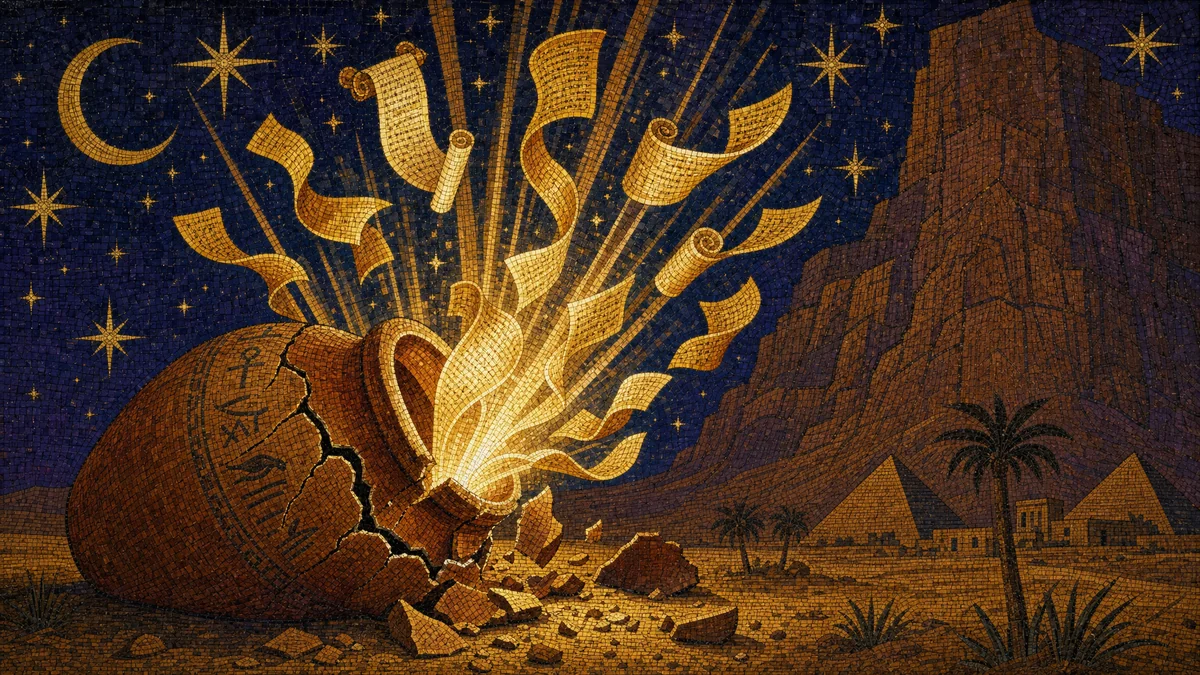
Al-Samman was digging for sabakh — a nitrate-enriched soil used as agricultural fertilizer — at the base of the Jabal al-Tarif cliff, near the town of Nag Hammadi in Upper Egypt. His mattock struck something hard. Digging around it, he uncovered a large earthenware jar, sealed at the top, about 60 centimeters tall.
He hesitated. Local tradition held that such jars sometimes contained a jinn — an evil spirit. But the prospect of gold won. Al-Samman smashed the jar with his mattock.
No gold. No jinn. Instead, the jar contained thirteen leather-bound books made of papyrus, wrapped in a leather covering. Al-Samman and his companions gathered them up and took them home. His mother, 'Umm-Ahmad, later burned some of the loose pages as kindling for the family oven. The books passed through several hands — a local Coptic priest, an antiques dealer, a teacher — before scholars became aware of their existence.
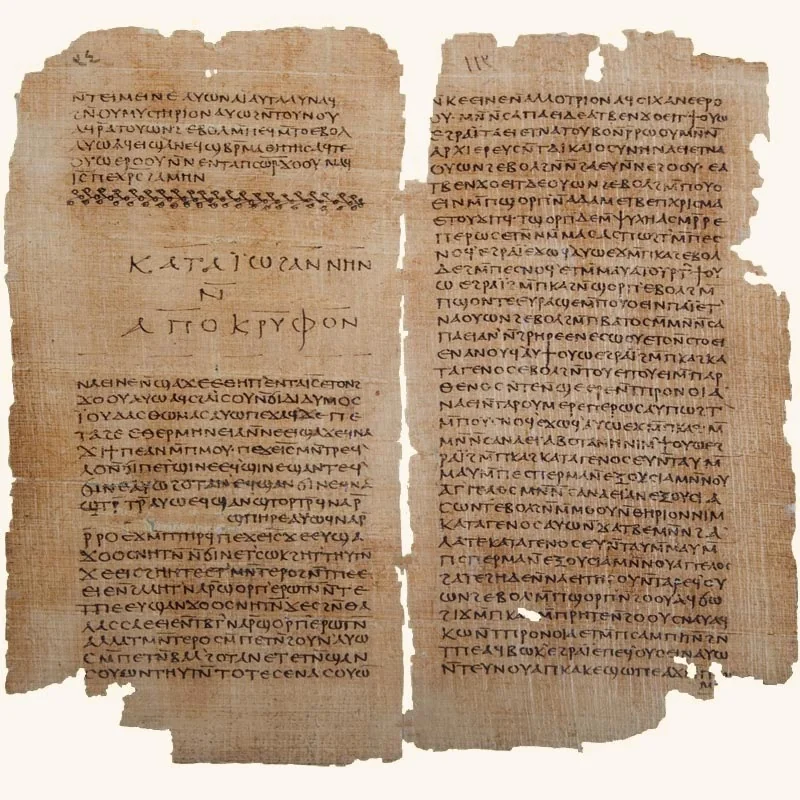
The French archaeologist Jean Doresse heard rumours of unusual manuscripts in 1946 and began investigating. By 1947 he had established that something significant had been found at Nag Hammadi. The scholarly world was about to be upended.
The Complicated Truth — What Robinson Discovered in the 1970s
The story of the Nag Hammadi discovery sounds simple: farmer finds jar, doesn't know its value, texts eventually reach scholars. The full story — reconstructed by James Robinson of Claremont Graduate University, who tracked down Muhammad Ali in the 1970s — is considerably stranger.
Robinson's account, recorded after extensive interviews, includes details Doresse's earlier investigation never mentioned. Al-Samman and his companions had not simply been digging fertilizer. They had traveled to the area on a blood feud mission — to avenge the murder of a relative. Robinson's account of what happened after the discovery of the jar includes the killing of an enemy and the eating of his heart, described as the culmination of the blood feud.
None of this diminishes what was found. But it is a reminder that one of the most important archaeological discoveries of the 20th century came not through organized excavation but through a combination of accident, superstition, agricultural work, and — in at least some versions of the story — violence.
Why Were the Texts Buried? Two Competing Theories
Why does a library end up sealed in a clay jar in the desert? Two serious scholarly theories have been proposed — and neither is simple.
The codices belonged to monks at the Pachomian monastery of Chenoboskion, located approximately 5 km from the discovery site. In 367 AD, Saint Athanasius, Bishop of Alexandria, issued his Easter Letter — a canonical list of approved scriptures that explicitly condemned non-canonical books as heretical. The monks, rather than destroy their library, buried it. Linjamaa's 2024 study argues that a small intellectual elite at the monastery used these texts as part of a wider Christian library — not as their central scriptures but as scholarly resources.
Theory 2 — Funerary Deposit (Lewis & Blount, 2014)
Book burials were common in 4th-century Egypt — wealthy individuals were sometimes interred with valuable objects including manuscripts. Lewis & Blount propose that the Nag Hammadi codices were privately commissioned prestige items buried with a wealthy non-monastic individual. The "bed of charcoal" and other burial-related details in some accounts of the discovery site support this reading.
The two theories are not mutually exclusive. A monastic or scholarly collection could have been deliberately buried to protect it; that burial might have followed conventions similar to funerary practice. What both theories agree on: the texts were buried intentionally, carefully, and with the expectation that they would be preserved.
What Was Inside the Jar? — 52 Texts in 13 Codices
The jar did not contain gold. It contained something more valuable.
The thirteen codices (twelve complete books plus fragments of a thirteenth) held 52 texts written in the Coptic language — 4th-century translations from earlier Greek originals, most composed in the 2nd and 3rd centuries AD. Not all of them are Gnostic: three belong to the Corpus Hermeticum (Egyptian-Greek philosophical and religious writings), and one is a partial translation of Plato's Republic. The remaining 48 are among the most important early Christian and Gnostic texts ever discovered.
| Text | Codex | Significance |
|---|---|---|
| Secret Book of John | II, III, IV | 3 copies — the most complete account of Gnostic cosmology. First Christian text to formulate a complete narrative of God, creation, and salvation (Karen L. King). |
| Gospel of Thomas | II | 114 sayings of Jesus — the only complete surviving text. Greek fragments had been known since 1898; the full text was unknown until 1945. |
| Gospel of Philip | II | Valentinian meditations on sacraments; source of "The world came into being through a mistake." |
| Reality of the Rulers | II | Vivid description of the Archons; exegesis of Ephesians 6:12. |
| Gospel of Truth | I | Possibly written by Valentinus himself; literary masterpiece; previously known only by name from Irenaeus. |
| Thunder, Perfect Mind | VI | A divine feminine voice speaking in paradoxes; widely quoted and influential in modern feminist theology. |
Most of these texts had been known only through hostile quotations in Church Father writings. For the first time, they could be read whole, in their own words.
The Long Road to Publication — 1945 to 1977
From the moment the jar was opened in 1945 to the moment the world could read all its contents in English, 32 years passed.
Elaine Pagels and the Public Discovery — 1979
The scholars had the texts. In 1979, the rest of the world got them.
Two years after Robinson's complete translation, Elaine Pagels — then at Barnard College, later Princeton University — published The Gnostic Gospels. It won both the National Book Award and the National Book Critics Circle Award. Pagels translated the academic significance of the Nag Hammadi library into human terms that non-specialists could understand: these texts showed that early Christianity had been far more diverse than the Church had admitted, that women had played a larger role than orthodox history recognized, and that the "heresy" label attached to Gnosticism was a political act, not a theological verdict.
The Robinson translation had opened the door. Pagels brought millions of readers through it.
What the Discovery Changed
Before December 1945, everything scholars knew about Gnosticism came from its enemies.
The Church Fathers — Irenaeus, Tertullian, Hippolytus, Epiphanius — had written extensively about Gnostic beliefs, but always to refute them. They quoted selectively, framed everything as error, and had no interest in accuracy. For over 1,600 years, that was the only source available. The Gnostics could not speak for themselves.
— Gnosticism was known almost entirely through the writings of its enemies
— The Gnostic texts themselves were presumed destroyed
— Early Christianity appeared relatively uniform in its first centuries
— The Church's claim to represent the original Christianity was largely uncontested
After:
— Gnostics could be read in their own words, in their own texts
— Early Christianity proved far more diverse than previously known
— The suppression of non-canonical texts had a documented history
— Questions about the historical Jesus and early Christian theology re-opened
The Nag Hammadi library did not answer every question about early Christianity. It opened new ones. The debates it sparked — about the historical Jesus, about women in the early Church, about what "orthodoxy" actually means — are still active today.
Where the Codices Are Now
The codices are in Cairo.
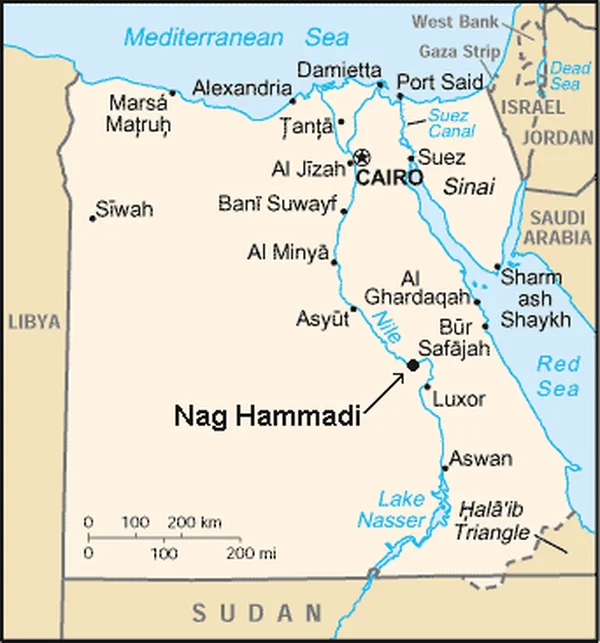
All thirteen — including the Jung Codex, which was finally returned from Zurich in 1975 — are held in the Coptic Museum in Cairo, Egypt. Eleven complete codices and fragments of two others survive: over 1,000 written pages of papyrus. The museum director at the time of nationalization, Pahor Labib, was insistent that they remain in their country of origin, and his determination prevailed.
The texts are not generally accessible for direct handling, but some codex pages are on display in the museum. High-resolution scans are available through academic databases. The standard reference for reading the texts is the facsimile edition published by Brill (1972–1984) and Marvin Meyer's edited volume The Nag Hammadi Scriptures (HarperOne, 2007) — still the most complete single-volume English translation available.
Frequently Asked Questions
Who found the Nag Hammadi library?
Muhammad Ali al-Samman, an Egyptian farmer, is credited with the discovery. He struck the sealed clay jar with his mattock while digging for sabakh (fertilizer soil) near Nag Hammadi in December 1945. James Robinson, who tracked al-Samman down in the 1970s, found that the story was more complicated than initially reported — involving a blood feud mission and other details that remain disputed. Jean Doresse, a French archaeologist, was the first scholar to investigate the find, beginning in 1946-47.
When was the Nag Hammadi library discovered?
December 1945. The precise date is uncertain — al-Samman's accounts varied, and the discovery was not reported to scholars until 1946. The texts were not fully available to the public until the publication of James M. Robinson's complete English translation in 1977 — 32 years after the physical discovery.
Why were the Nag Hammadi texts buried?
Two main theories exist. The Pachomian monastery hypothesis (Robinson, Lundhaug & Jenott, Linjamaa) holds that monks from a nearby monastery buried the texts after Saint Athanasius condemned non-canonical books in his Easter Letter of 367 AD. The funerary deposit hypothesis (Lewis & Blount, 2014) argues the codices were luxury items buried with a wealthy individual — book burials were common in 4th-century Egypt. The two theories are not mutually exclusive.
How many texts were found at Nag Hammadi?
52 texts in 13 codices (12 complete books plus fragments of a 13th). They are written in Coptic, and date to the 3rd–4th centuries AD — though the originals they were translated from were composed mostly in the 2nd–3rd centuries. Not all 52 are Gnostic: three belong to the Corpus Hermeticum, one is a partial translation of Plato's Republic, and the rest are early Christian or Gnostic texts.
What is the most important text in the Nag Hammadi library?
Two texts are most commonly cited as the most significant. The Secret Book of John is the most theologically complete — it provides the fullest account of Gnostic cosmology and appears in three copies, indicating it was considered central. The Gospel of Thomas is probably the most widely read — 114 sayings attributed to Jesus, the only complete text of which exists in the Nag Hammadi collection, though Greek fragments had been known since 1898.
Can I visit the Nag Hammadi codices?
The codices are held at the Coptic Museum in Cairo, Egypt. Some pages are on display in the museum's galleries. The museum is open to visitors; the codices themselves are not available for direct handling. High-resolution digital images of the codices are available through academic databases. The best way to "visit" the texts is through Marvin Meyer's The Nag Hammadi Scriptures (HarperOne, 2007) or the free online translations at gnosis.org.