
The Nag Hammadi Library is a collection of 52 early Christian and Gnostic texts discovered in Egypt in December 1945. Thirteen leather-bound papyrus codices were found sealed in a jar near the town of Nag Hammadi in Upper Egypt. They contained 41 texts never seen before — including the only complete copy of the Gospel of Thomas. The discovery transformed how scholars understand early Christianity, revealing a world far more diverse than the orthodox account had admitted. The codices are now in the Coptic Museum in Cairo.
The Discovery — A Blood Feud and a Buried Jar
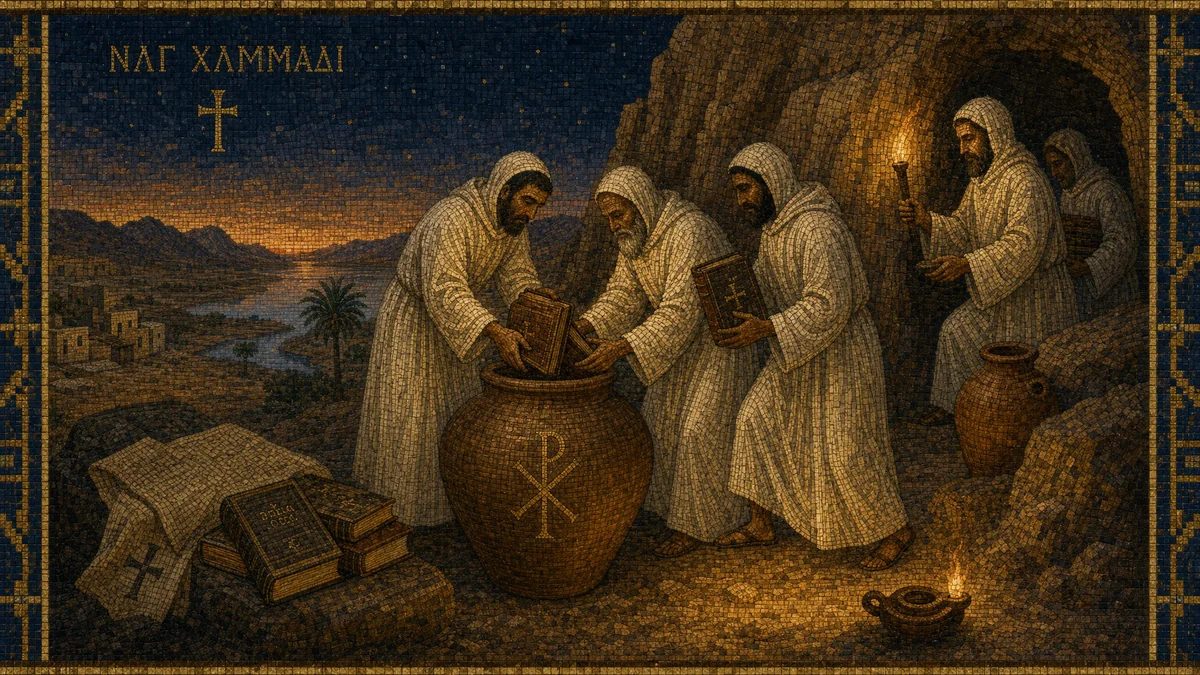
In December 1945, an Egyptian farmer named Muhammad 'Ali al-Samman went out to dig for fertiliser and came back with the most important religious discovery of the 20th century. He and his brothers were working near the base of the Jabal al-Tarif cliff, a few kilometres east of the town of Nag Hammadi in Upper Egypt, when their mattocks struck something hard in the soil.
It was a large sealed earthenware jar, about a metre tall. Muhammad 'Ali hesitated to break it — local tradition held that sealed jars might contain a jinn, a spirit, and opening one could bring misfortune. After some deliberation, he broke the seal anyway, hoping for gold. What tumbled out were books: thirteen leather-bound volumes packed with papyrus pages covered in writing.
The discovery was complicated from the start. The al-Samman family was in the middle of a blood feud — they had recently avenged their father's murder by killing the suspect and, according to accounts recorded later by the scholar James M. Robinson, eating his heart. When the books reached home, Muhammad 'Ali's mother burned some of the loose pages as tinder for the family oven. These are believed to have been most of Codex XII, now one of the most damaged in the collection.
Word spread slowly. A local teacher sold some pages to a Coptic priest; from there, fragments made their way to Cairo antiques dealers. The French scholar Jean Doresse was the first to alert the academic world, in 1946, that something significant had been found.
What’s Inside — 52 Texts in 13 Codices
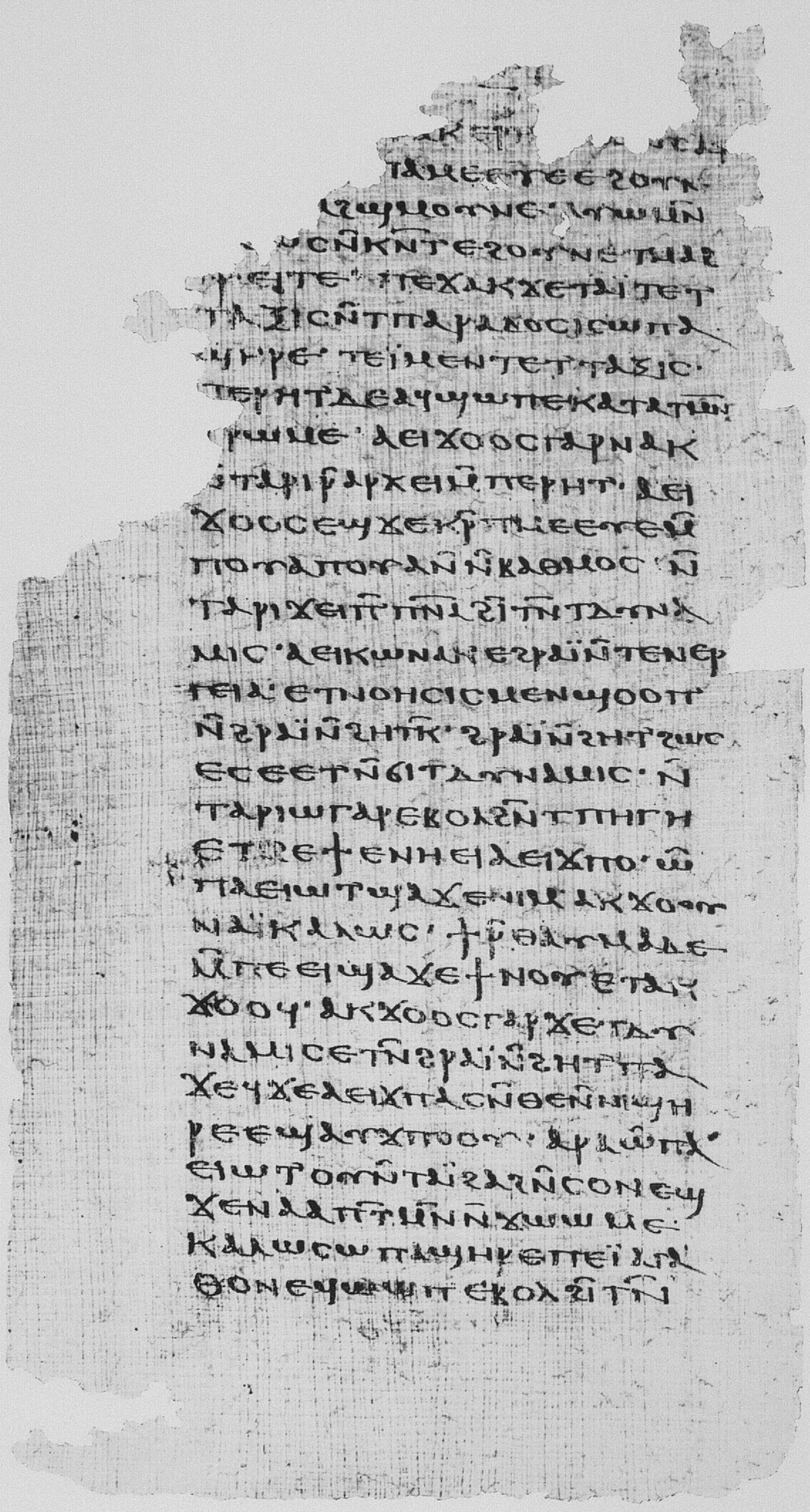
The jar contained thirteen leather-bound books — codices — packed with papyrus pages written in Coptic, a form of the ancient Egyptian language that uses a variant of the Greek alphabet. The manuscripts themselves date from the 4th century CE, but the texts they contain were originally composed in Greek, mostly during the 2nd and 3rd centuries CE.
The 13 codices hold 52 individual texts (called tractates). Six are duplicates — the same text copied in two different codices — leaving 46 unique works. Of those, 41 were completely unknown to scholars before 1945. That is more texts than are contained in the entire New Testament (27 books), added to the historical record in a single afternoon.
The collection is predominantly Gnostic, but not exclusively. It also contains three texts from the Corpus Hermeticum — a tradition of Egyptian-Greek mystical philosophy distinct from Gnosticism — and a partial translation of Plato's Republic. James M. Robinson, the lead English translator, described the library as representing a broad tradition of alternative spiritual writing rather than a single Gnostic sect's canon. All texts are now kept in the Coptic Museum in Cairo.
A full overview of all the Gnostic texts in the collection — and the broader tradition they represent — is available in our complete guide to Gnostic scripture.
The Most Important Texts
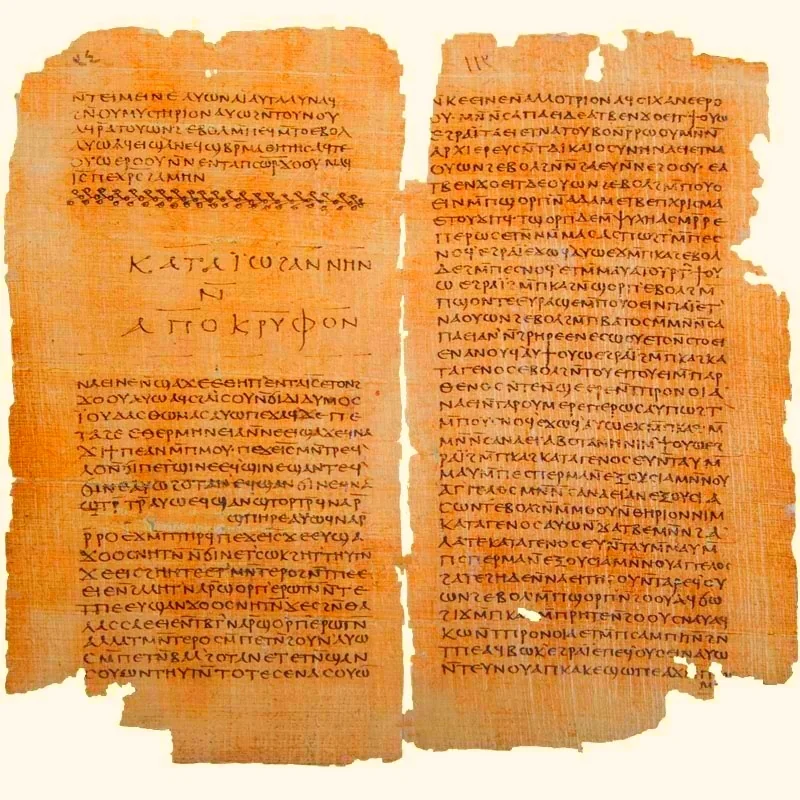
Of the 46 unique texts in the Library, a handful have had an outsized influence on how scholars — and the general public — understand early Christianity. Codex II alone contains four of the most studied: the Secret Book of John, the Gospel of Thomas, the Gospel of Philip, and the Reality of the Rulers.
| Text | Codex | Tradition | Why it matters |
|---|---|---|---|
| Gospel of Thomas | II | Thomasine | Only complete copy; 114 sayings of Jesus with no narrative or miracles |
| Secret Book of John | II, III, IV | Sethian | The most complete Gnostic creation myth; the Demiurge, Archons, Sophia, and the fall |
| Gospel of Philip | II | Valentinian | Mary Magdalene as companion of Jesus; salvation through the bridal chamber sacrament |
| Gospel of Truth | I, XII | Valentinian | Poetic homily possibly written by Valentinus himself; Jesus as shepherd and revealer |
| Gospel of the Egyptians | III, IV | Sethian | Seth as divine saviour; the Great Invisible Spirit; celestial baptism rites |
| Thunder, Perfect Mind | VI | Unknown | A female divine voice speaking in paradoxes — one of the most striking texts in antiquity |
Not all scholars agree that all these texts are properly "Gnostic." Paterson Brown argued that the Gospels of Thomas, Philip, and Truth each affirm the basic reality of material life in ways that contradict the Gnostic rejection of matter. The debate about which texts belong to which traditions continues in academic literature.
Who Buried Them — and Why?
The most important question about the Nag Hammadi Library is not what it contains — but why it was buried. The books were not lost by accident. Someone deliberately sealed them in a jar and placed them in the ground.
The most compelling explanation involves a Pachomian monastery that stood near the Jabal al-Tarif cliff in the 4th century. Pachomius was an Egyptian Christian ascetic who founded a system of communal monastic life; his monasteries were among the most intellectually active institutions in 4th-century Egypt. The caves in the Jabal al-Tarif cliff, close to the burial site, show clear signs of use as monastic retreat cells.
In 367 CE, Athanasius of Alexandria — Archbishop of the entire Egyptian church — sent his Festal Letter to every monastery under his authority. In it, he listed precisely which books were acceptable (the 27 that became the New Testament) and ordered that all others be destroyed. James M. Robinson, the lead English translator of the library, argued that the monks buried their collection rather than burn it — a quiet act of preservation in the face of an official destruction order.
The Long Road to Publication
The discovery in 1945 and the first complete English translation in 1977 — 32 years apart. That gap was filled with bureaucratic obstruction, political upheaval, legal disputes, and one of the strangest acts of academic patronage in history.
The Egyptian government eventually confiscated most of the texts and sent them to the Coptic Museum in Cairo, fearing that the codices would be sold abroad piecemeal. One codex, however, had already escaped. Codex I was sold by a Cairo antiques dealer, and after failed attempts to sell it in New York and Paris, it was acquired by the Carl Gustav Jung Institute in Zurich in 1951 — purchased through the mediation of the Dutch scholar Gilles Quispel as a birthday gift for Carl Jung. It became known as the "Jung Codex." When Jung died in 1961, a legal dispute over ownership delayed its return to Cairo until 1975.
The turning point came in 1966, at the Messina Congress in Italy. There, James M. Robinson of Claremont Graduate University assembled an international team of editors and translators, with UNESCO support, to produce a complete bilingual edition. A facsimile edition in twelve volumes appeared between 1972 and 1977. The full English translation — The Nag Hammadi Library in English — was published in 1977, and a revised edition followed in 1988. The texts, buried for over 1,600 years, were finally available to anyone who wanted to read them.
What Changed — Before and After 1945
Before 1945, everything scholars knew about Gnosticism came from its enemies. The Church Fathers — Irenaeus of Lyon (Against Heresies, c. 180 CE), Tertullian, Epiphanius — wrote detailed refutations of Gnostic beliefs, preserving long summaries and quotations in order to demolish them. These were the only sources available. Scholars could study Gnosticism only through the eyes of people whose stated purpose was to discredit it.
After 1945, the heretics could speak for themselves. The Nag Hammadi texts showed that Gnostic Christianity was not the crude, ignorant parody that Irenaeus described — it was sophisticated, diverse, and deeply engaged with the same scriptural tradition as orthodox Christianity. Karen L. King of Harvard has argued that the discovery proved early Christianity had no single centre: there were dozens of competing movements in the 2nd century, each with different scriptures, different understandings of Jesus, and different paths to salvation.
Elaine Pagels translated this scholarship for general readers. Her 1979 book The Gnostic Gospels — drawing directly on the Nag Hammadi texts — became a bestseller and introduced millions of people to the idea that the Christianity they knew was one version among many. Bart Ehrman's Lost Christianities (2003) pursued the same argument with equal force. The full story of how the library was discovered — and the decades of work required to make it public — is one of the great scholarly dramas of the 20th century.
Where to Read the Texts Free Online
Every text in the Nag Hammadi Library is available to read free online — no paywall, no subscription. The complete collection has been digitised and published by multiple academic sources.
For a print edition, the most authoritative current translation is Marvin Meyer's The Nag Hammadi Scriptures (HarperOne, 2007) — a full scholarly translation with introductions to every text. James Robinson's original 1977 edition (The Nag Hammadi Library in English, revised 1988) remains in print and is the most widely cited.
Frequently Asked Questions
Is the Nag Hammadi Library the same as the Gnostic Gospels?
The terms overlap but are not identical. "Gnostic Gospels" is Elaine Pagels's popularising term from her 1979 book — it refers loosely to the Nag Hammadi texts that present alternative accounts of Jesus. The Nag Hammadi Library is the full collection of 52 texts, most of which are not "gospels" in any conventional sense (they include apocalypses, hymns, philosophical treatises, and cosmological myths). And not all important Gnostic gospels come from Nag Hammadi: the Gospel of Mary (Berlin Codex, 1896) and the Gospel of Judas (Codex Tchacos, 2006) were found separately.
Are the Nag Hammadi texts older than the Bible?
The physical codices date from the 4th century CE — later than the oldest New Testament manuscripts. But the texts they contain were originally composed in the 2nd and 3rd centuries CE, making them roughly contemporary with the later New Testament writings and earlier than the councils that finalised the biblical canon. The Gospel of Thomas may contain sayings traditions that predate the canonical Gospels, though this is debated.
Why aren't the Nag Hammadi texts in the Bible?
Because they were excluded — or never considered — during the process by which church authorities defined the biblical canon in the 4th century. Athanasius's Festal Letter of 367 CE named exactly 27 acceptable books. Texts like the Gospel of Thomas and the Secret Book of John presented a different understanding of Jesus, God, and salvation that church authorities found incompatible with the theology they were establishing. The Nag Hammadi discovery shows how many alternative scriptures existed and were actively suppressed.
Where is the Nag Hammadi Library kept today?
All thirteen codices are housed in the Coptic Museum in Old Cairo, Egypt, where they have been since the Egyptian government declared them national property after the 1952 revolution. The exception was Codex I (the "Jung Codex"), which spent 24 years in Zurich before being returned to Cairo in 1975. The codices are not generally on public display — they are held in controlled conditions to preserve the fragile papyrus.
Is the Gospel of Judas part of the Nag Hammadi Library?
No. The Gospel of Judas is a separate discovery — it was found in a different location in Egypt (the Codex Tchacos), surfaced on the antiquities market in the 1970s, and was not published until 2006 by the National Geographic Society. It is a Gnostic text from the same broad tradition as the Nag Hammadi texts but was not part of the 1945 find.
Who translated the Nag Hammadi Library into English?
The standard English translation is The Nag Hammadi Library in English, edited by James M. Robinson of Claremont Graduate University, first published in 1977 with a revised edition in 1988. A more recent and complete scholarly translation is Marvin Meyer's The Nag Hammadi Scriptures (HarperOne, 2007). Bentley Layton's The Gnostic Scriptures (Doubleday, 1987) offers an alternative translation of key texts with extensive annotations.