
In Gnosticism, Jesus Christ is not a sacrificial victim whose death atones for sin — he is a divine revealer whose mission is to awaken humanity to gnosis. He came from the Pleroma, the realm of Barbelo, and his teachings — not his death — are the mechanism of salvation. Most Gnostic sects held that he only appeared to have a physical body.
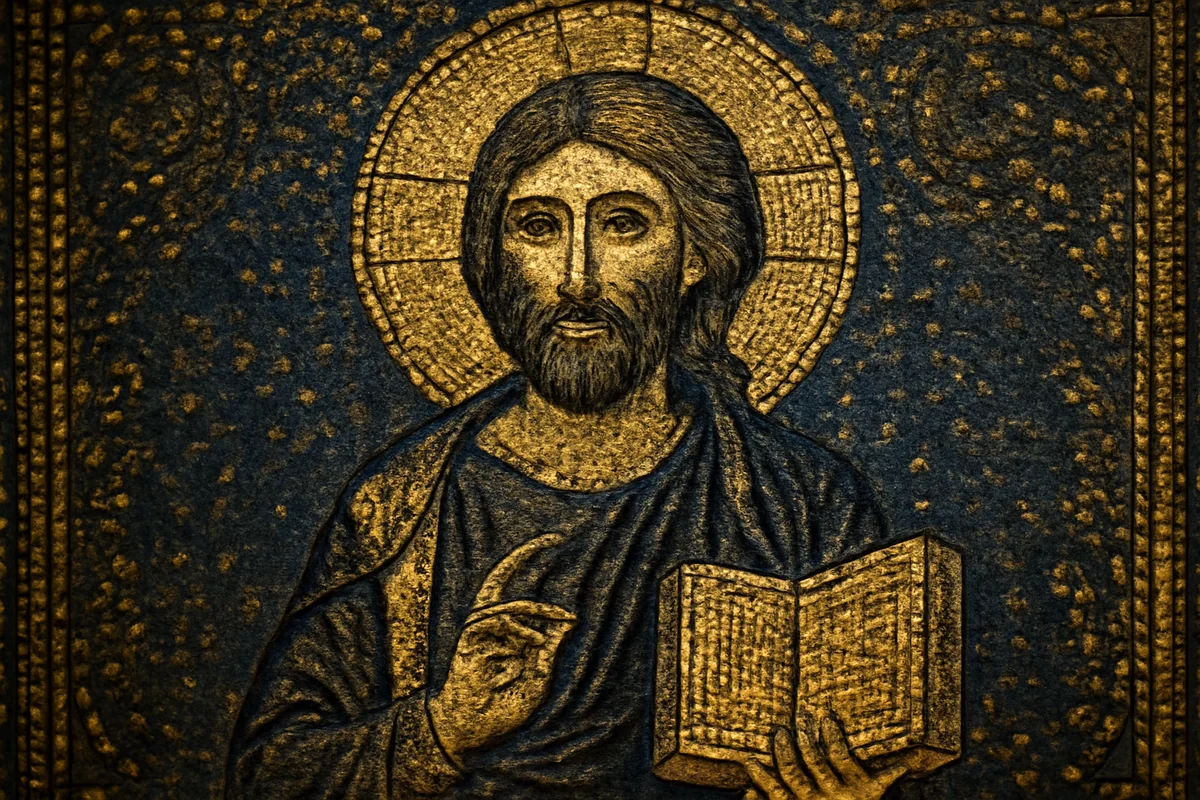
The Gnostics and the proto-orthodox church agreed on more about Jesus than is commonly assumed. Both saw him as a divine being who existed before the world was made. Both believed he came to earth on a salvific mission. Both revered the same texts — or at least many of the same texts — as records of his life and teaching.
Where they disagreed was on four questions that turned out to be irreconcilable: what Christ taught, what kind of being he was, what his death meant, and whether he was a unique being or a model for others to emulate.
Christ's Mission — Revealer, Not Redeemer
The proto-orthodox church placed Christ's death at the centre of salvation: he died for humanity's sins, and faith in that death and resurrection is what saves. The Gnostics placed Christ's teachings at the centre: he came to impart gnosis, and gnosis is what saves.
This was not a minor difference in emphasis. It was a structural inversion of what Christianity was for.
The Gnostic Christ is an emissary from the true God the Father, sent into the material world to awaken the divine spark in pneumatic human beings. His teachings are not primarily moral instructions or doctrinal assertions — they are gnosis-producing transmissions. The Gospel of Thomas states this directly in its prologue: "Whoever discovers the interpretation of these sayings will not taste death." The sayings are instruments of awakening, not rules to follow.
The Gnostics could point to canonical support for this view. Luke 17:20-21: "The kingdom of God does not come with observation... for indeed, the kingdom of God is within you." Mark 4:11: "To you has been given the secret of the kingdom of God, but for those outside, everything comes in parables." The Gnostics read these not as rhetorical flourishes but as straightforward statements: Christ's real teaching was inner, secret, and aimed at gnosis — not the outer shell that the proto-orthodox had mistaken for the whole.
What Kind of Being Was the Gnostic Christ?
The proto-orthodox church held that Christ was fully human and fully divine — two natures inseparably joined. For the Gnostics, this was, at best, a category confusion and, at worst, a blasphemy: how could a perfect divine being truly suffer at the hands of matter? To say Christ suffered physically was to say matter had power over the divine — which contradicted the entire Gnostic framework.
Two Gnostic solutions to this problem dominated:
Strict docetism held that the physical Jesus was an illusion throughout. A softer version — held by many Valentinians — distinguished between the spiritual Christ who descended at Jesus's baptism and the human Jesus who was born of Mary. The divine Christ occupied the human Jesus temporarily, departed before the crucifixion, and the man Jesus died alone.
The Gospel of Judas takes the most radical position: Christ laughs when the disciples pray over the bread and cup, because he knows they are inadvertently worshipping the Demiurge. The crucifixion, in this text, is something Christ arranges rather than suffers — a departure from the physical vehicle, not a sacrifice.
The Gnostic Christ in the Primary Texts
The Gnostic texts present Christ in several distinct registers — as cosmic revealer, as inner voice, and as post-resurrection teacher.
Immediately, while I was grieving, the heavens were opened, and the whole creation under the sky was illuminated, and the world was shaken. I was afraid, and I saw in the light a youth who stood by me. While I looked at him he became like an old man. And he changed his form again, becoming like a servant. There were not a plurality of him but there was a single likeness having several forms in the light. And the likenesses appeared through each other, and the vision had three forms.
Christ appears here in three forms simultaneously — youth, old man, servant — a Trinitarian theophany that explicitly transcends any single physical form. He has come to answer the question the fallen Aeon asks: "Why was the Savior appointed, and why was he sent into the world by his Father, and who is his Father who sent him?" The entire Secret Book of John is Christ's answer.
Jesus said: I am the light that is over all things. I am all: from me all came forth, and to me all attained. Split a piece of wood; I am there. Lift up the stone, and you will find me there.
This is not Christ as historical person but as cosmic presence — the light that permeates all things, the divine principle hidden in matter itself. Even wood and stone contain him. For the Gnostics, this was Christ as gnosis-principle: the divine light that the pneumatic person recognises, first in the teachings, then in everything.
The Death and Resurrection — What They Meant
For the proto-orthodox, the crucifixion was the salvific event: Christ's physical suffering and death atoned for human sin; his bodily resurrection proved the possibility of humanity's own resurrection. Remove the physical death and resurrection and the entire proto-orthodox soteriology collapses.
For the Gnostics, physical death and resurrection were not the point — and in some traditions, they did not occur as described. Several positions existed:
| Gnostic tradition | What happened at the crucifixion | What resurrection meant |
|---|---|---|
| Strict docetists | Christ only appeared to suffer — the body was illusory throughout | Proof that spirit transcends matter; bodily resurrection not the point |
| Valentinians | The divine Christ departed before the crucifixion; the human Jesus died | The spiritual body was raised — not the physical body |
| Basilideans (per Irenaeus) | Simon of Cyrene was crucified in Christ's place while Christ stood by, laughing | Irrelevant — Christ could not be touched by the Archons |
| Gospel of Judas | Christ arranged his own departure through Judas; the crucifixion served his purpose | Return to the Pleroma — not physical resurrection |
The Gnostic Treatise on the Resurrection makes the clearest statement of the Gnostic position on resurrection: "The resurrection is not an illusion... it is truth. It is more fitting to say that the world is an illusion, rather than the resurrection which has come into being through our Lord the Savior." Resurrection, here, is not a future event for bodies — it is the present inner experience of gnosis. "Leave the state of dispersion and bondage, and then you already have resurrection."
Christ as Model, Not Unique Savior
One of the most radical Gnostic positions on Christ concerns his uniqueness. For the proto-orthodox, Christ was the unique Son of God — his incarnation, death, and resurrection were singular events that could not be replicated and did not need to be. The believer benefited from them through faith and sacrament.
For the Gnostics, Christ was the first to achieve full gnosis and return to the Pleroma — but not the only one who could do so. He was a model and a teacher, not a unique redeemer whose achievement could be vicariously appropriated. The successful Gnostic did not merely believe in Christ; the successful Gnostic became, in some sense, Christ.
The Gospel of Philip states this with characteristic sharpness:
You saw the Spirit, you became spirit. You saw Christ, you became Christ. You saw the Father, you shall become Father. So in this place you see all and you do not see yourself, but in that place you do see yourself — and what you see you shall become.
This is not blasphemy in the Gnostic framework — it is the logical consequence of gnosis. If the divine spark within the pneumatic is ontologically the same substance as the Pleroma, then the fully-gnosis-bearing pneumatic and the divine Christ are the same kind of thing. The Gnostic does not worship Christ from below; the Gnostic recognises Christ in himself.
Christ in Gnostic Texts vs. the New Testament
The Gnostics did not reject the canonical gospels — they read them, quoted them extensively, and found their views confirmed in them. But they also had their own texts, which they considered either additional revelations or, in some cases, the more authentic record of Christ's secret teachings.
| Text | Christ's primary role | Key teaching |
|---|---|---|
| Secret Book of John | Post-resurrection revealer of cosmic secrets | The creation myth; the divine spark's origin; how to ascend through the spheres |
| Gospel of Thomas | Speaker of gnosis-producing sayings | "The kingdom is within you and outside you" — inner recognition is salvation |
| Gospel of Philip | Divine bridegroom of the Pleroma | The bridal chamber — union with the divine as the model of salvation |
| Gospel of Judas | Divine being arranging his own departure | Only Judas understands Christ's true identity ("from the immortal realm of Barbelo") |
| First Apocalypse of James | Teacher of post-death navigation | Passwords for the Archon gates — practical gnosis for the soul's ascent |
Why the Proto-Orthodox Won
The Gnostic Christ was, in many ways, a more sophisticated theological construction than the proto-orthodox one. He was not limited to a single historical life; his teachings addressed the deepest questions of human existence; his salvific power was available to anyone who achieved gnosis rather than depending on institutional mediation.
But the proto-orthodox Christ had advantages that mattered more in the 2nd and 3rd centuries: simplicity, accessibility, and institutional scalability. A salvation that required gnosis — a rare inner experience that could not be conferred by any external authority — could not organise a church. A salvation that required faith, baptism, and obedience to clergy could. Irenaeus understood this. His attack on Gnostic Christology was simultaneously a defence of episcopal authority: if Christ's salvific work was unique, unrepeatable, and mediated through the institution, then the bishops who controlled access to that institution controlled access to salvation.
The Gnostic Christ survived, not as an institution, but as an idea — recurring in Christian mysticism, in the Cathars and Bogomils, in Jung's psychology, and in the religious imagination of anyone who has ever suspected that the Jesus of the creeds is not quite the same as the one who said "the kingdom of God is within you."
Frequently Asked Questions
What did Gnostics believe about Jesus?
Gnostics believed Jesus was a divine being sent from the true God (the Father) to impart gnosis — direct spiritual knowledge of the soul's divine origin. His mission was to awaken the divine spark in pneumatic human beings, not to die as a sacrifice for sin. Most Gnostic schools held that Jesus only appeared to have a physical body (docetism), that his death was either an illusion or spiritually irrelevant, and that his resurrection was a spiritual rather than physical event. His teachings, correctly understood, were instruments of inner awakening rather than moral or doctrinal instructions.
What is docetism in Gnosticism?
Docetism (from Greek dokein, "to seem") is the belief that Christ only appeared to have a physical body — that he projected the form of a human being without actually inhabiting flesh and blood. This view was held by many Gnostic sects and some non-Gnostic early Christians. For Gnostics, it followed logically from their cosmology: a perfect divine being from the Pleroma could not truly subject itself to matter, the domain of the Demiurge and Archons. The crucifixion, on a docetic reading, involved no real physical suffering — Christ's divine nature was beyond the reach of material pain.
Did Gnostics believe Jesus died on the cross?
Most Gnostic traditions held that the crucifixion was either an illusion (strict docetism) or that the divine Christ departed before it occurred (Valentinianism). The Basilidean tradition, as reported by Irenaeus, held that Simon of Cyrene was crucified in Christ's place while Christ watched. The Gospel of Judas presents Christ as actively arranging his own departure through Judas. What virtually all Gnostic traditions agreed on was that whatever happened at the crucifixion was not a sacrificial atonement for sin — the entire logic of atonement theology was rejected, since the Gnostic God the Father had nothing to do with the material world and no relationship with sin or justice in the ordinary sense.
How did Gnostics read the Gospel of John?
The Gnostics particularly valued the Gospel of John among the canonical gospels. Its prologue — "In the beginning was the Word (Logos)" — aligned with their view of Christ as a pre-existent divine principle, not merely a historical figure. Its emphasis on Christ's extended revelatory speeches (rather than miracles or actions) matched the Gnostic view of Christ as teacher of hidden knowledge. John 1:10-11 — "He was in the world, and the world did not know him" — resonated with the Gnostic experience of alienation. The first commentary on any gospel was Heracleon's commentary on John, written by a Valentinian Gnostic around 170 AD.
What is the difference between the Gnostic Christ and the orthodox Christ?
The key differences: (1) Mission — orthodox Christ came to die for sin; Gnostic Christ came to reveal gnosis. (2) Nature — orthodox Christ was fully human and fully divine; Gnostic Christ was a divine being who only appeared human (docetism). (3) Death — orthodox: physical, salvific, real; Gnostic: illusory, spiritually irrelevant, or arranged by Christ himself. (4) Resurrection — orthodox: bodily, future model for believers; Gnostic: spiritual, already achievable through gnosis in this life. (5) Uniqueness — orthodox: unique redeemer whose achievement is appropriated through faith; Gnostic: first exemplar of gnosis, a model the pneumatic can replicate.