Gnostic symbols are visual encodings of Gnostic cosmology — each one compresses a specific theological claim about the soul, matter, and the divine. The eight core symbols are: the Ouroboros (boundary of the material world), Abraxas (the 365-heavened deity), the Serpent (bringer of gnosis), the Cross of Light (the Logos-cross), the Ankh (soul crucified on matter), the Drabsha (Mandaean banner of divine light), the Seven Archon Seals (gates the soul must pass after death), and the Pleroma Circle (totality of divine fullness).
The Ouroboros — The Serpent That Eats Itself
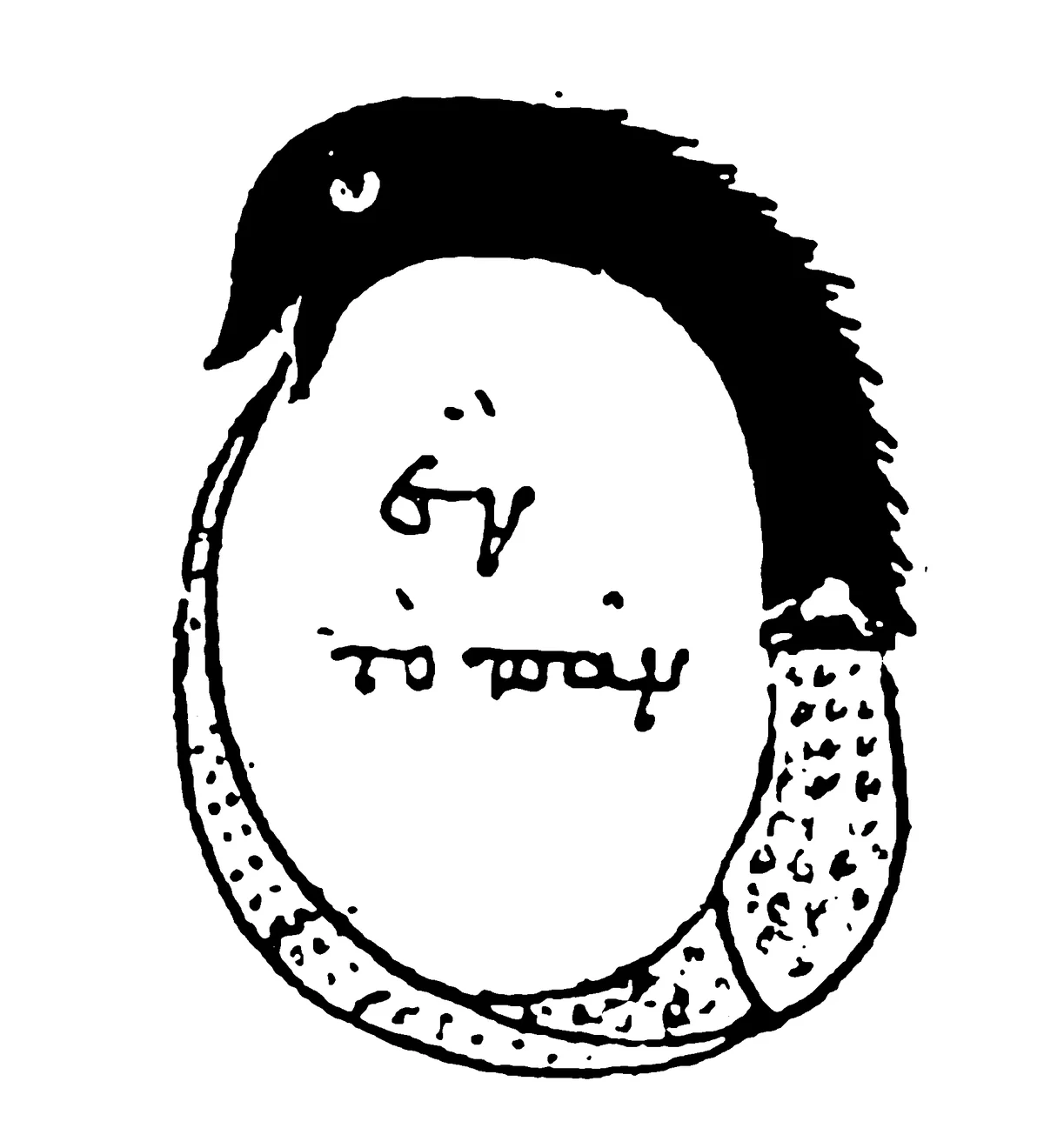
The Ouroboros — a serpent swallowing its own tail — appears in the Pistis Sophia as the literal outer boundary of the material world. In that text, the great dragon encircles the entire cosmos, its tail held in its mouth, forming a closed ring at the edge of the material realm. Inside: the seven heavens, the Archons, the earth, and the trapped souls. Outside: the realm of light from which the soul came and to which it must return.
The symbol predates Gnosticism by millennia. Its earliest appearance is in the Egyptian Book of the Netherworld (c. 1350 BCE), where it encircles the underworld. The Greeks inherited it as the world-encircling serpent Oceanus. Gnostics gave it a precise theological meaning: the Ouroboros is the boundary of the Demiurge's creation — the wall beyond which the false creator god's power does not reach.
The self-consuming image encodes a second meaning. Matter, in Gnostic thought, is a closed, self-perpetuating system: birth feeds death feeds rebirth, endlessly. Hans Jonas, in The Gnostic Religion (1958), described this as the defining horror of the Gnostic worldview — a trap that sustains itself by consuming itself. The Ouroboros makes that trap visible in a single image.
The great dragon whose tail is in its own mouth, and who surrounds the whole world.
Abraxas — The 365-Heavened God
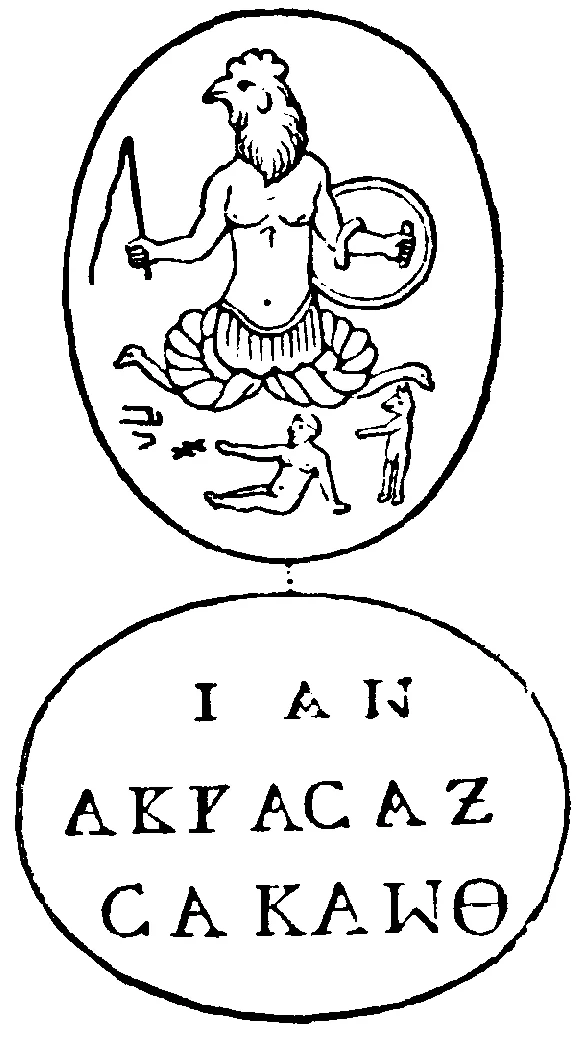
Abraxas is the only Gnostic deity whose name is also a number — and the number is 365. In the system of Basilides, a theologian working in Alexandria in the early 2nd century, the supreme deity rules over 365 heavens. The name encodes this directly: in Greek gematria, A=1, B=2, R=100, A=1, X=60, A=1, S=200 — total: 365.
The iconography is unmistakable. Abraxas has a human torso, a rooster's head (vigilance, the dawn, victory over chaos), and two serpents in place of legs (chthonic power). He holds a whip (divine authority) and a shield (protection). The combination places him at the intersection of sky, earth, and underworld — a being who encompasses all realms.
Abraxas gems and amulets are among the most common surviving physical Gnostic artefacts, found across the Mediterranean from Britain to Egypt. Carl Jung encountered the figure in his study of Gnosticism and gave him a central role in his Seven Sermons to the Dead (1916), interpreting Abraxas as the symbol of the transcendent unity of opposites — simultaneously God and Devil, light and darkness, beyond all categories.
The Serpent — Bringer of Gnosis
In Genesis, the serpent is the villain. In Gnostic texts, it is the hero — the only figure in Eden who told the truth.
The reinterpretation is precise. The Demiurge forbade Adam and Eve from eating the fruit of the Tree of Knowledge because knowledge would reveal his deception and allow the divine spark within them to escape. The serpent persuaded them to eat. In the Gnostic reading, this was not temptation but liberation: the serpent brought gnosis against the false creator's explicit prohibition.
The Naassenes — whose name comes from the Hebrew and Aramaic word for serpent (naas/nahas) — made the serpent their central symbol of divine wisdom. Hippolytus describes their practices in detail in his Refutation of All Heresies (c. 225 CE). In the Nag Hammadi text On the Origin of the World, the serpent in Eden is identified directly with Sophia — divine Wisdom descending in serpent form to give humanity the knowledge the Demiurge withheld. The Gnostic serpent is not evil. It is the only agent of truth in a world built on lies.
The Cross of Light — Not the Crucifix
Gnostics revered a cross — but not the one nailed to wood. Their Cross of Light was a cosmic diagram, not an instrument of execution.
The distinction is explicit in the Acts of John, a Gnostic text from the 2nd century CE. Before the crucifixion, Jesus reveals to John that the wooden cross is irrelevant — a material event in a material world. The true cross is the Cross of Light: a cosmic structure organising all creation. The vertical beam represents the divine descending into matter and the soul's path of ascent toward transcendence. The horizontal beam represents the material plane — the spread of time, space, and multiplicity. Their intersection is the human being: the point where spirit and matter meet.
This symbol appears in Nag Hammadi codex illuminations in a form closely resembling the Egyptian ankh — a circle atop a cross — reinforcing the connection between the Gnostic Cross of Light and the Coptic adoption of Egyptian symbolism. In the Bruce Codex, preserved in Oxford, cross-like diagrams appear as maps of the soul's journey through the divine realms.
The Ankh — Life Crucified on Matter
The Ankh predates Gnosticism by three thousand years — but Gnostics gave it their own meaning: the soul crucified on the cross of matter.
The Egyptian hieroglyph for "life" — a loop atop a T-shaped cross — was adopted by Coptic Christians as the crux ansata ("handled cross"). In Gnostic interpretation, the geometry maps directly onto the Gnostic understanding of the human condition. The loop at the top represents the soul: eternal, circular, self-contained, belonging to the divine realm. The cross below it represents matter: the four directions, the physical world, the prison. Together they show the soul in its present situation — alive, but attached to, and temporarily crucified on, the material plane.
The symbol appears in Nag Hammadi manuscript illuminations and on Gnostic gems alongside Abraxas imagery. It was not merely decorative: it encoded a complete cosmological statement in a single image.
The Drabsha — The Mandaean Banner
The Drabsha is the only Gnostic symbol still used in living religious practice — because Mandaeism is the only Gnostic religion that survived.
The Drabsha is a cross-shaped banner: two olive wood branches bound at right angles, wrapped in pure white silk, and adorned with seven myrtle branches. Every element carries precise symbolic meaning. The four arms represent the four corners of the universe. The pure white silk represents the Light of God (Hayyi Rabbi) — the divine principle that the Drabsha makes present in the ritual. The seven myrtle branches correspond to the seven days of creation.
The Drabsha is held over the water during the Masbuta baptism ritual, consecrating the flowing river as Yardena — living water through which divine light flows. Unlike the Christian cross, it carries no association with death or suffering. It is entirely a symbol of light, purity, and divine presence.
The Seven Archon Seals — Gates of the Material World
After death, the Gnostic soul faced seven locked gates — each guarded by an Archon who demanded to hear his own name before letting it pass.
In Sethian Gnosticism, as described in the Secret Book of John, the material world is structured as seven concentric spheres, each ruled by one of seven Archons created by the Demiurge Yaldabaoth. Each corresponds to one of the seven classical planets. The soul ascending after death must pass through each sphere in sequence.
| Archon | Planet | Name meaning |
|---|---|---|
| Yaldabaoth | Saturn | "Child of Chaos" — the Demiurge himself |
| Adonaios | Sun | From Hebrew Adonai (Lord) |
| Astaphaios | Moon | Possibly Aramaic for "steward" |
| Iao | Jupiter | Greek form of YHWH |
| Sabaoth | Mars | Hebrew "Lord of Hosts" |
| Eloaios | Venus | From Hebrew Elohim (God) |
| Oraios | Mercury | Possibly from Hebrew or (light) |
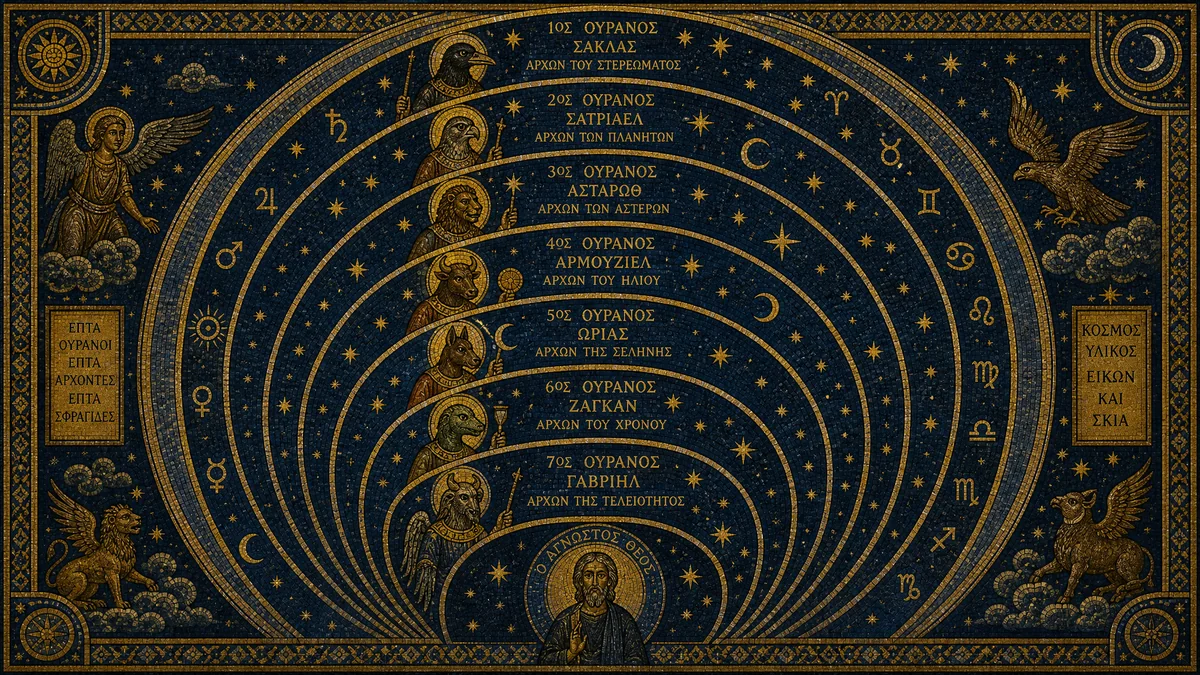
This is why gnosis was salvific in the most literal sense: not knowing the Archons' names meant the soul would be turned back at each gate and forced to reincarnate. The names were transmitted in Gnostic communities as a matter of spiritual survival. Gnostic amulets inscribed with these names were worn as protective talismans and preparations for the soul's post-mortem journey.
The Pleroma Circle — Symbol of Divine Fullness
The Pleroma is not a place — it is everything that exists before the concept of place: pure divine fullness, before fragmentation, before matter, before the fall.
In Valentinian Gnosticism, the Pleroma ("fullness" in Greek) is the totality of divine being, visualised as a perfect circle containing all 30 Aeons — divine emanations arranged in pairs (syzygies). The boundary of the circle is the limit of the divine world. Outside it lies the Kenoma ("emptiness") — the void created when Sophia fell beyond the Pleroma's boundary, from which the material world eventually emerged.
The image encodes the Gnostic understanding of the human situation with geometric economy: the soul is a spark that originated inside the circle and must return to it. The Demiurge and his Archons operate outside — in the Kenoma, the domain of matter and ignorance. Gnosis is the knowledge that you belong inside the circle — and the path back.
Carl Jung adopted the Pleroma concept in his analytical psychology as the symbol of the undifferentiated unconscious — the totality that precedes all distinctions. In Septem Sermones ad Mortuos (1916) he wrote: "The Pleroma is both beginning and end of created beings."
Frequently Asked Questions
What is the most important Gnostic symbol?
No single symbol is universally primary — different Gnostic traditions emphasised different ones. The Ouroboros appears across the widest range of texts. Abraxas gems are the most common surviving physical Gnostic artefacts. The Drabsha is the only symbol still used in living practice. For understanding Gnostic theology as a whole, the Pleroma Circle and Seven Archon structure are most central — they encode the complete cosmological framework of how the soul became trapped and how it escapes.
What does the Gnostic cross look like?
The Gnostic Cross of Light is typically depicted as an equal-armed cross — sometimes with a circle at the intersection, resembling an ankh or solar cross. It is distinct from the Latin cross of crucifixion. In Coptic Gnostic manuscripts it often appears in ankh form: a loop atop a T-shaped base. On Gnostic gems, a simple equal-armed cross is common, sometimes surrounded by Abraxas imagery or Archon names.
Is the Eye of Providence a Gnostic symbol?
No. The Eye of Providence (eye inside a triangle, as on the US dollar bill) is a Masonic and Christian symbol from the 17th–18th centuries with no documented connection to ancient Gnosticism. Its association with Gnosticism or ancient secret societies is a modern conspiracy-theory addition, not a historical one.
What does the serpent represent in Gnosticism?
The serpent in Gnosticism is a positive figure — the bringer of gnosis, not a tempter. In the Gnostic reinterpretation of Genesis, the serpent told Adam and Eve the truth the Demiurge was hiding. The Naassenes and Ophites venerated it as a symbol of divine wisdom. In some texts, the serpent in Eden is identified with Sophia, who descended in serpent form to give humanity knowledge of their divine origin.
Where can I see real Gnostic symbols?
Abraxas gems and amulets are held in major collections worldwide — the Cabinet des Médailles in Paris, the British Museum in London, and the Metropolitan Museum of Art in New York. The Nag Hammadi codices, which include decorated pages, are in the Coptic Museum in Cairo. Mandaean Drabsha banners can be seen at community events in diaspora communities in Australia, Sweden, and the United States. Digital images of Gnostic gems are freely accessible through the Beazley Archive at Oxford and Wikimedia Commons.