The Gospel of Thomas is a collection of 114 sayings attributed to Jesus, discovered at Nag Hammadi in 1945. Unlike the canonical gospels, it has no narrative — no birth story, no miracles, no crucifixion, no resurrection. Its opening promise: "Whoever discovers the meaning of these sayings will not taste death." The sayings are not doctrines to believe but puzzles designed to produce gnosis — direct inner recognition of the divine.
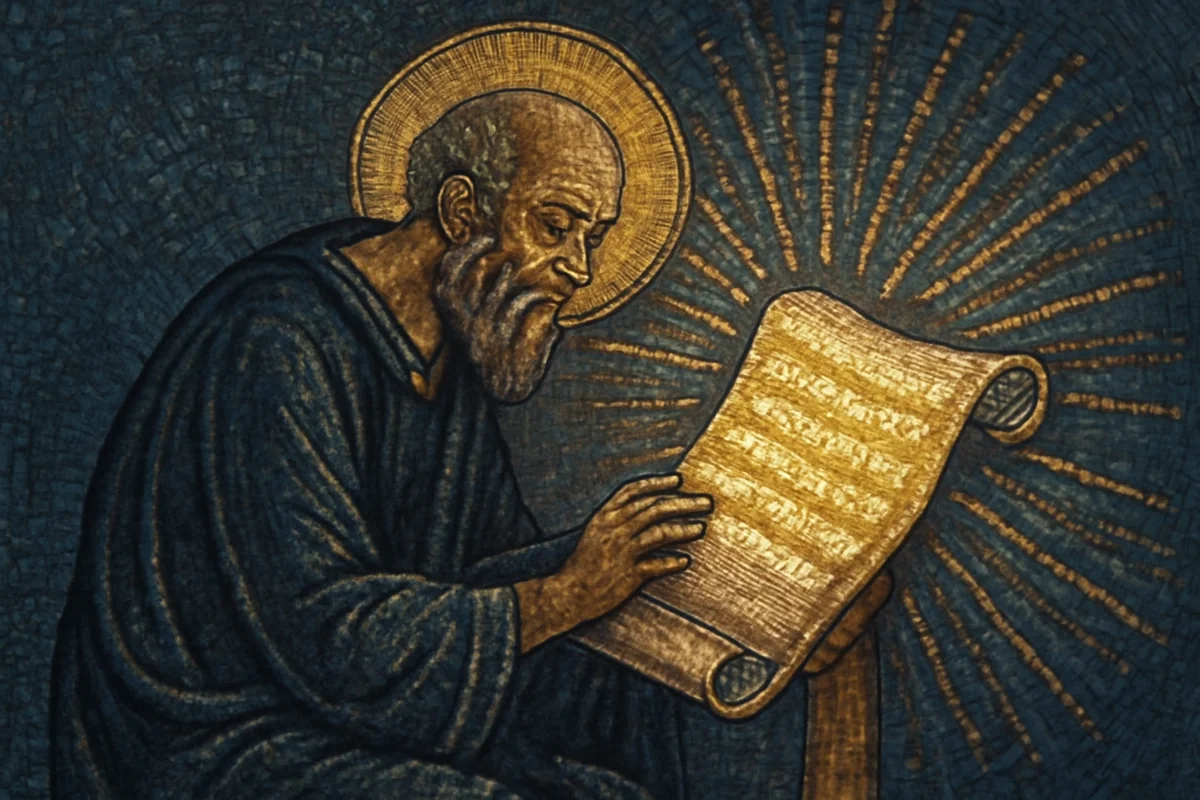
Most gospels are stories. The Gospel of Thomas is a list.
No angels announce a birth. No disciples are called beside the sea. No loaves are multiplied, no blind men healed, no body is raised on the third day. What the Gospel of Thomas offers instead is 114 sayings — terse, often cryptic, sometimes paradoxical — each attributed to "the living Jesus" and each demanding interpretation rather than acceptance.
It is the most-read Gnostic text in the world. It is also one of the most debated — by scholars who cannot agree on when it was written, whether it is Gnostic at all, or what its most important sayings actually mean. This page gives you the text, the context, and an honest account of what remains contested.
Not a Gospel in the Usual Sense
Most gospels are stories. The Gospel of Thomas is a list.
The Prologue states its purpose plainly:
These are the hidden sayings that the living Jesus spoke and Didymos Judas Thomas wrote down. And he said, "Whoever discovers the interpretation of these sayings will not taste death."
Two things in this Prologue matter immediately. First: the sayings are "hidden" — they have a surface meaning and a deeper meaning, and only the deeper meaning saves. Second: the speaker is "the living Jesus" — not the historical Jesus of Nazareth, not the resurrected Christ of Paul's letters, but a figure who exists in a continuous present, still speaking.
The text contains no crucifixion, no resurrection, no Last Supper, no Last Judgement. These omissions are not oversights — they are the point. The canonical gospels understood salvation through Jesus's death and resurrection. The Gospel of Thomas understands salvation through understanding Jesus's words. The mechanism is completely different: not atonement but illumination; not faith in an event but discovery of a meaning.
Two Discoveries — Oxyrhynchus 1897 and Nag Hammadi 1945
The Gospel of Thomas was discovered twice — 48 years apart.
The Oxyrhynchus Greek fragments (dated 130–250 AD) are older than the Nag Hammadi Coptic manuscript (c. 340 AD). They give scholars a window into an earlier form of the text — and reveal that the wording sometimes differs significantly between the Greek and Coptic versions. The Gospel of Thomas likely passed through several stages of editing and may have circulated in more than one form.
What "Thomas the Twin" Means
The name in the Prologue is unusually specific: not just Thomas, but "Didymos Judas Thomas."
Thomas is the Aramaic/Syriac word for "twin." Didymos is the Greek word for "twin." The name contains "twin" twice — in two languages. This is not coincidence. The Gospel of Thomas presents its narrator as the spiritual twin of Jesus: not merely a disciple who recorded his teacher's words, but someone who has become identical to Christ through gnosis.
Saying 13 is the structural pivot of the entire text. Jesus asks his disciples: "Compare me to someone and tell me whom I am like." Simon Peter says "a just messenger." Matthew says "a wise philosopher." Judas Thomas says: "My mouth is utterly unable to say whom you are like." Jesus responds: "I am not your master. Because you have drunk, you have become intoxicated from the bubbling spring that I have tended." Then Jesus takes Thomas aside and tells him three things privately. When Thomas returns, the other disciples ask what Jesus said. Thomas responds: "If I tell you one of the things which he told me, you will pick up stones and throw them at me; a fire will come out of the stones and burn you up."
Thomas wins not by giving an answer but by recognising that the question exceeds language. This is the Gnostic epistemology in miniature: the knowledge that saves cannot be articulated. It can only be pointed at — which is exactly what the 114 sayings do.
Ten Sayings That Change Everything
The 114 sayings of the Gospel of Thomas are not equally weighted. Some are mild parallels to the Synoptics. Others carry the text's full theological charge. Here are the ten that matter most:
Jesus said: Whoever finds the interpretation of these sayings will not experience death.
Salvation through interpretation, not belief. The sayings are not doctrines — they are puzzles. The act of discovering their meaning is itself the saving act.
Jesus said: If your leaders say to you, "Look, the kingdom is in the sky," then the birds of the sky will precede you. If they say to you, "It is in the sea," then the fish will precede you. Rather, the kingdom is inside of you, and it is outside of you. When you know yourselves, then you will be known, and you will understand that you are children of the living Father. But if you will not know yourselves, you dwell in poverty and it is you who are that poverty.
The kingdom is not a future event or a distant location — it is a present inner state. Self-knowledge and divine knowledge are the same thing. Poverty here is not economic but ontological: existing without knowing what you are.
Jesus said: If you bring forth what is within you, what you have will save you. If you do not have that within you, what you do not have within you will kill you.
This is the divine spark in saying form: the saving power is already within you. The danger is not sin but suppression — failing to bring forth what is there.
Saying 2: "Let whoever seeks not stop seeking until he finds. When he finds, he will be disturbed. When he is disturbed, he will be astonished." — The path to gnosis passes through disturbance, not comfort.
Saying 77: "I am the light that is above all things. I am all; all things came forth from me, and all things reached me. Split a piece of wood; I am there. Lift up the stone, and you will find me there." — Christ as cosmic presence within matter itself. (This saying troubles strict Gnostics: it implies the divine is immanent in the material world, not absent from it.)
Saying 82: "Whoever is close to me is close to fire, and whoever is far from me is far from the kingdom." — Gnosis is not safe. Approaching the divine source is like approaching fire.
Saying 108: "Whoever drinks from my mouth will become as I am, and I will become him, and what is hidden will be revealed to him." — Union with Christ is the goal; knowledge and identity merge.
Saying 113: "His disciples said to him: On what day will the kingdom come? Jesus said: It will not come by watching for it. They will not say: Look, here it is, or: Look, there it is. Rather, the kingdom of the Father is spread out upon the earth, and people do not see it." — The kingdom is already here. The blindness is the problem, not the absence.
Saying 5: "Know what is in front of your face, and what is hidden from you will be disclosed to you. For there is nothing hidden that will not be revealed." — Gnosis is not about acquiring new information but perceiving what is already present.
Is the Gospel of Thomas Gnostic?
Was the Gospel of Thomas written by Gnostics? The consensus leans toward no — but the text was almost certainly written for people moving in the same direction.
| Arguments FOR Gnostic | Arguments AGAINST Gnostic |
|---|---|
| Emphasis on gnosis as the mechanism of salvation | No Demiurge, no Archons, no Sophia myth |
| Sayings-gospel format fits Gnostic priority of teaching over narrative death | Saying 77 implies Christ is present within matter — incompatible with anticosmicism |
| Cherished and used by Gnostic communities | Saying 85 implies Adam is responsible for the fall, not Sophia |
| Found in the Nag Hammadi Library alongside Gnostic texts | Saying 53 implies God created both body and soul — not the Demiurge |
| Kingdom-as-inner-state fits Gnostic soteriology | No creation myth of any kind — the Gnostic myth is entirely absent |
The honest position: the Gospel of Thomas shares Gnosticism's most important commitment — gnosis as the path to salvation — while lacking its most distinctive features (the Demiurge, the creation myth, the Archons, strict anticosmicism). It belongs to the same family of spiritual ideas but represents an earlier or parallel branch, not the full developed system. This is why gnosticismexplained.org calls it "proto-Gnostic" — a text the Gnostics loved and used, but one that predates their complete theological framework.
How to Read the Gospel of Thomas
The Gospel of Thomas punishes reading it like a normal book.
If you approach it looking for doctrine, you will find contradictions. Saying 77 ("I am in the stone") seems to contradict Saying 56 ("Whoever has come to know the world has discovered a corpse"). Saying 113 ("the kingdom is spread upon the earth") seems to contradict Saying 27 ("If you do not fast from the world, you will not find the kingdom"). These apparent contradictions are not errors — they are the method.
Saying 2 announces the methodology: "When they find, they will be disturbed. When they are disturbed, they will be astonished." The disturbance comes first. A saying that disturbs you — that will not resolve into a comfortable meaning — is working correctly. Sit with it. The resolution, if it comes, will not be intellectual. It will be experiential.
Full text available at gospels.net/thomas and through the Gnostic Society Library.
Which translation to use:
— Thomas O. Lambdin (NHC standard translation) — scholarly, literal, most widely cited
— Marvin Meyer (The Gospel of Thomas: The Hidden Sayings of Jesus, 1992) — more readable, with excellent introduction
— Stevan Davies (The Gospel of Thomas: Annotated and Explained, 2002) — best for first-time readers; saying-by-saying annotations
Reading time: approximately 30 minutes for the full text.
Frequently Asked Questions
Is the Gospel of Thomas in the Bible?
No. The Gospel of Thomas is non-canonical — it was never included in the New Testament. Origen of Alexandria mentioned it as heretical around 233 AD, and it was explicitly condemned by several Church Fathers. It was effectively suppressed after the 4th-century canonisation of the New Testament, and the physical texts were buried or destroyed. The surviving copies (the Nag Hammadi Coptic text and the Oxyrhynchus Greek fragments) escaped destruction by chance.
How old is the Gospel of Thomas?
The dating is genuinely debated. The Greek fragments from Oxyrhynchus are dated 130–250 AD. The Coptic Nag Hammadi text is c. 340 AD. The original Greek composition is estimated between 50 AD (very early — possibly pre-dating some canonical gospels) and 140 AD (mid-2nd century). Most scholars place it in the late 1st or early 2nd century. A minority argue for an early date of c. 50–60 AD, which would make it one of the oldest surviving Christian texts. The debate centres on whether Thomas drew on the Synoptic Gospels (which would require a post-70 AD date) or independently accessed common oral sources (which would allow an earlier date).
Is the Gospel of Thomas reliable?
"Reliable" depends on what you mean. As a historical source for Jesus's actual words, it is disputed — Stevan Davies and John Dominic Crossan argue it preserves early independent traditions; Bart Ehrman and others hold it is a 2nd-century composition with little historical value. As a window into 2nd-century Christian diversity, it is highly reliable: it clearly represents a real tradition of early Christian thought that differed substantially from what became orthodoxy. As a spiritual text, its value is independent of its historical reliability — the sayings function as contemplative challenges regardless of their origin.
What is the most important saying in the Gospel of Thomas?
Scholars and readers disagree. Saying 3 ("The kingdom is within you and all around you") is the most cited. Saying 70 ("If you bring forth what is within you, what you have will save you") most precisely captures the text's soteriology. Saying 108 ("Whoever drinks from my mouth will become as I am") most clearly states the text's ultimate goal. The opening of Saying 1 ("Whoever discovers the meaning of these sayings will not taste death") is the text's own answer to this question — the most important thing is the act of interpretation itself.
Who was Thomas in the Gospel of Thomas?
The Gospel of Thomas does not treat Thomas as a historical figure so much as a symbolic role. Thomas (Aramaic/Syriac for "twin") is presented as the spiritual twin of Jesus — someone who has achieved gnosis and thereby become identical to Christ. The full name "Didymos Judas Thomas" contains the word "twin" twice (Didymos = Greek for twin, Thomas = Aramaic for twin), emphasising this identification. The historical Thomas the Apostle may be the hook on which this tradition was hung, but the text's Thomas is primarily a model: the reader who successfully interprets the sayings becomes Thomas, and thereby becomes Christ's twin.