Mandaeism is an ancient Gnostic and dualistic religion practiced by the Mandaeans — an ethnic group from southern Iraq and Iran. Their name comes from manda, Aramaic for "knowledge," making them the only people in history to name themselves explicitly after gnosis. Unlike every other Gnostic movement from late antiquity, Mandaeism is still practiced today, with roughly 60,000–70,000 followers worldwide, most of them now living in diaspora communities in Australia, Sweden, and the United States.
What Is Mandaeism?
Mandaeism takes its name from the Aramaic word manda — meaning knowledge — making it, as the scholar Kurt Rudolph noted in Gnosis: The Nature and History of Gnosticism (1977), the only ancient sect to name itself explicitly after gnosis. "Mandaean" follows the same root: Mandaiia in Classical Mandaic means, simply, "one who knows."
It is a Gnostic, dualistic, and ethnic religion with roots in Greek, Iranian, and Jewish thought. Gnostic because its central concern is gnosis — direct experiential knowledge of the divine. Dualistic because it divides the cosmos between light and darkness, soul and matter. Ethnic because membership is inherited, not chosen: there is no conversion.
Today, roughly 60,000–70,000 Mandaeans exist worldwide. Until 2003, most lived in southern Iraq and the Khuzestan province of Iran, along the banks of the Tigris, Euphrates, and Karun rivers — the same rivers their ancestors settled beside over two thousand years ago.
John the Baptist — Not Jesus
The central prophetic figure in Mandaeism is not Jesus but John the Baptist — and Mandaeans consider Jesus a false prophet who corrupted John's original teachings. This surprises most people who encounter Mandaeism for the first time.
Mandaeans revere a chain of prophets stretching from Adam to John: Adam, Abel, Seth, Noah, Shem, and finally John the Baptist, who is the greatest and final prophet. Adam is considered the religion's founder; John is its culminating teacher. Crucially, John is not seen as the forerunner of Jesus but as a prophet in his own right — one whose message Jesus later distorted and falsified.
For centuries, European missionaries who encountered Mandaeans in Mesopotamia called them "Christians of Saint John," assuming they were a surviving community of John's disciples who had adopted Christianity. Carmelite priests in 17th-century Basra were among the first to use this label. It was wrong on both counts.
What Mandaeans Believe
The supreme God in Mandaeism has no single fixed name. Mandaeans call him Hayyi Rabbi ("The Great Living God"), Malka d-Nhura ("King of Light"), or simply "The First Life." He is eternal, entirely transcendent, and wholly good — the source of all light and entirely separate from the material world he did not create.
The material world, in Mandaean cosmology, is the work of a lesser being called Ptahil — a demiurge-figure who fashioned the physical world (Tibil) without the true God's sanction. This places Mandaeism firmly within the broader Gnostic tradition: matter is not a divine creation but a secondary, imperfect product of a being operating below the level of the true God. Celestial rulers called uthras — angelic beings of light — assist souls on their earthly journey and after death.
The human soul is a fragment of divine light, exiled from the World of Light (Mshunia Kushta) and trapped in matter. Its purpose on Earth is to seek purity and return to its origin. After death, the soul passes through a series of purification stages called the Matartas before ascending to the World of Light.
Unlike some Gnostic systems, Mandaeism holds that there is no eternal punishment. God is merciful. Even souls that fall short in this life will eventually reach the World of Light — punishment is temporary, not permanent.
Water at the Centre — Mandaean Rituals
Water is not incidental to Mandaean worship — it is the medium through which the divine reaches the human. Every major Mandaean ritual requires immersion in what they call Yardena — "living water" — meaning flowing, natural water: a river, a stream, never a pool or tank. Because of this, Mandaean communities have always been built along riverbanks. The requirement is both theological and practical.
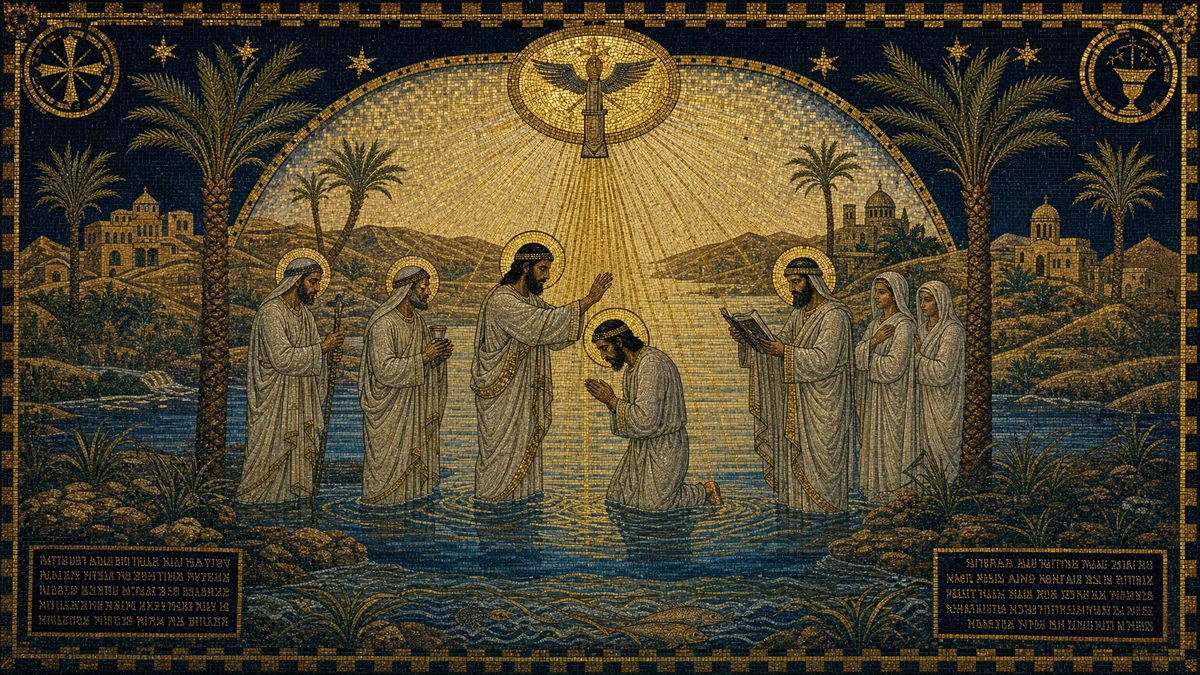
The central rite is Masbuta — baptism by full immersion. Unlike Christian baptism, Masbuta is not performed once at the start of life. Mandaeans undergo it regularly — typically on Sundays, their holy day — as a repeated act of purification and reconnection with the divine. The rite involves triple full immersion, anointing with sesame oil, and a ritual handclasp (kushta) with the officiating priest.
The second major ritual is Masiqta — the mass for the dead. Performed three days after a person's death, it is a complex ceremony designed to guide the soul safely through the Matartas on its ascent to the World of Light. A priest is required; without one, the ceremony cannot be performed.
Daily life is structured by Rishama — ablutions of the face and limbs accompanied by prayer, performed at each of the three prayer times: dawn, noon, and dusk. Together, these rituals give Mandaean life a rhythm organised entirely around purity, water, and return to the divine.
The Sacred Texts
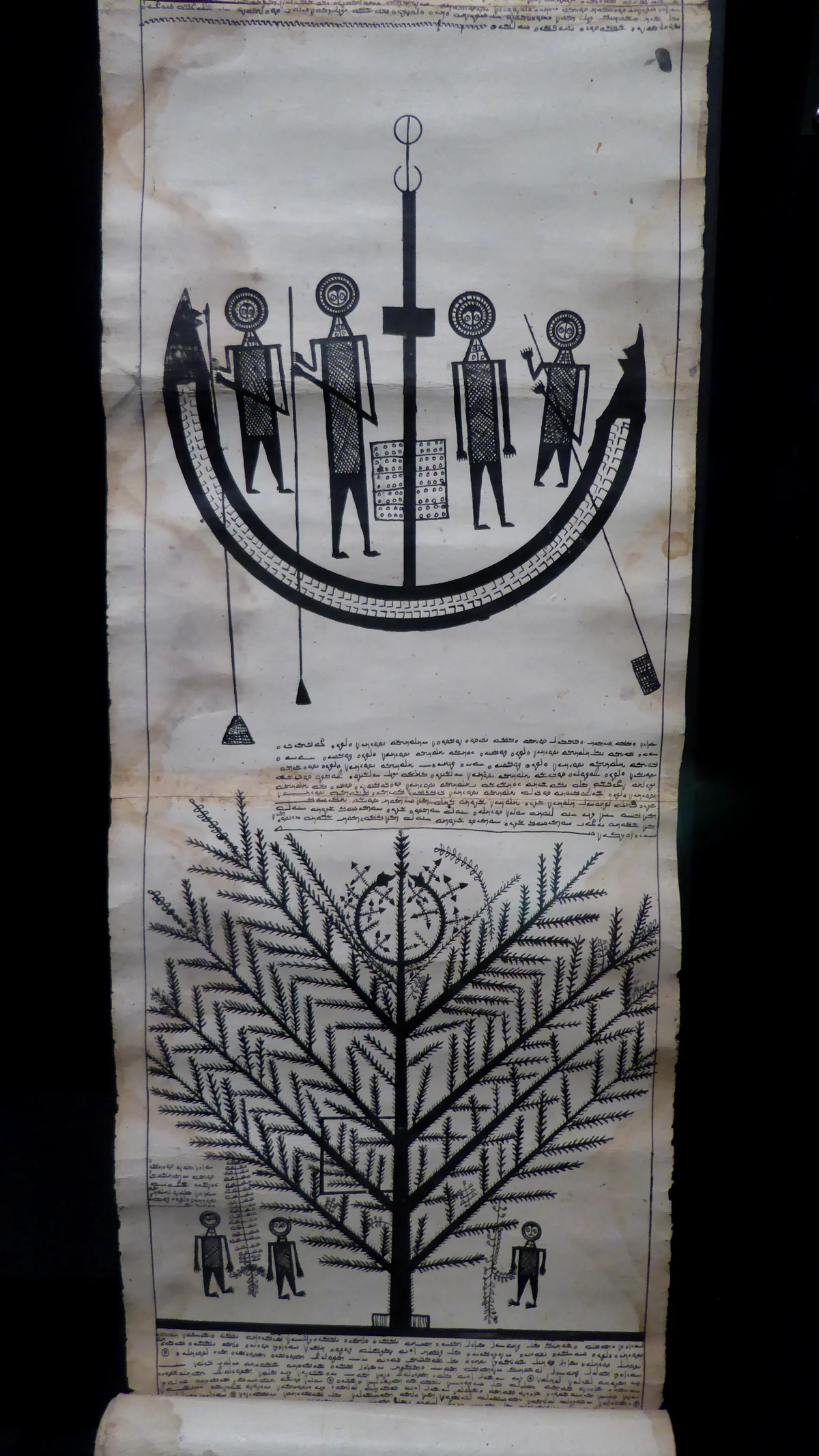
The Ginza Rabba — "The Great Treasure" — is the closest thing Mandaeism has to a Bible. It is a substantial codex divided into two parts: the Right Ginza (cosmology, theology, and the creation of the world) and the Left Ginza (hymns that accompany the soul on its ascent after death). All Mandaean scripture is written in Classical Mandaic, an Eastern Aramaic language still used liturgically by priests today.
Two other texts complete the canonical core. The Mandaean Book of John (Draša d-Yahya — "The Book of the Kings") records the teachings of John the Baptist and accounts of his life and mission. The Qulasta is the prayer book — a collection of liturgical hymns and ritual formulas used in Masbuta, Masiqta, and daily prayer. A fourth text, the Haran Gawaita, is a historical narrative recounting the Mandaean people's early migrations from Jerusalem to Mesopotamia.
| Text | Contents | Function |
|---|---|---|
| Ginza Rabba | Cosmology, theology, creation myth, soul hymns | Primary scripture |
| Mandaean Book of John | Teachings and life of John the Baptist | Prophetic teaching |
| Qulasta | Liturgical prayers and ritual formulas | Ritual use |
| Haran Gawaita | Early Mandaean history and migrations | Historical record |
Origins — Jerusalem or Mesopotamia?
Where Mandaeism began is one of the most contested questions in the study of ancient religion. Two main theories compete, and neither has achieved scholarly consensus.
The first — and the one Mandaeans themselves hold — is a Jerusalem or Jordan Valley origin. According to the Haran Gawaita, a community of John the Baptist's disciples left Jerusalem in the 1st century CE following persecution, migrated through Haran (possibly Harran in modern Turkey), and eventually settled in southern Mesopotamia. The scholar Jorunn Jacobsen Buckley has argued in favour of this account in The Mandaeans: Ancient Texts and Modern People (2002), noting that it is corroborated across multiple independent Mandaean texts. Mandaeans themselves claim their religion predates not just Christianity but Judaism and Islam.
The second theory places Mandaean origins in Mesopotamia itself. Proponents cite the Babylonian elements in Mandaean magical texts, the use of the Iranian calendar, and the distinctly Mesopotamian character of the Mandaic language. Some researchers using this framework date Mandaean development in Mesopotamia to as early as the 3rd century BCE, with influences from Babylonian, Hellenic, and Jewish traditions.
What is clear is that by the 2nd–3rd centuries CE, a fully formed Mandaean community was established along the Tigris and Euphrates — with its own scripture, priesthood, and ritual system.
How Mandaeism Outlasted Every Other Gnostic Sect
Every other Gnostic sect — Valentinian, Sethian, Manichaean — died out by the 7th century. Mandaeism survived. Understanding why requires following three phases of history.
Under the Parthian Empire (c. 250 BCE – 224 CE), Mandaeans received royal protection and flourished along the southern Mesopotamian waterways. This was the formative period of their scripture, priesthood, and ritual.
The Sasanian Empire brought crisis. When Emperor Bahram I came to the throne in 273 CE, his powerful Zoroastrian high priest Kartir launched systematic persecutions of all non-Zoroastrian communities — Christians, Buddhists, Manichaeans, and Mandaeans alike. The Mandaean community survived, but under severe pressure.
The decisive survival move came at the Muslim conquest of Mesopotamia around 640 CE. The Mandaean leader Anush bar Danqa is said to have appeared before Muslim authorities, presented the Ginza Rabba, and proclaimed John the Baptist — also named Yahya ibn Zakariya in the Quran — as their chief prophet. This identified Mandaeans as Sabians, one of the "Peoples of the Book" protected under Islamic law. Every other Gnostic group had already disappeared. Mandaeans secured their legal status — and survived.
Mandaeism is the only Gnostic tradition that survived as a living community with continuous ritual practice. All others became purely literary — known only through texts discovered centuries after their extinction.
The Modern Crisis — From 60,000 to 5,000
In 2003, roughly 60,000 Mandaeans lived in Iraq — a community that had survived two millennia of empire, persecution, and displacement. Four years later, fewer than 5,000 remained in the country.
The 2003 US-led invasion and the sectarian violence that followed devastated the Mandaean community. As a small, pacifist, non-Muslim minority with no political allies and no armed faction, Mandaeans were targeted by extremist groups. Kidnappings, murders, and forced conversion drove the vast majority to flee. Within a decade, the Iraqi Mandaean community had effectively ceased to exist as a community.
Today, the largest Mandaean diaspora communities are in Australia (particularly Sydney and Perth), Sweden (Stockholm, Gothenburg), and the United States. The global population is estimated at 50,000–70,000, but scattered across dozens of countries on four continents.
The diaspora creates a second, slower crisis: ritual survival. Masbuta requires an ordained priest and flowing natural water. Many diaspora communities have neither — no priests trained in the full liturgical tradition, and no rivers running through their suburbs. The priesthood, already weakened by a cholera epidemic in the 19th century that killed much of the clerical class, is now spread thin across a global diaspora. For a religion whose entire practice depends on water and ordained clergy, this is an existential problem that no amount of cultural preservation can fully solve.
Frequently Asked Questions
Can you convert to Mandaeism?
No. Mandaeism is an ethnic religion — membership is passed from parent to child. There is no conversion ritual and no path to membership for outsiders. A child is Mandaean only if both parents are Mandaean. This rule has protected the religion's integrity for centuries but also limits its ability to replace members lost to diaspora and assimilation.
Is Mandaeism a form of Christianity?
No. Mandaeans revere John the Baptist but consider Jesus a false prophet who distorted John's teachings. The label "Christians of Saint John," applied by European missionaries in the 17th century, is explicitly rejected by Mandaeans. Mandaeism is an independent Gnostic tradition with roots in Second Temple Judaism and Mesopotamian religion, predating Christianity in its own historical account.
Do Mandaeans still practice their religion today?
Yes — but under severe pressure. Most Mandaeans now live in diaspora following displacement caused by the Iraq War. Regular Masbuta baptisms and Masiqta ceremonies continue where priests and flowing water are available, but many communities lack both. Cultural organisations in Australia, Sweden, and the US work to preserve the tradition and train new priests.
How is Mandaeism related to other Gnostic sects?
Mandaeism shares key features with Sethian Gnosticism: a supreme transcendent God, a demiurge who creates the material world, the soul as divine exile, and knowledge (gnosis) as the path to salvation. Unlike Sethian or Valentinian Gnosticism — which died out leaving only texts — Mandaeism survived as a living community with unbroken ritual practice. It is the only Gnostic tradition that never became purely literary.
What is the Ginza Rabba?
The Ginza Rabba ("The Great Treasure") is the primary Mandaean scripture — a comprehensive codex covering cosmology, theology, the soul's journey after death, and liturgical prayers. It is divided into the Right Ginza (teachings about creation and the divine) and the Left Ginza (hymns to guide the soul after death). Written in Classical Mandaic, it is traditionally kept in wooden chests wrapped in white cloth and treated with the same reverence as a living presence.
Where do most Mandaeans live now?
Following displacement from Iraq after 2003, most Mandaeans now live in Australia (Sydney, Perth), Sweden (Stockholm, Gothenburg), the United States, Germany, and the Netherlands. Iraq — the heartland of Mandaeism for two thousand years — now has fewer than 5,000 Mandaeans. Iran retains a small community in Khuzestan province, centered around the city of Ahvaz.