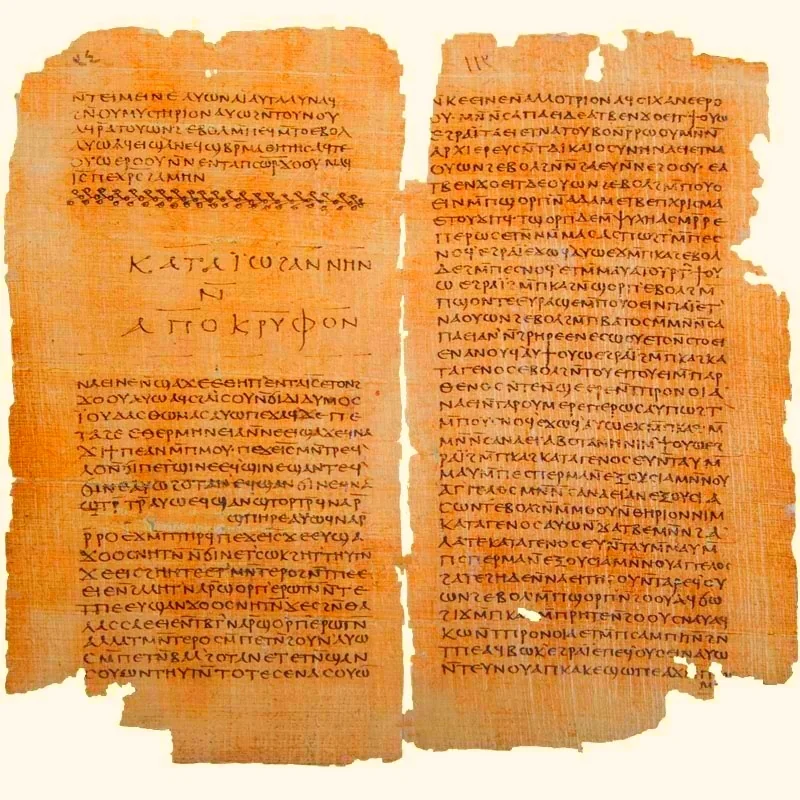
The Gospel of Philip is a Valentinian Gnostic text found in Nag Hammadi Codex II, dating from around the 3rd century CE. It is not a narrative gospel — it is a collection of sayings, meditations, and theological reflections on sacraments, spiritual transformation, and the nature of knowledge. It is best known for its description of Mary Magdalene as the companion Jesus "loved more than the disciples," and for its teaching on the Bridal Chamber as the highest Gnostic sacrament.
What Kind of Text Is It?
The Gospel of Philip is not a gospel in any conventional sense — it has no narrative, no scenes from Jesus's life, no miracles, no passion story. It is a collection of aphorisms, parables, theological meditations, and brief polemics, loosely structured around Valentinian sacramental theology. It reads more like a private reflection or a catechetical notebook than a public proclamation.
The title comes from a colophon at the end of the Coptic manuscript — Philip the Apostle is mentioned once in the text itself (at 73,8) but makes no extended appearance. The text was composed in Greek (probably in Syria) around the 3rd century CE and survives only in its Coptic translation in Nag Hammadi Codex II — the same codex that contains the Gospel of Thomas.
The Five Sacraments
The most distinctive theological contribution of the Gospel of Philip is its account of five Gnostic sacraments — presented not as outward rituals but as inner realities that correspond to degrees of spiritual transformation:
- Baptism — purification; the beginning of spiritual life
- Chrism (anointing) — higher than baptism; the text says "the anointing is superior to baptism"
- Eucharist — participation in the body of Christ understood spiritually
- Redemption — liberation from the power of the Archons
- Bridal Chamber — the highest sacrament; the Holy of Holies
The Lord did everything in a mystery, a baptism and a chrism and a eucharist and a redemption and a bridal chamber... He said on that day in the thanksgiving, "You who have joined the perfect light with the Holy Spirit, unite the angels with us also, as being the images."
The Bridal Chamber
The Bridal Chamber (nymphon) is the central mystery of the Gospel of Philip. It is called "the Holy of Holies" — the innermost sanctuary of the divine presence — and is presented as the ultimate sacrament that surpasses all others. The text is deliberately obscure about whether it involves a literal ritual or is entirely inner and spiritual. Most scholars understand it as a contemplative union of the soul with its divine counterpart in the Pleroma — the moment the fallen divine spark recognises and reunites with its unfallen angelic twin.
The Bridal Chamber is not available to ordinary Christians or "psychics" — only the pneumatics (those with an active divine spark) can enter it: "This is the Holy within the Holy. The veil at first concealed how God controlled the creation, but when the veil is rent and the things inside are revealed, this house will be left desolate."
Mary Magdalene
The Gospel of Philip contains the most discussed passage about Mary Magdalene in all Gnostic literature:
And the companion of the [Saviour is] Mary Magdalene. [But Christ loved] her more than [all] the disciples, [and used to] kiss her [often] on her [...]. The rest of [the disciples were offended] by it [...]. They said to him, "Why do you love her more than all of us?" The Saviour answered and said to them, "Why do I not love you like her?"
The word for "kiss" is clear in the Coptic; the word for where she was kissed is lost in a lacuna (hole in the manuscript). Speculation about the missing word ("mouth") has driven enormous popular interest. The scholarly consensus is that the passage describes a spiritual relationship — the "kiss" in Valentinian theology is the transmission of gnosis from mouth to mouth. Mary Magdalene's role here is as the disciple who most fully receives and embodies the secret teaching.
Key Sayings
The Gospel of Philip contains some of the most striking individual sayings in all Gnostic literature:
- "He who has knowledge of the truth is a free man, but the free man does not sin, for 'He who sins is the slave of sin.' Truth is the mother, knowledge the father."
- "You saw the Spirit, you became spirit. You saw Christ, you became Christ. You saw the Father, you shall become Father."
- "Those who say they will die first and then rise are in error. If they do not first receive the resurrection while they live, when they die they will receive nothing."
- "Jesus came to crucify the world."
Where to Read It
The full text is available free at gnosis.org/naghamm/gop.html in Wesley Isenberg's translation. The most recent scholarly translation with full apparatus is in Marvin Meyer's The Nag Hammadi Scriptures (HarperOne, 2007).
Was Mary Magdalene married to Jesus according to the Gospel of Philip?
No. The Gospel of Philip describes Mary Magdalene as Jesus's "companion" (koinonos — a word implying close spiritual partnership, not marriage) and says he kissed her often, which sparked popular speculation. In Valentinian theology, the "kiss" is a symbol of transmitting gnosis — the teacher breathes knowledge into the student. The passage describes a privileged spiritual relationship, not a romantic or marital one. The Gospel of Philip has no basis for the "married to Jesus" claim popularised by fiction like The Da Vinci Code.
Who wrote the Gospel of Philip?
Unknown. The text has no claimed author — the title "Gospel of Philip" was added by a later hand in a colophon. It is classified as Valentinian based on its theological content (the three types of people, the sacramental theology, the Bridal Chamber). It was probably composed in Greek in Syria in the 3rd century CE and survives only in its Coptic translation.