
Hermetic Gnosticism refers to the overlap between two distinct but related traditions: Hermeticism (the philosophical and mystical tradition attributed to Hermes Trismegistus, preserved in the Corpus Hermeticum) and Gnosticism (the diverse 2nd–4th century religious movement centered on gnosis and liberation from matter). Both emerged in Greco-Egyptian Alexandria in the same period, share a dualistic cosmology, and were found alongside each other in the Nag Hammadi Library. Three Hermetic texts are included in the Nag Hammadi collection, establishing a direct historical overlap.
What Is Hermeticism?
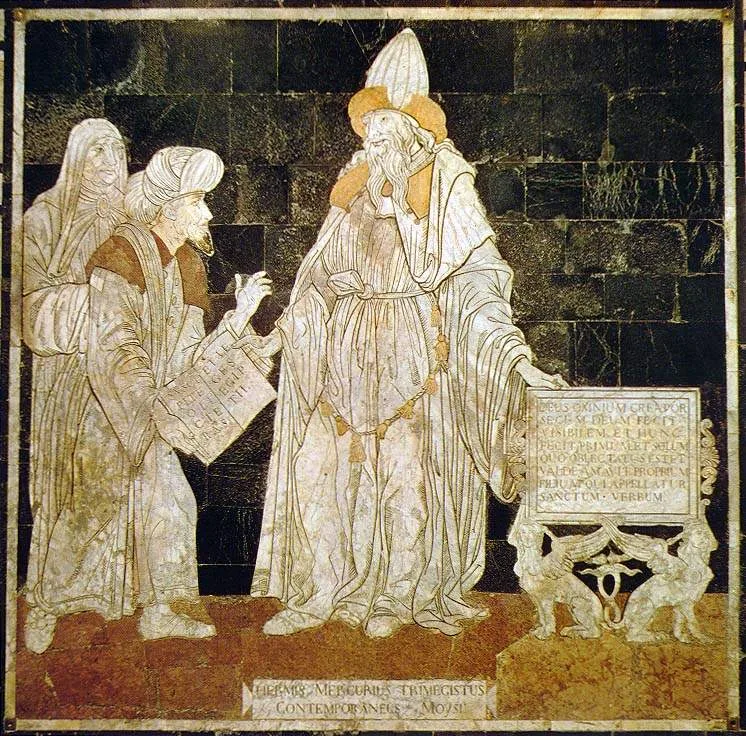
Hermeticism is a philosophical and religious tradition attributed to Hermes Trismegistus ("Thrice-Great Hermes") — a legendary syncretic figure combining the Greek god Hermes with the Egyptian god Thoth. The tradition is preserved in the Corpus Hermeticum — seventeen Greek treatises composed in Egypt roughly between 100 and 300 CE — plus the Asclepius and related texts. These writings present a mystical theology centred on the soul's ascent to God through knowledge, the correspondence between the divine and human realms ("as above, so below"), and the ultimate unity of all existence.
The name "Hermetic" comes from Hermes Trismegistus, who presents himself as an ancient sage who received divine wisdom directly. Renaissance scholars assumed these texts were ancient Egyptian wisdom older than Moses — Marsilio Ficino translated them into Latin in 1463, and they became central to Renaissance philosophy. In 1614 Isaac Casaubon demonstrated they were actually Greek compositions from the 1st–3rd centuries CE, roughly contemporary with Gnosticism and Neoplatonism.
How Hermeticism Overlaps with Gnosticism
Hermeticism and Gnosticism developed in the same milieu — Greco-Roman Egypt, c. 1st–4th centuries CE — and share several fundamental features:
- The divine spark: Both traditions teach that the human soul is a fragment of divine light trapped in matter, and that its goal is to return to its divine source.
- Dualism: Both contrast the spiritual realm (pure, good, divine) with the material realm (limited, fallen, or corrupt).
- Gnosis as salvation: In both traditions, the mechanism of liberation is direct experiential knowledge of one's divine nature — not ritual, not belief, but knowing.
- The Demiurge: Several Hermetic texts describe a craftsman-like figure who fashions the material world, closely parallel to the Gnostic Demiurge.
- Ascent of the soul: Both traditions describe the soul's post-mortem journey through the planetary spheres, shedding material influences at each level.
Hermetic Texts in the Nag Hammadi Library
The most direct evidence of overlap is in the Nag Hammadi Library itself. Three texts in the collection are Hermetic rather than Gnostic:
- Asclepius 21–29 (NHC VI,8) — a Coptic translation of a section of the Latin Asclepius, one of the core Hermetic texts
- The Discourse on the Eighth and Ninth (NHC VI,6) — describes initiation into the eighth and ninth heavenly spheres; not found elsewhere
- The Prayer of Thanksgiving (NHC VI,7) — a short liturgical prayer found also in the Greek Asclepius
Their presence in the same sealed jar as Sethian and Valentinian texts suggests the community that buried the library did not make a sharp distinction between "Gnostic" and "Hermetic" — both were expressions of the same broad tradition of esoteric knowledge.
Key Differences
Despite the overlaps, Hermeticism and Gnosticism are distinguishable traditions:
| Hermeticism | Gnosticism | |
|---|---|---|
| View of creation | Matter is lower but not evil; cosmos has beauty | Matter is evil; cosmos is a prison |
| The creator | Demiurge is subordinate but not malicious | Demiurge is ignorant or actively malicious |
| Scripture | Hermetic writings (Corpus Hermeticum) | Varied — Sethian, Valentinian, etc. |
| Salvation | Gradual ascent through knowledge and practice | Gnosis + liberation through specific cosmological knowledge |
| Jesus | Generally absent or peripheral | Central (as revealer of gnosis) |
| Attitude to world | Cosmic sympathy; astrology, alchemy | Cosmic alienation; reject matter |
Hermetic Gnosticism in the Western Tradition
After the Nag Hammadi discovery, scholars like Garth Fowden (The Egyptian Hermes, 1986) and Wouter Hanegraaff (Esotericism and the Academy, 2012) have traced the influence of Hermetic-Gnostic ideas through medieval alchemy, Renaissance Neoplatonism, Rosicrucianism, Freemasonry, and modern Western esotericism. The Hermetic-Gnostic synthesis — the idea of humanity as divine light trapped in matter, ascending through knowledge — is one of the most persistent threads in Western intellectual history.
Frequently Asked Questions
Is the Corpus Hermeticum Gnostic?
Not exactly. The Corpus Hermeticum belongs to Hermeticism — a related but distinct tradition. It shares several features with Gnosticism (divine spark, soul's ascent, gnosis) but differs in its attitude toward the material world (less hostile), its absence of Christian elements, and its cosmological framework (no Sophia narrative, no Archon myth in most texts). Three Hermetic texts appear in the Nag Hammadi Library alongside Gnostic texts, showing the overlap in practice.
What is the Emerald Tablet and is it Gnostic?
The Emerald Tablet (Tabula Smaragdina) is a short Hermetic text, probably composed in Arabic between the 6th and 8th centuries CE, containing the famous phrase "as above, so below." It is Hermetic rather than Gnostic — it describes alchemical transformation rather than the Gnostic myth of the trapped soul. It became foundational to medieval alchemy and Renaissance esotericism.