
Mani (c. 216–274 CE) was one of the most audacious figures in the history of religion — a prophet who set out to found the definitive world religion, combining the teachings of Zoroaster, the Buddha, and Jesus into a single coherent system, and then spent his life personally writing its scriptures, training its missionaries, and dispatching them across the known world. For a time, it worked. Manichaeism became one of the most widespread religions in history, stretching from Spain to China. Then the empire that sheltered him killed him, and every other empire that inherited his followers suppressed them. See our full article on Manichaeism for the complete history of the religion.
Early Life and the Elcesaites
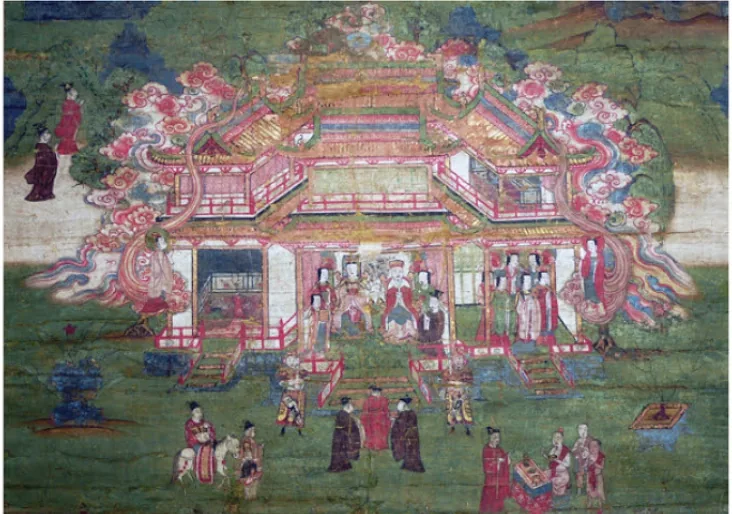
Mani was born around April 216 CE near Ctesiphon (south of modern Baghdad), in the Parthian Empire, shortly before the Sasanian dynasty seized power. His father Pātik, possibly of Parthian nobility, had joined the Elcesaites — a Jewish-Christian Gnostic baptismal sect that practiced ritual immersion and followed strict purity laws. Mani grew up in this community and was deeply shaped by its Jewish-Christian-Gnostic synthesis.
According to the Cologne Mani Codex — a miniature Greek parchment discovered in Egypt in 1969 and considered the most reliable ancient source on Mani's life — he received his first revelation at age 12 from a divine being he called his "celestial twin" or Syzygos. A second revelation came at 24, when the twin commanded him to leave the Elcesaites and begin his public mission. Both revelations are described as moments of recognition rather than information: the twin showed Mani who he already was.
The Revelations and the Universal Mission
Mani's core theological claim was that every major religion before him — Zoroastrianism, Buddhism, Christianity — had received a genuine revelation from the divine, but each revelation had been corrupted by followers who kept it local, language-bound, and incomplete. He was sent to deliver the final, universal version: a religion that would incorporate and transcend all previous ones, expressed in multiple languages, and spread by missionaries across every culture.
This was not humility but ambition of an extraordinary kind. Mani declared himself the Paraclete promised by Jesus in the Gospel of John, the final prophet in the sequence Zoroaster → Buddha → Jesus → Mani. He identified himself on his personal sealstone as "Mani, apostle of Jesus Christ" — a title that placed him simultaneously within and beyond the Christian tradition.
The Scriptures He Wrote Himself
What made Mani unique among religious founders was his decision to personally compose his own canonical scriptures — in multiple languages, during his lifetime — to prevent the distortion that he believed had corrupted earlier revelations. He wrote seven canonical works:
- Shabuhragan — cosmology and eschatology in Middle Persian, presented to Emperor Shapur I
- The Living Gospel — his primary scripture in Syriac
- The Treasure of Life — doctrine in Syriac
- The Pragmateia — theological treatise in Syriac
- The Book of Mysteries — polemical, against other religions
- The Book of Giants — an elaboration of the Enochian tradition
- The Arzhang — an illustrated picture book encoding Manichaean cosmology visually
He also invented his own alphabet — the Manichaean script — to ensure consistent copying across languages. Most originals were destroyed; fragments survive through the Turfan collection (found in China) and the Cologne Mani Codex.
At the Sasanian Court
Mani's early career benefited from the tolerance of Shapur I (r. 240–270 CE), who allowed him to travel freely across the Sasanian Empire and into India, preaching and establishing communities. The Shabuhragan was presented directly to Shapur I. For a period Mani had something approaching court patronage.
The situation reversed under Bahram I. The Zoroastrian high priest Kartir — who had survived the transition between emperors and used his influence to suppress all non-Zoroastrian religions — turned Bahram I against Mani. Around 274–277 CE, Mani was summoned before Bahram I, condemned, and imprisoned. He died in prison, either from the conditions or by execution. His followers called his death "the Passion of the Illuminator" — a deliberate echo of the crucifixion.
Legacy
The religion Mani founded outlived him by more than a millennium. Manichaean communities were established from North Africa to China, surviving under multiple empires by adapting their presentation to local contexts. The Uyghur Khaganate made Manichaeism its official state religion from 762 to 840 CE — the only time a Gnostic tradition held state power. Augustine of Hippo spent nine years as a Manichaean Hearer before his conversion to Christianity. The last known Manichaean communities in China disappeared around the 14th–17th centuries.
Was Mani a Gnostic?
Mani is usually classified as a Gnostic thinker, though Manichaeism is sometimes treated as a separate world religion rather than a Gnostic sect. His system shares defining Gnostic features: a supreme God distinct from the material creator, the soul as trapped divine light, and salvation through gnosis. What distinguished Mani was his universal missionary ambition, his founder-written canonical scriptures, and his explicit incorporation of non-Christian prophetic traditions (Zoroaster, Buddha) alongside Jesus.
What happened to Mani's writings?
Almost all were destroyed during centuries of persecution — by the Sasanian, Roman, Byzantine, Islamic, and Chinese empires, each of which suppressed Manichaeism. What survives comes from two main sources: the Turfan collection (thousands of manuscript fragments found in Xinjiang, China, by German expeditions in the early 1900s) and the Cologne Mani Codex (a tiny Greek parchment discovered in Egypt in 1969). Together they have transformed scholarly understanding of Mani's actual teachings.