The Gnostic creation myth rewrites Genesis from beginning to end. The material world was not made by God — it was made by the Demiurge, a flawed lesser being born from a mistake. The true God never touched matter. Humans carry a fragment of divine light (the divine spark) trapped inside them by the Demiurge and his Archons, and Christ came to help them remember their real origin through gnosis.
Before Genesis — The World That Existed Before Creation
The Gnostic creation myth does not begin with "In the beginning, God created." It begins long before that — in a realm where no creation had yet occurred and no flaw yet existed.
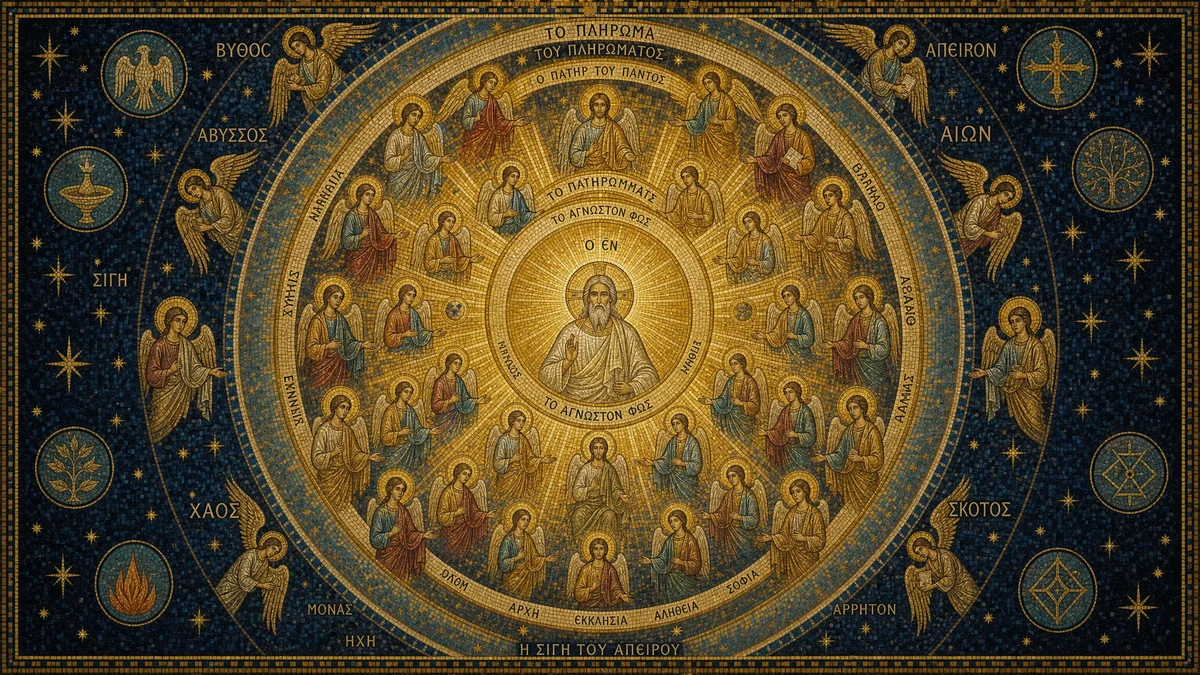
In the beginning, the Gnostics taught, there was only the Father — the true God. The Secret Book of John describes him as beyond all description: "illimitable, since there is nothing before it to limit it; unfathomable, since there is nothing before it to fathom it; invisible, since nothing has seen it." This is not the God of Genesis. This God never acts, never commands, and never creates anything deliberately. He simply is — perfect, boundless, unknowable.
Surrounding the Father was luminous spiritual water. He gazed into it, saw his reflection, and from that reflection arose Barbelo — the first divine emanation, the Mother, his female counterpart. She in turn joined with the Father to produce Christ, the Son. From Christ flowed further Aeons: Mind, Will, Word, the Four Luminaries, and their companions. The last of these companions was Sophia — Wisdom.
The Pleroma was complete, radiant, and in harmony. What broke that harmony was Sophia.
The Fall of Sophia — How the Mistake Happened
Everything that goes wrong in the Gnostic universe traces back to one moment: Sophia's act of creation without consent.
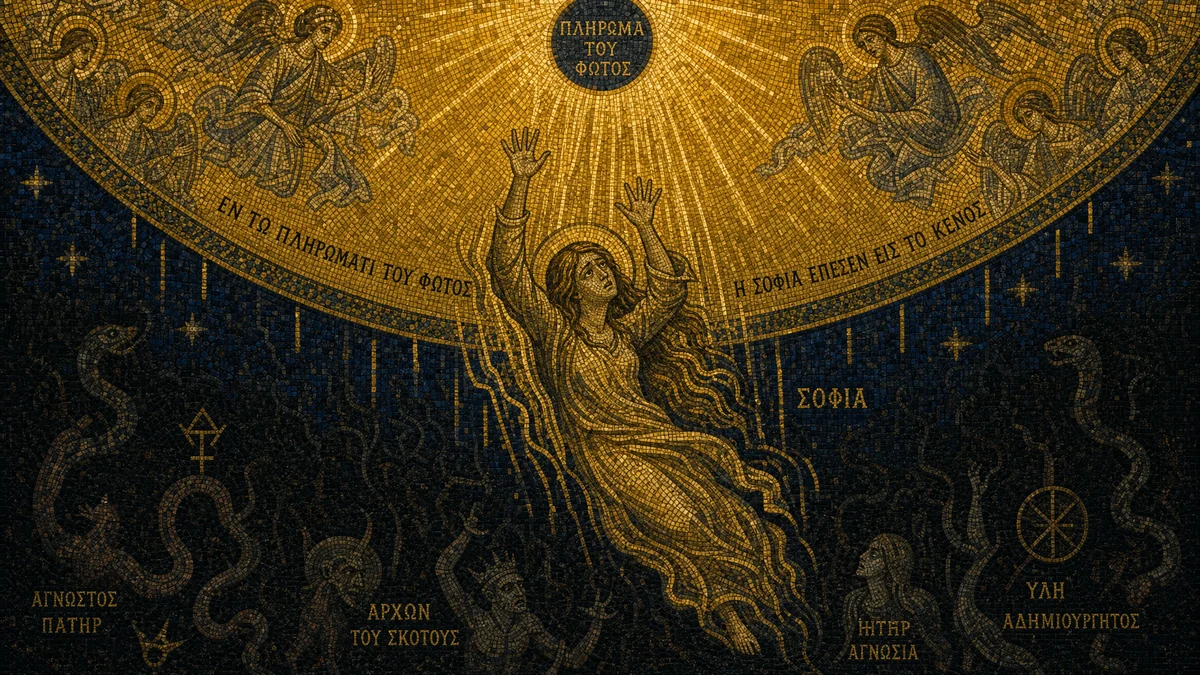
Sophia — watching the Father and Barbelo generate new beings together — felt a desire to create on her own. She didn't consult her divine partner. She didn't seek the Father's approval. She simply acted, driven by a power she didn't fully control. The being that emerged from her unilateral act was nothing like the other Aeons.
It was like a snake with a lion's head. Its eyes burned like lightning. She cast it away from her, outside of the Pleroma, so that none of the immortals would see it, because she was overcome with shame. She wrapped it in a luminous cloud and placed a throne in the middle of the cloud so that no one might see it.
Sophia named her monstrous son Yaldabaoth — probably from Aramaic meaning "child of chaos." He is also called Sakla ("fool") and Samael ("blind god"). Overcome with shame, she cast him into a void outside the Pleroma and hid him in a luminous cloud. He was alone, surrounded by nothing — with no idea that an entire divine realm existed above him.
Yaldabaoth — The God Who Didn't Know He Was Second
Alone in the void, Yaldabaoth looked around, saw nothing above him, and came to the only conclusion his limited nature allowed: he was God.
This is the most radical move in the entire Gnostic system. The Gnostics identified Yaldabaoth with the God of the Old Testament — the God who parted the Red Sea, demanded sacrifices, declared himself jealous, and commanded genocides. The flaws in that God's behavior were not distortions or misreadings of the text. They were evidence of his true nature: an ignorant, jealous, limited being who genuinely believed he was supreme.
Marvin Meyer, in his introduction to The Nag Hammadi Scriptures (2007), describes Yaldabaoth's declaration as "the defining act of his ignorance." He does not know that Sophia — his own mother — weeps above him, or that her power is still inside him, or that the true, unknowable God looks down at him with compassion rather than anger.
Building a Broken World — The Creation of Matter
Yaldabaoth did not create the material world from nothing — he copied it from a blueprint he only dimly understood.
Within him was Sophia's power — the divine energy that had accidentally flowed into him at his birth. That power carried a faint imprint of the Pleroma's structure. Using that imprint as his model, Yaldabaoth created a material world: seven heavens, twelve powers, and a physical universe meant to mirror the perfection above him. But because he was flawed, his copy came out distorted.
He then created the Archons — seven planetary rulers, one for each celestial sphere — to help him govern his creation. Together, they set about populating the material world with all the mechanisms of fate: planets, seasons, time, death, and rebirth. The universe they built was a prison, though they didn't know it. They thought it was a masterpiece.
The Creation of Humanity — A Cosmic Trick
The Gnostics had a specific answer to why human beings feel like they don't belong in this world: because they were built by beings who didn't know what they were creating.
Yaldabaoth and his Archons, gazing upward through the void, caught a glimpse of something — an image of the heavenly Adam, reflected from the Pleroma. They were transfixed. They decided to recreate that image in matter. But when they fashioned a physical body from clay, it lay on the ground lifeless. They had no idea how to give it a soul.
Then came the trick. Beings from the Pleroma — acting to recover the fragment of Sophia's power still trapped inside Yaldabaoth — appeared to him as advisors. They told him: breathe your spirit into Adam's face, and the body will come to life. Yaldabaoth did so. Sophia's power — the divine spark — flowed out of him and into Adam.
Adam rose from the ground. He was immediately wiser than his creators. The Archons, horrified at what they had produced, made him mortal to limit him, and placed him in the Garden of Eden — filling it with pleasures to distract him from his true, divine nature. They had tried to create a servant. They had accidentally created something that carried more of God inside it than they did.
Adam, Eve, and the Tree of Knowledge
In the Gnostic version of Eden, everything the conventional reading calls good is evil — and everything it calls evil is good.
The Archons extracted Adam's divine insight and placed it in a new being: Eve. This was their attempt to keep the divine spark divided and controlled. But when Adam saw Eve, he immediately recognized her as his spiritual equal — not a helper created from his rib, but the other half of the divine light that had been split.
Christ — in Sethian Gnostic texts appearing in the Garden as a divine messenger, and in Ophite traditions identified directly with the serpent — urged Adam and Eve to eat. They ate. For a moment, they remembered who they were: beings of light, children of the true God, temporarily trapped in matter. This is the Gnostic understanding of the Fall: not a descent from innocence into sin, but a first ascent from ignorance toward gnosis.
Why the Serpent Is the Hero
In at least some Gnostic traditions, the serpent in the Garden of Eden is not the villain. It is the hero.
The Ophites — a Gnostic tradition whose name derives from the Greek ophis ("serpent") — revered the serpent as the first bringer of gnosis. In their reading, the serpent's offer of the fruit was an act of liberation, not temptation. Yaldabaoth's fury after Adam and Eve ate confirmed it: the serpent had done exactly what the Archons feared most.
Gnostic exegesis of Genesis 3:22 — "Behold, the man has become like one of us, knowing good and evil" — read "us" not as God but as the Archons. Their alarm at Adam and Eve's awakening was the reaction of jailers who had just discovered their prisoner had found the key.
The Water of Forgetfulness — The Final Act of Control
Yaldabaoth could not destroy the divine spark — but he could make humanity forget it was there.
After Adam, Eve, and their enlightened son Seth achieved gnosis, Yaldabaoth acted. He forced all three to drink from what the Secret Book of John calls the "water of forgetfulness" — a divine amnesia that erased their direct knowledge of the Pleroma and their own divine origin. From that point on, human beings would be born into a state of fundamental spiritual amnesia.
This is why Christ came. Not to die for humanity's sins — but to restore the memory that the water of forgetfulness had suppressed. The Gnostic Christ is not a sacrifice. He is a reminder. His message is not "believe in me and be saved" but "you have forgotten who you are — I am here to help you remember."
Gnostic Creation vs. Genesis — A Direct Comparison
The Gnostic creation myth uses the same characters and events as Genesis — and reaches the opposite conclusion at every turn.
| Element | Genesis (Orthodox) | Gnostic Version |
|---|---|---|
| The creator god | The supreme, good God | The Demiurge — a flawed lesser being; the true God never touches matter |
| The material world | "God saw that it was good" | A degraded copy of the Pleroma, made by an ignorant being |
| Creation of humanity | God's intentional act of love | An accidental release of Sophia's divine power into clay |
| The Garden of Eden | Paradise provided by a loving God | A cage designed to keep Adam distracted from his divine nature |
| The Tree of Knowledge | Forbidden — eating it is sin | The path to gnosis — the Archons forbade it to maintain control |
| The serpent | Satan; tempter; agent of evil | A divine messenger (in some traditions, Christ); bringer of gnosis |
| The Fall | Human disobedience; descent from innocence | The first act of gnosis; a partial awakening from Archon-imposed ignorance |
| Exile from Eden | God's punishment for sin | Yaldabaoth's revenge against beings who had briefly escaped his control |
| "I am God, there is no other" | God's true identity | Proof of the Demiurge's ignorance — the true God is above and beyond him |
What Does the Myth Actually Explain?
Why did ancient people find this myth compelling? Because it answered a question orthodox Christianity struggled to answer: why is the world so obviously wrong?
The problem of evil — theodicy — asks how a good, omnipotent God can allow a world full of senseless suffering. Orthodox theology offers answers: God permits free will, suffering builds character, divine purposes transcend human understanding. The Gnostics cut through all of that with a simpler answer: the god who made this world is not good, and his creation reflects that.
More than theodicy, the myth addresses something deeper: the persistent human sense of exile. Most people, at some point, feel that this world is not home — that life is somehow more narrow, more painful, more confusing than it should be. The Gnostic myth does not pathologize that feeling. It validates it. You feel like you don't belong here because you don't. You are a being of light in a world built by someone who doesn't understand light. The gnosis you seek is not an achievement — it is a memory.
Hans Jonas, in The Gnostic Religion (1958), called this the "alien God" — the true God who is so utterly beyond this world that the world's very existence is proof of his absence from it. The Gnostic creation myth is not pessimistic. It is, in its own way, deeply hopeful: the wrongs of this world have a cause, the cause has a name, and the divine spark that can transcend it has never been extinguished.
Frequently Asked Questions
What is the Gnostic creation myth in simple terms?
The Gnostic creation myth teaches that the material world was created by a flawed, ignorant lesser god called the Demiurge — not the true God. The Demiurge came into being through a mistake made by Sophia (Wisdom), one of the divine beings in the true God's heavenly realm. He created the material world as a distorted copy of that realm, and trapped fragments of divine light inside human beings. Humans feel alienated from this world because they genuinely don't belong to it — they carry a divine spark that belongs to the realm above.
Who is Yaldabaoth?
Yaldabaoth is the Demiurge — the chief Archon and creator of the material world in Sethian Gnostic tradition. He was born from Sophia's unilateral act of creation, without the true God's involvement. His name likely means "child of chaos." He is also called Sakla ("fool") and Samael ("blind god"). The Gnostics identified him with the God of the Old Testament — his declaration "I am God and there is no other god beside me" was, for them, evidence of his ignorance rather than proof of his supremacy.
Why is the serpent a hero in some Gnostic versions?
In Ophite Gnosticism and related traditions, the serpent in the Garden of Eden is a divine messenger — in some texts identified with Christ — who offers Adam and Eve the fruit of the Tree of Knowledge as an act of liberation. Yaldabaoth had forbidden the fruit specifically because it would give Adam and Eve gnosis — knowledge of their divine origin — which would free them from his control. The serpent's offer was therefore an act of resistance against the Demiurge, not an act of evil.
What is the "water of forgetfulness"?
The water of forgetfulness appears in the Secret Book of John as the substance Yaldabaoth forced Adam, Eve, and Seth to drink after they had achieved gnosis. It erased their direct knowledge of their divine origin, plunging them — and their descendants — into the spiritual amnesia that characterizes ordinary human existence. This is the Gnostic explanation for why most people don't know who they really are. Importantly, it couldn't erase the capacity for gnosis entirely — which is why Christ's mission to restore that memory was necessary and possible.
How does the Gnostic creation myth differ from Genesis?
The Gnostic myth uses the same characters as Genesis but inverts their roles at every point. The creator God of Genesis is, in the Gnostic version, the flawed Demiurge — not the true God. The Garden of Eden is a distraction rather than a gift. The Tree of Knowledge is a liberation rather than a temptation. The serpent is a helper rather than a villain. The Fall is a partial awakening rather than a descent into sin. Where Genesis reads the story as humanity's failure, the Gnostics read it as humanity's first encounter with gnosis — and the beginning of the soul's long journey home.
Where can I read the original Gnostic creation myth?
The most complete version is the Secret Book of John (Apocryphon of John), found in the Nag Hammadi Library. It is available free online at gnosis.org and at earlychristianwritings.com. The most authoritative print translation is in Marvin Meyer's The Nag Hammadi Scriptures (HarperOne, 2007). The Reality of the Rulers (Hypostasis of the Archons) and On the Origin of the World also contain related creation accounts.