
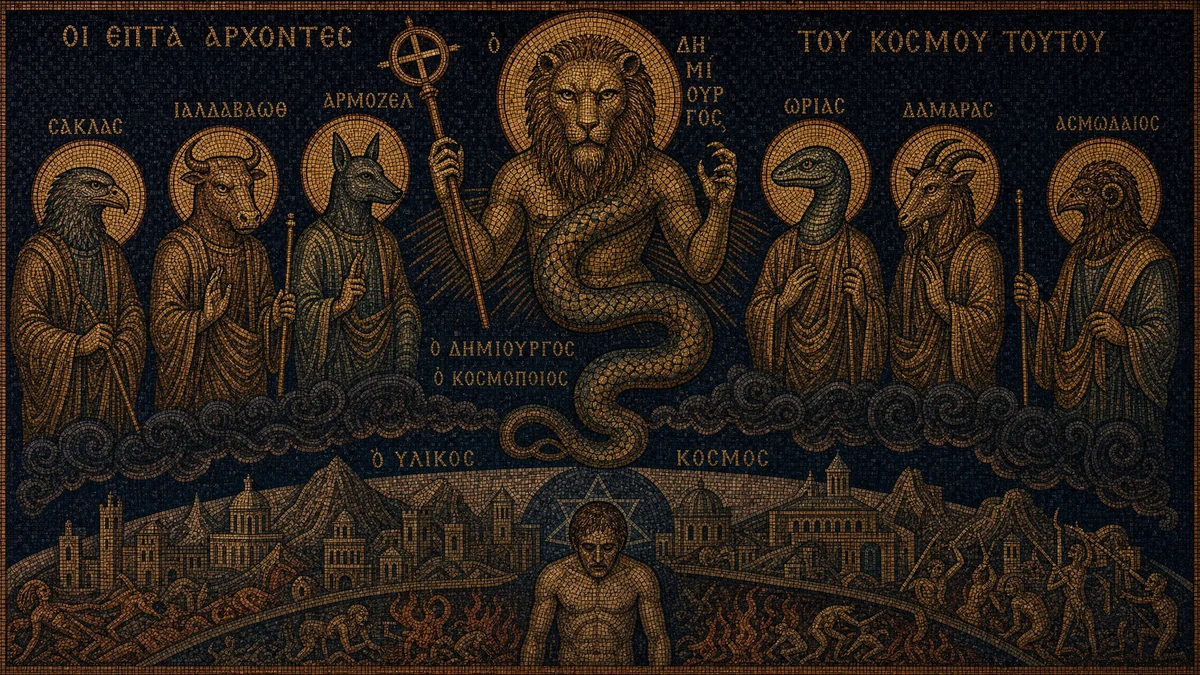
The Demiurge is the flawed lesser god who created the material world in Gnostic cosmology. He is not the true God — he is a being born from Sophia's error, ignorant of the divine realm above him. He believes he is the supreme God because he has never seen anything higher. Gnostics identified him with the God of the Old Testament and called him by three names: Yaldabaoth, Saklas ("fool"), and Samael ("blind god").
The One-Sentence Answer
The Demiurge is the being who built the world — and who had no idea what he was doing.
In Gnostic cosmology, the material universe was not created by the true God. It was created by a lesser, flawed being who came into existence through an accident in the divine realm. This being — the Demiurge — worked from a dimly understood blueprint of the perfect spiritual world above him and produced a distorted copy. He then trapped fragments of divine light inside human bodies, believing he was the supreme creator. He was not. The true God is infinitely above him and never touched matter at all.
The Word — From Plato to Gnosticism
The Gnostics didn't invent the word "demiurge" — they took it from Plato, and inverted everything Plato meant by it.
The Greek word δημιουργός (dēmiurgós) originally meant "craftsman" or "artisan" — someone who works with their hands to make things. Plato adopted it in his dialogue *Timaeus* (c. 360 BC) to describe the divine craftsman who fashioned the material universe. For Plato, the Demiurge was **benevolent**: he looked at the eternal Forms (perfect archetypes of all things) and shaped chaotic matter into the best possible copy of that perfection. Plato's Demiurge is good, wise, and does his best with imperfect raw material.
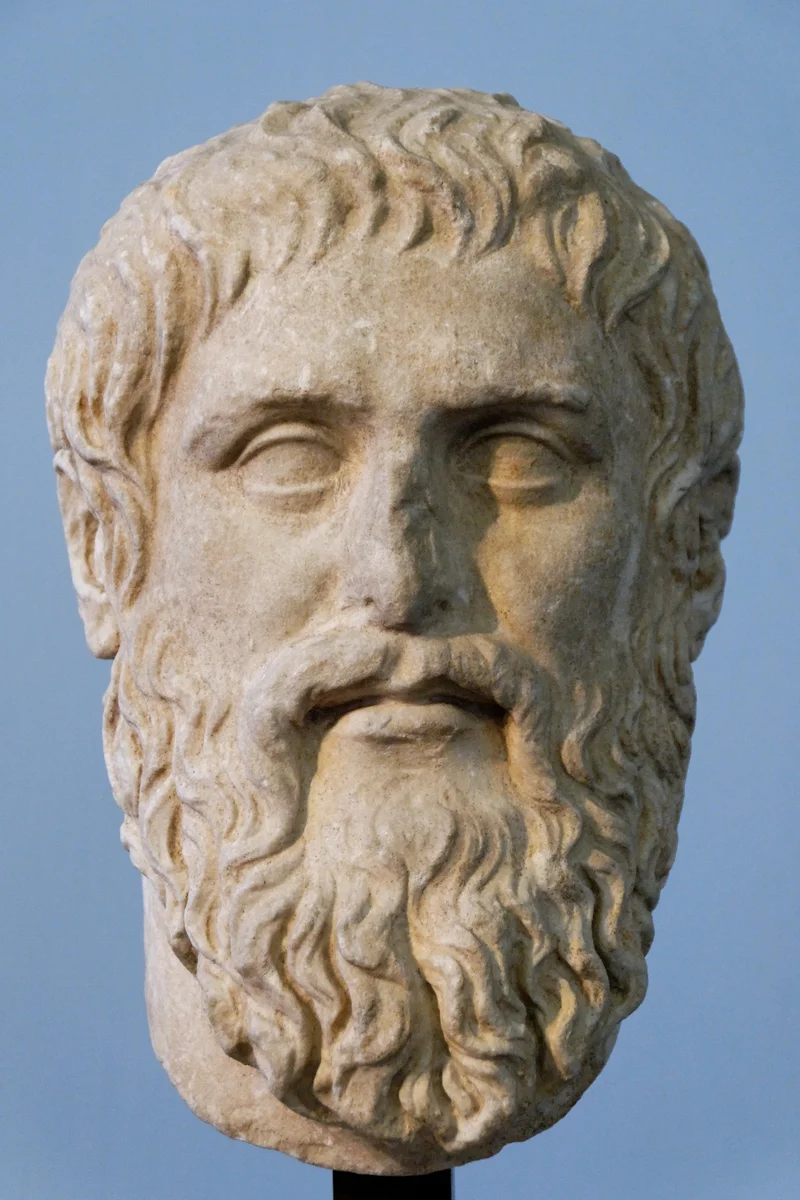
Plato (c. 360 BC): Benevolent craftsman. He shapes matter lovingly, doing his best. His creation is as good as matter allows. He is wise and serves the higher Good.
Gnostics (2nd century AD): Same word, opposite meaning. Ignorant creator. His creation is broken because he is broken. He thinks he is supreme God. He is the problem to be escaped, not the source of goodness.
David Brakke, in The Gnostics (2010, p.59), identifies this inversion as one of the defining intellectual moves of Gnosticism: "The Gnostics took Plato's Demiurge seriously — and then asked: what if the craftsman was flawed?"
His Three Names — Yaldabaoth, Saklas, Samael
The Demiurge goes by three names in the Gnostic texts — and each one is an insult.
| Name | Language | Meaning | What it implies |
|---|---|---|---|
| Yaldabaoth | Aramaic (disputed) | Probably "child of chaos" | He is the product of error — born from disorder, not from God. Gershom Scholem (1974) showed earlier etymologies were wrong. |
| Saklas | Aramaic | "Fool" | He is stupid. He doesn't understand what he is doing or where he came from. His most basic quality is ignorance. |
| Samael | Aramaic | "Blind god" or "God of the Blind" | He cannot see the divine realm above him. He declares himself the only God not from arrogance but from blindness. |
Nicola Denzey Lewis notes (*Introduction to Gnosticism*, 2013, p.137) that "Yaldabaoth" in the Gnostic text *On the Origin of the World* is fancifully translated as "Youth, move over there" — an obviously wrong rendering that illustrates how even ancient interpreters weren't sure what the name meant. The etymology "child of chaos" is the most widely accepted today, though still contested. What is certain is the intent: all three names communicate that this creator is fundamentally deficient.
What Does He Look Like?
The Gnostic texts don't leave the Demiurge as an abstraction — they describe him in precise, disturbing detail.
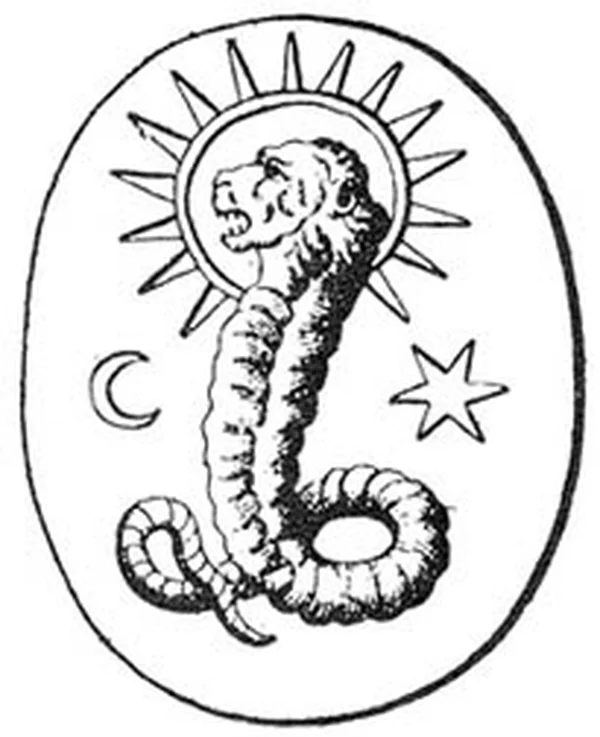
The Secret Book of John provides the most famous description: Yaldabaoth has the body of a serpent and the head of a lion, with eyes that burn like lightning. The Reality of the Rulers calls him an "arrogant beast" that resembled an aborted fetus in both appearance and character.
The lion's head is not decorative. Nicola Denzey Lewis observes that in Greek philosophy, the lion represented the irrational passions — the part of the soul that cannot be controlled by reason. Plato's tripartite soul placed the spirited, passionate element (represented by the lion) below the rational mind. By giving the Demiurge a lion's head, the Gnostics were making a philosophical statement: he is ruled by passion, not reason. He cannot control his impulses. He creates the way a hot-tempered craftsman builds — impulsively, without thinking, producing something that reflects his own disorder.
Where He Came From — Sophia's Error
The Demiurge did not create himself — he was an accident.
Sophia — the last and lowest of the divine Aeons — attempted to create a new being on her own, without her divine partner and without the true God's consent. What emerged was Yaldabaoth: hideous, powerful, and unknowing. Horrified by what she had produced, Sophia cast him into the void outside the divine realm (the Pleroma) and concealed him behind a luminous cloud.
The crucial detail is what Sophia left inside him: a fragment of her own divine power. That fragment of light — accidentally transferred from Sophia to Yaldabaoth at his creation — is what the Demiurge will later breathe into Adam, producing the divine spark in human beings. The Demiurge is not only the source of the problem; he is, unknowingly, the vehicle through which divine light enters the material world.
For the full story of Sophia's fall and what preceded the Demiurge's creation, see The Gnostic Creation Myth.
What He Did — Building a Broken World
Once alone in the void, the Demiurge got to work.
He created the Archons — seven planetary rulers, each governing one celestial sphere. Then, using the fragment of the Pleroma's structure that he dimly carried within himself through Sophia's power, he created the material universe — a distorted copy of the divine original. Finally, he and the Archons created Adam: a human body designed to trap the divine sparks that had leaked from the Pleroma into the material world.
I am God and there is no other God beside me — for he is ignorant of his strength, the place from which he had come.
David Brakke (*The Gnostics*, 2010, p.64) identifies the Old Testament passages that the Gnostics read as evidence of the Demiurge's limited knowledge and violent temperament: "The god of Genesis walks in an earthly garden and must ask where Adam is (Genesis 3:8-9); he concludes that his creation of humanity and animals was a mistake and decides to destroy all people, except for a single family and a few beasts (6:5-22); and he later annihilates entire cities by raining sulfur and fire down upon them (19:24-25)." The Gnostics, Brakke concludes, "took Genesis at its word" — and concluded that this god was passionate, limited, and inferior.
Is He Evil or Just Ignorant?
Not all Gnostics agreed on whether the Demiurge was malicious or merely incompetent — and the difference matters theologically.
Sethian Gnosticism: The Demiurge is oppressive and malicious. He intentionally traps divine sparks in matter, actively opposes Christ's mission, and rules through the Archons with deliberate cruelty. Yaldabaoth is the enemy.
Valentinian Gnosticism: The Demiurge is well-meaning but limited. He doesn't understand what he is doing. His creation, despite his ignorance, almost accidentally becomes good — shaped by divine influences he cannot perceive. He is pitiable, not hateful.
Marcion: A third position entirely. Marcion's Demiurge is the "just" God (díkaios) — fair by his own standards, a god of law and retribution, not malicious but not the highest God. Above him is the "good" God (agathós) — the God of love revealed by Christ. Marcion does not call the Demiurge evil; he calls him lower.
The Valentinian position is particularly striking: in some Valentinian accounts, the Demiurge's creation is described as "almost perfect" despite his ignorance — because divine light leaked into it through Sophia's power. He built better than he knew, without understanding why.
The Demiurge and the God of the Bible
When Gnostics identified the Demiurge with the God of Genesis, they were not being careless — they were being literal.
Simone Pétrement, in A Separate God (1990, p.46), describes the Gnostic project as "attempting to limit the value of the Old Testament within a religion that nevertheless preserves it." The Gnostics did not reject the Hebrew scriptures — they reread them. Everything the Old Testament described was accurate. The God walking in the Garden of Eden and asking "Where are you, Adam?" was not using a figure of speech — he genuinely did not know where Adam was. The flood, the fire and brimstone, the jealousy ("I am a jealous God") — all of it was evidence of a being with limited power, passionate temperament, and no knowledge of the true God above him.
What Happens to Him in the End?
Most discussions of the Demiurge focus on his creation of the world — but the Gnostic texts also describe what happens to him at the end of all things.
The Apocryphon of John is direct: at the consummation of the ages, all light will return to the Pleroma. "But Yaldabaoth, the demiurge, with the material world, will be cast into the lower depths." He does not achieve redemption. He is destroyed with the world he made.
The Pistis Sophia presents a different picture — one that implies his fate has already begun. In that text, Yaldabaoth has "sunk from his high estate and resides in Chaos, where, with his forty-nine demons, he tortures wicked souls in boiling rivers of pitch." He has become one of the punishers rather than the rulers — already fallen, already diminished.
Frequently Asked Questions
What is the Demiurge in simple terms?
The Demiurge is the being who created the physical world in Gnostic cosmology. He is not the true, supreme God — he is a lesser being who came into existence through an accident and who believes he is the only God because he has never seen anything above him. He built the material universe out of ignorance, trapping fragments of divine light inside human beings in the process. His three names in the texts — Yaldabaoth, Saklas, and Samael — all mean some form of "fool" or "blind god."
Is the Demiurge the same as Satan?
Not exactly, though they overlap in some Gnostic systems. The Demiurge is the creator of the material world — a role Satan does not have in Christian theology. In some Gnostic traditions (particularly Sethian), the Demiurge and Satan are distinct: the Demiurge rules from the heavens, Satan from the lower world. In Valentinian theology, the Devil is a separate being made by the Demiurge himself from "appropriate substance." Marcion kept the Demiurge as a creator-god while understanding Satan as a separate principle of evil. The relationship varies significantly across traditions.
Why does the Demiurge have a lion's head?
In Greek philosophy, the lion represented the irrational passions — the part of the soul that acts without reason. Plato's tripartite soul placed the passionate element (thumos) below the rational mind. By giving the Demiurge a lion's head, Gnostic writers were making a philosophical statement: he is governed by passion rather than wisdom. He creates impulsively, the way an angry craftsman builds — without reflection, producing something that reflects his own disorder. The serpent body adds associations with chaos and primal forces.
Is the Demiurge evil or just ignorant?
It depends on the Gnostic tradition. Sethian Gnosticism portrays the Demiurge as oppressive and malicious — he deliberately traps souls and actively opposes liberation. Valentinian Gnosticism portrays him as well-meaning but limited — his creation almost accidentally becomes good due to divine influences he cannot perceive. Marcion held a third view: the Demiurge is the "just" God, fair by his own standards but not the highest God. Most modern discussions oversimplify this — the Gnostic traditions held genuinely different views on the Demiurge's moral status.
Which Gnostic texts describe the Demiurge?
The most detailed descriptions are in the Secret Book of John (Apocryphon of John), which describes his creation by Sophia and his physical appearance. The Reality of the Rulers (Hypostasis of the Archons) depicts him as an "arrogant beast" and shows his behavior in the Garden of Eden. The Pistis Sophia shows his later degraded state in Chaos. The Gospel of Judas names him "Nebro" (rebel) and gives him a different role. On the Origin of the World provides a detailed account of his creation of the material world and the Archons.
Is the Demiurge idea in mainstream philosophy?
Yes — the word and concept originate in Plato's Timaeus (c. 360 BC), where the Demiurge is a benevolent divine craftsman who shapes matter into the best possible copy of the eternal Forms. The Neoplatonists (Plotinus and his school, 3rd century AD) further developed the concept, identifying the Demiurge with the divine Nous (Mind), the second principle after the One. The Gnostic version was an explicit inversion of the Platonic original — taking the same role and filling it with an ignorant, flawed being rather than a wise and good one.