
Valentinianism was the most widespread and intellectually sophisticated Gnostic school of the 2nd–4th centuries CE, founded by Valentinus (c. 100–165 CE) and continued by his disciples across the Roman Empire. It taught a complex theology centred on the Pleroma (divine fullness of 30 Aeons), the fall of Sophia, and a three-tier division of humanity into pneumatics, psychics, and hylics. The Valentinians generated more Nag Hammadi texts than any other single Gnostic tradition.
Origins and Valentinus
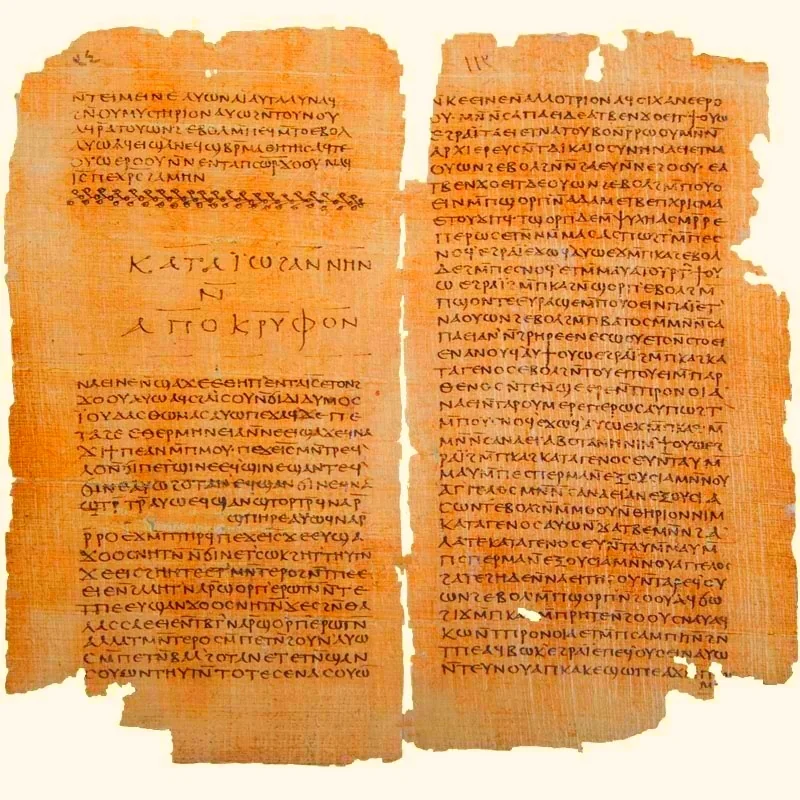
Valentinianism takes its name from Valentinus (c. 100–165 CE) — an Alexandrian-educated theologian who taught in Rome for roughly two decades and developed the most intellectually sophisticated Gnostic system of the 2nd century. Unlike simpler Gnostic dualism (good God vs evil Demiurge), Valentinus constructed a nuanced monistic system in which the entire cosmos — including matter — was a manifestation of the divine, however distorted. Tertullian called it "the most plausible of heresies."
Valentinus was never formally declared a heretic during his lifetime — he was a prominent member of the Roman Christian community and may have been a candidate for bishop. It was only after his death, when his school had grown significantly, that Irenaeus wrote five books of Against Heresies (c. 180 CE) specifically targeting Valentinianism.
The Pleroma — Thirty Aeons in Fifteen Pairs
The defining feature of Valentinian theology is the Pleroma — the divine fullness, a realm containing 30 Aeons (divine emanations) arranged in 15 sexually complementary pairs (syzygies). The Aeons emanate from an unknowable first principle called Bythos ("Depth" or "Abyss") together with his consort Sige ("Silence"). They are arranged in groups: the first Ogdoad (8), then a Decad (10), then a Dodecad (12) — totalling 30.
The Valentinian Aeons are not abstract principles but almost personal beings, each embodying a divine attribute: Nous (Mind), Aletheia (Truth), Logos (Word), Zoe (Life), Anthropos (Human), Ecclesia (Church), and so on through 30 names. This Pleroma is the true divine realm — infinite, luminous, complete. The material world exists because one Aeon — Sophia ("Wisdom"), the youngest — overstepped her boundaries by trying to know Bythos directly, without her consort. Her passion produced an abortion outside the Pleroma: the Demiurge, who created the material world.
Three Types of People
Valentinianism distinguishes three types of human being, defined by their essential nature:
| Type | Greek term | Nature | Destiny |
|---|---|---|---|
| Spiritual | Pneumatics | Possess an active divine spark from the Pleroma | Return to the Pleroma through gnosis |
| Soul-people | Psychics | Have souls capable of development; ordinary Christians | Lesser salvation in a middle realm |
| Material | Hylics | Fully dominated by matter; no divine spark | Perish with the material world |
The classification is ontological, not moral — it describes what one is, not what one does. This made Valentinianism simultaneously elitist (not everyone can be saved equally) and compassionate (the Demiurge is ignorant rather than evil, and even psychics can achieve some salvation). Valentinus distinguished himself from harsher Gnostic systems in this way.
The Valentinian Schools
After Valentinus's death, his movement split into Eastern and Western branches, with significant theological differences:
- Western (Italian) school: Ptolemy, Heracleon, Florinus. More focused on ethics, exegesis, and community practice. Ptolemy wrote the famous "Letter to Flora" explaining Valentinian interpretation of the Mosaic Law. Heracleon wrote the first known biblical commentary on the Gospel of John.
- Eastern school: Theodotus (quoted by Clement of Alexandria), Axionicus of Antioch. More speculative, emphasising the cosmic drama of the Pleroma. Held that Jesus had a "psychic" body rather than a purely spiritual one — a significant theological distinction.
- Marcosians: Followers of Marcus, who developed elaborate numerological mysticism and ritual practices. Irenaeus treated them with particular hostility.
Valentinian Texts in the Nag Hammadi Library
More Nag Hammadi texts reflect Valentinian theology than any other single Gnostic tradition:
- Gospel of Truth (Codex I) — attributed to Valentinus himself
- Gospel of Philip (Codex II) — sacramental theology, Bridal Chamber
- Tripartite Tractate (Codex I) — comprehensive systematic Valentinian theology
- Treatise on Resurrection (Codex I) — on spiritual resurrection now rather than bodily resurrection later
- A Valentinian Exposition (Codex XI) — liturgical and theological texts
Decline
Valentinianism declined rapidly after Emperor Theodosius I issued the Edict of Thessalonica in 380 CE, establishing Nicene Christianity as the state religion of the Roman Empire. Legal toleration of alternatives ended, and the institutional and legal pressure that had already been building through anti-heretical legislation became decisive. Valentinian communities are last documented in the early 5th century. Their texts survived only underground — literally, in the jar buried at Nag Hammadi.
What is the difference between Valentinianism and Sethian Gnosticism?
Sethian Gnosticism is older, more mythological, and centres on Seth (son of Adam) as a divine saviour figure. Its cosmology is darker: the Demiurge Yaldabaoth is actively malicious, and Archons deliberately trap souls. Valentinianism is more philosophical and Christian-influenced: the Demiurge is ignorant but not evil, Sophia's fall is a cosmic mistake rather than a conspiracy, and the system is more monistic (everything ultimately derives from the one divine source). Valentinians also had a more developed sacramental practice and a stronger church-like organisation.
Is the Gospel of Philip Valentinian?
Yes. The Gospel of Philip is classified as Valentinian based on its theological content — the three types of people (pneumatics, psychics, hylics), the Bridal Chamber as the highest sacrament, and its treatment of the sacraments as spiritual realities rather than material rituals. It is the richest Valentinian text for understanding community practice and sacramental theology.