
The Pleroma is the divine realm of fullness — the totality of true divine reality. The Aeons are the divine beings who inhabit it, emanating outward from the Father like light from a source. Together they form the complete architecture of the Gnostic divine world, from which the material cosmos is a deficient and unintended echo.
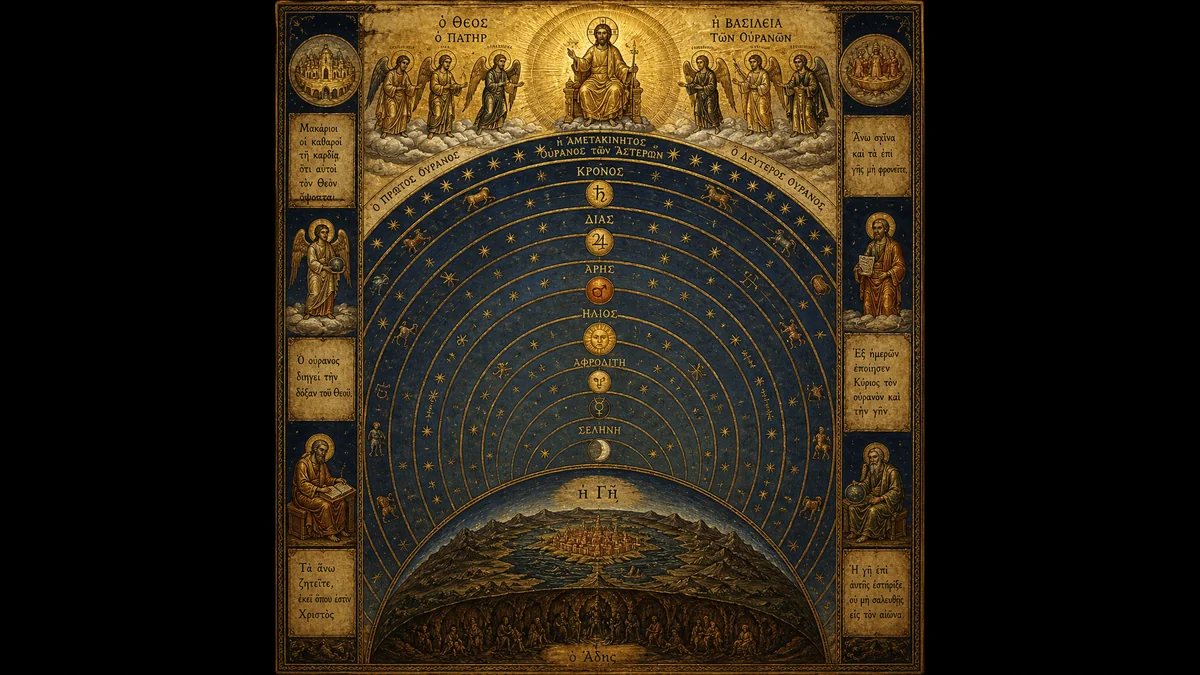
Two words appear constantly in Gnostic texts and stop modern readers cold: Pleroma and Aeon. They sound technical, esoteric, invented. They were none of these things to their original audience. Understanding what they meant — precisely — unlocks the entire architecture of Gnostic thought.
Two Words That Sound Strange but Weren't
Before explaining what the Pleroma and the Aeons are, it helps to know that neither word was strange to its original audience.
Pleroma (πλήρωμα) is not Gnostic jargon — it is standard Greek, meaning "fullness" or "that which fills." It appears seventeen times in the New Testament, including passages that became central to orthodox Christology:
Colossians 1:19 — "For in him all the fullness (pleroma) of God was pleased to dwell"
Colossians 2:9 — "For in him the whole fullness (pleroma) of deity dwells bodily"
Ephesians 1:23 — the Church as "the fullness (pleroma) of him who fills all in all"
Ephesians 3:19 — "that you may be filled with all the fullness (pleroma) of God"
The Gnostics did not invent the word — they developed a meaning already present in texts both they and the proto-orthodox church considered sacred.
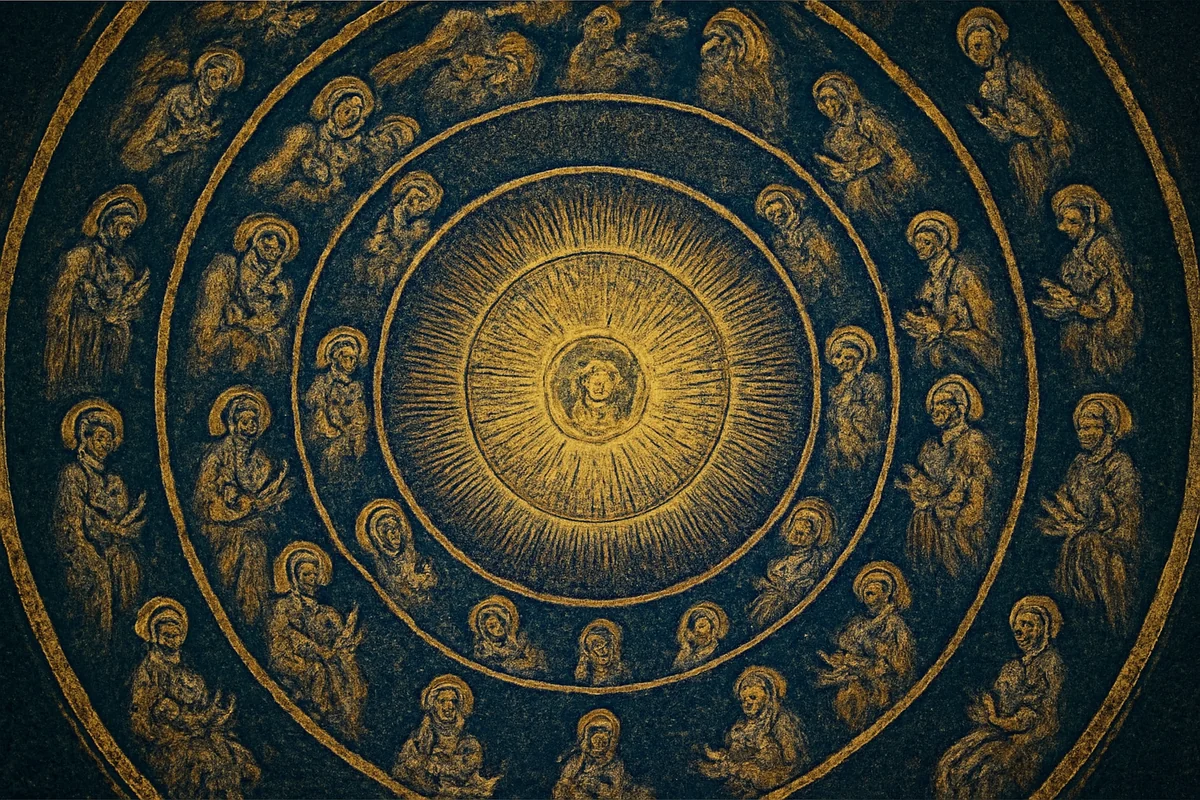
Aeon (αἰών) was equally familiar. In ordinary Greek it meant a long stretch of time, an age, an era — the source of the English word "eon." In Jewish and early Christian usage it also referred to divine beings or spiritual realms. The Gnostics used it for the divine inhabitants of the Pleroma. To a 2nd-century Greek-speaking reader in Alexandria, this was no more exotic than a modern Christian speaking of "the Holy Spirit" or "heavenly hosts."
Nicola Denzey Lewis, in Introduction to "Gnosticism" (2013), makes the point clearly: "Gnostic terminology, for all its apparent strangeness to us, was drawn from the same cultural vocabulary as mainstream early Christianity. The difference was not the words — it was what the Gnostics built with them."
The Pleroma — What It Is and What It Isn't
The Pleroma is not heaven in the sense of a place you go after death — it is the totality of what truly exists.
The contrast with the Kenoma is the key to understanding the Pleroma. The material world is not a second, independent realm that happens to be inferior — it is the privation of Pleroma fullness. Where the Pleroma is, matter is not. Where the Pleroma is absent, matter accumulates. The Kenoma is not so much a place as a condition: the condition of being without the Pleroma.
The Gospel of Truth — a Valentinian homily from the Nag Hammadi Library — expresses this through the language of deficiency and restoration:
Thus fullness, which has no deficiency but fills up deficiency, is provided to fill a person's need, so that the person may receive grace. While deficient, the person had no grace, and because of this a diminishing took place where there was no grace. When the diminished part was restored, the person in need was revealed as fullness.
Salvation, in this framework, is not escape to a distant reward. It is the restoration of fullness — the filling of what had been emptied. The Pleroma is not somewhere you arrive; it is something you recover.
How the Aeons Came to Be — Emanation, Not Creation
The Aeons did not come into being because the Father decided to create them — they came into being because he could not help it.
This is the defining distinction between Gnostic theology and Genesis-style creation. The God of Genesis speaks the world into existence by will: "Let there be light." The Gnostic Father does nothing of the kind. The Aeons overflow from his infinite being — the way heat radiates from fire, or light radiates from the sun, without the fire or sun choosing to radiate.
The Gnostic texts give two accounts of how this overflow occurred. In the Sethian account (most clearly in the Secret Book of John), the Father gazes into the primordial waters and sees his own reflection — that reflection becomes Barbelo, the first Aeon, who then produces further emanations. In other accounts, the Father's infinite thought overflows and crystallises into distinct entities, each one a specific aspect of his being made semi-independent.
David Brakke, in The Gnostics (2010), describes the Aeons as "extensions of particular parts of his being who could nevertheless think and act independently — like different fingers on the same hand, or different peaks on the same mountain." They are not separate gods. They are God's own infinite being, differentiated.
The Structure of the Pleroma — The Aeons in Detail
The Valentinian school, founded by Valentinus in Rome around 136 AD, gave the most systematic account of the Pleroma's population — thirty Aeons arranged in four precise groups.
The thirty Valentinian Aeons, as reconstructed from Irenaeus's account in Against Heresies I.1 and corroborated by Nag Hammadi texts:
| Group | Count | Syzygy pairs (masc. / fem.) | Meaning |
|---|---|---|---|
| Tetrad (root) | 4 | Bythos / Sige · Nous / Aletheia | Depth / Silence · Mind / Truth |
| Ogdoad | 8 | Logos / Zoe · Anthropos / Ekklesia · + Tetrad | Word / Life · Human / Church |
| Decad | 10 | Bythios / Mixis · Ageratos / Henosis · Autophyes / Hedone · Akinetos / Synkrasis · Monogenes / Makaria | Abyssal / Mixture · Ageless / Union · Self-grown / Pleasure · Immovable / Blending · Only-begotten / Blessedness |
| Dodecad | 12 | Parakletos / Pistis · Patrikos / Elpis · Metrikos / Agape · Aeinous / Synesis · Ekklesiastikos / Makariotes · Theletos / Sophia | Comforter / Faith · Paternal / Hope · Maternal / Love · Ever-minded / Understanding · Ecclesiastical / Blessedness · Desired / Wisdom |
Sophia — "Wisdom" — occupies the final position in the Dodecad: the 30th Aeon, the outermost, the furthest from the Father's centre. Her name means wisdom, but she is the one who acts without wisdom. This structural irony is deliberate.
Sophia — The Aeon Who Fell
Sophia is both the last Aeon of the Pleroma and the one whose action shattered it — at least temporarily.
As the youngest and outermost Aeon, Sophia occupied the position of maximum distance from the Father. In Valentinian cosmology, this positional distance correlated with greater autonomy and, inevitably, greater capacity for error. She desired to know the Father directly — without her consort, without permission. That autonomous desire produced a being that should not have existed: formless, ignorant, defective. The Demiurge.
For the full account, see Sophia — Wisdom, the Fall & the Divine Feminine and The Gnostic Creation Myth.
The Pleroma's Response — How the Divine Realm Reacts
The Pleroma is not passive. The moment Sophia's fall produced the Demiurge, the divine realm responded — and that response is the origin of salvation.
In Valentinian cosmology, Christ and the Holy Spirit are sent into the Pleroma first, to stabilise the remaining Aeons. Sophia's autonomous act had introduced instability — a desire to reach beyond one's proper scope — that could, in principle, have spread. Christ gives the Aeons form; the Holy Spirit gives them knowledge of the Father. The Pleroma is sealed and restored.
Then a second divine figure — Jesus, the "common fruit of the Pleroma" — is produced by all thirty Aeons together and sent as an emissary to redeem Sophia's lower aspect (Achamoth, her projection outside the Pleroma) and impart gnosis to the pneumatic human beings who carry the scattered divine sparks.
The Pleroma as Inner State — Not Just Cosmology
The Pleroma is not merely a cosmological realm above the material world — it is also a state of being available to the pneumatic human being in this life.
The Gospel of Philip makes this explicit with a statement that collapses the external and internal dimensions of the Pleroma into one:
What is innermost in a person is the Fullness (Pleroma), and there is nothing further within. And this is what they call uppermost.
The innermost is the uppermost. The deepest interior of the self and the highest point of the cosmos are the same place. This is not metaphor — it is the Gnostic theological claim that the divine spark within the pneumatic is literally a fragment of the Pleroma, making the Pleroma accessible from within.
The Secret Book of James has Christ urge his disciples: "Be filled and leave no space within you empty, for the coming one can fill what is lacking in you." And the Prayer of the Apostle Paul — the shortest text in the Nag Hammadi Library — ends with the words addressed to Christ: "You are my fullness." Not "you give me fullness." You are it.
This inner dimension of the Pleroma is what distinguishes gnosis from mere intellectual knowledge about it. To know the Pleroma cosmologically is theology. To experience the Pleroma within is gnosis — the direct encounter with divine fullness that the material world was designed to prevent.
Sethian vs. Valentinian — Two Maps of the Same Territory
Both major Gnostic traditions map the Pleroma differently — but the underlying structure is the same.
| Feature | Valentinian | Sethian |
|---|---|---|
| Root principle | Bythos (Depth) + Sige (Silence) as first syzygy | The Father/Monad alone — invisible, perfect, unbounded |
| First emanation | Nous (Mind) from Bythos | Barbelo — the Father's first thought/reflection |
| Aeon count | 30 — precisely named in four groups | Variable — Secret Book of John names ~12 major Aeons |
| Sophia's lower aspect | Achamoth — Sophia's projection outside Pleroma; becomes world-soul | Sophia herself falls and is eventually restored; no Achamoth distinction |
| Key texts | Gospel of Truth, Gospel of Philip, Tripartite Tractate | Secret Book of John, Three Steles of Seth, Gospel of the Egyptians |
The Valentinian approach is more philosophical — the 30-Aeon structure maps onto Pythagorean number symbolism and Platonic categories. The Sethian approach is more mythological — the Aeons are characters in a drama rather than structural nodes in a cosmic diagram. Both are responses to the same underlying question: how does a perfect, infinite God relate to an imperfect, finite world?
Frequently Asked Questions
What is the Pleroma in simple terms?
The Pleroma is the Gnostic name for the divine realm — the totality of true divine reality. The word means "fullness" in Greek, describing a realm completely full of divine light, being, and truth, with no deficiency or absence. It contains the true God and all the divine beings (Aeons) who emanate from him. It is contrasted with the Kenoma (emptiness) — the material world, defined by its lack of Pleroma fullness. The Gnostic texts also describe the Pleroma as an inner state: the divine spark within the pneumatic human being is a fragment of the Pleroma, making it accessible from within as well as above.
How many Aeons are in the Pleroma?
It depends on the Gnostic tradition. The Valentinian school described 30 Aeons in four groups: a root Tetrad (4), Ogdoad (8), Decad (10), and Dodecad (12). Each group consists of male-female pairs called syzygies. The Sethian tradition, as found in the Secret Book of John, describes a variable number — typically a core triad of Father, Barbelo, and Christ, followed by additional Aeons. Some Basilidean texts describe 365 Aeons, one for each day of the year. The number varies because different Gnostic schools developed the cosmology in different directions — the underlying structure (Father radiating outward through successive emanations) is consistent even when the count is not.
What is a syzygy in Gnostic cosmology?
A syzygy (from Greek σύζυγος, "yoke" or "pair") is a male-female pair of Aeons in the Pleroma. The Aeons emanate in complementary pairs — one member with a grammatically masculine name (e.g., Logos, Word), the other with a grammatically feminine name (e.g., Zoe, Life). This pairing represents complementary aspects of divine reality rather than biological sex. Sophia's fall in Valentinian cosmology is partly explained by her acting without her consort — breaking the syzygy principle and thereby introducing instability into the Pleroma.
Is the Pleroma the same as heaven?
They overlap but are not identical. Christian heaven is primarily an eschatological concept — a place or state entered after death as a reward for faithful living. The Gnostic Pleroma is an ontological concept — the realm of true being, which exists regardless of human fate and which is accessible, in principle, in this life through gnosis. The Pleroma is not reached by dying righteously; it is reached by the divine spark recognising its own origin. The Gnostic texts also describe the Pleroma as an inner state available now, not only after death — making it less like a destination and more like a dimension of reality that can be perceived or forgotten.
What is the difference between the Pleroma and the Kenoma?
The Pleroma (fullness) and Kenoma (emptiness/deficiency) are the two fundamental realms of Gnostic cosmology. The Pleroma is the divine realm — the totality of true being, light, and reality. The Kenoma is the material realm — not an independent second realm, but the absence of Pleroma fullness made concrete. The Kenoma came into existence as a consequence of Sophia's fall: when the Demiurge was expelled from the Pleroma, the space he occupied and subsequently shaped became the Kenoma. Everything in the material world — matter, sensation, time, suffering — belongs to the Kenoma. The divine spark within pneumatic human beings is a Pleroma fragment that does not belong there.