
The Gospel of Judas is a 2nd-century Gnostic text in which Judas Iscariot is not a traitor — he is Jesus's most enlightened disciple, the only one who recognises Christ's true divine origin. Jesus takes Judas aside and teaches him secret cosmological knowledge unavailable to the other apostles, then asks him to perform the necessary act of "sacrificing the man that clothes me" — handing Christ over so his divine spirit can be liberated from its physical shell.
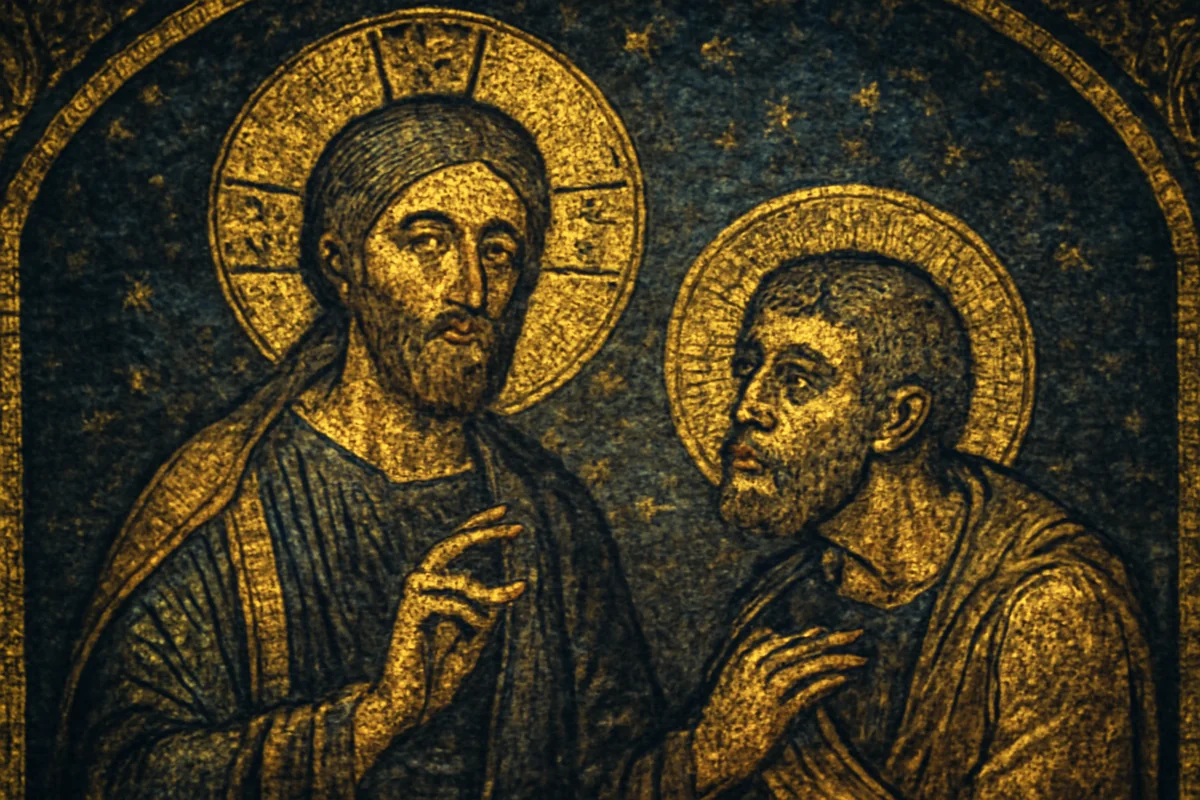
For 1,700 years, Judas Iscariot was the most reviled figure in Christian history. The man who sold Christ for thirty pieces of silver. The disciple who planted a kiss of betrayal. Dante placed him in the lowest circle of Hell, his body eternally chewed by Satan.
Then a damaged papyrus codex surfaced in Egypt, was nearly destroyed in a New York freezer, and finally reached scholars who could read it. What it said overturned two millennia of assumption: in at least one strand of early Christianity, Judas was not the villain. He was the only one who understood.
What the Gospel of Judas Actually Says
The Gospel of Judas is not a narrative gospel in the style of Matthew or Mark — it is a dialogue revelation: a series of private conversations between Jesus and his disciples in the eight days before his arrest. The text announces itself plainly in its opening line:
The secret account of the revelation that Jesus spoke in conversation with Judas Iscariot during a week, three days before he celebrated Passover.
Three scenes carry the text's theological weight.
Scene 1 — Jesus laughs at the Eucharist. Jesus encounters his disciples performing a ritual of thanksgiving (the Eucharist). He laughs. The disciples are offended. He explains: "I am not laughing at you. You are not doing this because of your own will but because it is through this that your god will be praised." The other disciples are worshipping the wrong god — the Demiurge, the inferior creator of the material world. They do not know this. Their most sacred ritual is directed at the wrong recipient.
Scene 2 — Judas identifies Christ correctly. Jesus challenges the disciples: "Let any one of you who is strong enough among human beings bring out the perfect human and stand before my face." The disciples cannot answer. Judas steps forward alone. His response is cosmologically precise:
I know who you are and where you have come from. You have come from the immortal realm of Barbelo, and I am not worthy to utter the name of the one who has sent you.
Jesus rewards Judas: "Step away from the others and I shall tell you the mysteries of the kingdom." But he also warns him immediately: "you will grieve a great deal." Knowing the truth has a cost.
Scene 3 — The commission. After the cosmological teachings (covered below), Jesus gives Judas his task directly: "But you will exceed all of them. For you will sacrifice the man that clothes me." Judas will do what none of the other disciples could do or would do: help Jesus's divine spirit escape its material body.
The Discovery — A 1,700-Year Journey
The Gospel of Judas spent 1,700 years lost — and its survival into the modern era was by the narrowest of margins.
The freezer episode deserves its own note. The decision to freeze the codex — apparently made by Ferrini in an attempt at preservation — was the single most damaging event in the manuscript's post-discovery history. The freeze-thaw cycles separated ink from fibre, darkened the already brittle papyrus to near-illegibility, and shattered pages that had survived 1,700 years in Egyptian sand. What Wurst's team reassembled was a puzzle of over 1,000 pieces. Up to a third of the text remains illegible today.
What Judas Gets Right — The Confession of Barbelo
The most structurally important scene in the Gospel of Judas is modelled on a passage every early Christian would have known — the Confession of Peter.
In Matthew 16:13-23, Jesus asks his disciples "Who do people say the Son of Man is?" Various answers come. Then Jesus asks directly: "But who do you say I am?" Peter steps forward: "You are the Messiah, the Son of the living God." Jesus responds: "Blessed are you, Simon son of Jonah... you are Peter, and on this rock I will build my church."
The Gospel of Judas replays this scene with deliberate precision — and reverses it. Jesus poses the same challenge. Only one disciple steps forward. But this time it is Judas, not Peter. And his answer is not "You are the Messiah, the Son of the living God" but "You have come from the immortal realm of Barbelo."
The parallel is not accidental. The author of the Gospel of Judas is writing against the Petrine tradition — the proto-orthodox claim that the church was founded on Peter's authority, derived from his correct identification of Christ. By replacing Peter with Judas in this structurally identical scene, the text implies: if the church is founded on the disciple who correctly identified Jesus, then it should have been founded on Judas, not Peter.
The Cosmological Teachings — What Jesus Tells Judas in Secret
Having identified Judas as his only true disciple, Jesus takes him aside and delivers the "mysteries of the kingdom" — a cosmological revelation that maps the Gnostic universe from the true God down to the material world.
The cosmology Jesus delivers to Judas is recognisably Sethian — the same framework as the Secret Book of John — but with some distinctive features. The creator gods in this text are named Nebro (meaning "rebel") and Saklas (meaning "fool") rather than the more familiar Yaldabaoth. Twelve angels are created to rule over chaos and the underworld. Humanity is then made by these subordinate beings.
Jesus said: "Come, that I may teach you about [secrets] no person [has] ever seen. For there exists a great and boundless realm, whose extent no generation of angels has seen, [in which] there is [a] great invisible [Spirit], which no eye of an angel has ever seen, no thought of the heart has ever comprehended, and it was never called by any name."
The teaching concludes with the assignment: Judas will "sacrifice the man that clothes me." The physical body of Jesus is described as a garment — the divine Christ wears it temporarily and needs it removed. Judas performs this service. Whether this makes him a hero depends on how you read the text — which is where scholarship gets complicated.
Judas as Hero or Demon? — The Translation Controversy
The 2006 publication of the Gospel of Judas came with a confident headline: Judas was the hero all along. Within a year, that headline was challenged — seriously and by a serious scholar.
April DeConick, professor of Biblical Studies at Rice University, published The Thirteenth Apostle: What the Gospel of Judas Really Says in 2007. Her argument turned on three specific translation choices:
Elaine Pagels and Karen King responded the same year in Reading Judas: The Gospel of Judas and the Shaping of Christianity (2007), defending the sympathetic reading: the text overall presents Judas positively, the cosmological teachings given to him are a mark of honour, and the commission to "sacrifice the man that clothes me" is a request, not a condemnation.
The debate remains unresolved — genuinely so, not merely academically. The manuscript's extensive damage means that several key passages are fragmentary. Both readings are defensible from what survives. DeConick's challenge was important and corrective: the 2006 publication overclaimed certainty. The honest position is that the Gospel of Judas presents a Judas who is theologically privileged — he alone receives gnosis — but whose ultimate fate within the text may be more ambiguous than the initial translation suggested.
Elaine Pagels & Karen King, Reading Judas (2007): "The text clearly honours Judas as the disciple who understood Jesus's teaching — whatever one makes of the ambiguous passages, the structure of the text places Judas in the position of privilege."
Why the Proto-Orthodox Church Feared This Text
Irenaeus of Lyon mentioned the Gospel of Judas around 180 AD — not to summarise it fairly but to bury it.
In Against Heresies I.31.1, he wrote: "They declare that Judas the traitor was thoroughly acquainted with these things, and that he alone, knowing the truth as no others did, accomplished the mystery of the betrayal; by him all things, both earthly and heavenly, were thus thrown into confusion. They produce a fictitious history of this kind, which they style the Gospel of Judas."
The threat Irenaeus saw was structural. The proto-orthodox church rested its authority on apostolic succession — the chain of authority running from Peter's Confession through the bishops to the present. If Judas, not Peter, was the disciple who truly understood Jesus, then the founding act of the institutional church (Jesus building it "on this rock" of Peter's faith) was based on the wrong disciple's testimony.
Irenaeus's designation of the Gnostic group using this text as "Cainites" — people who venerated Cain, Esau, and other figures condemned in the Hebrew Bible — was part of his rhetorical strategy: associate the Gospel of Judas with the most scandalous possible group, making it easy to dismiss. Whether the text was actually used by a "Cainite" sect or whether Irenaeus invented or exaggerated this connection is debated. The text itself shows no particular interest in Cain.
How to Read the Gospel of Judas Today
The Gospel of Judas is freely available online and takes about 30 minutes to read in full.
Which translation: For a first read, use the Kasser/Meyer/Wurst National Geographic translation (2006/2007 Critical Edition) — it is readable and well-annotated. For deeper study, read it alongside April DeConick's translation in The Thirteenth Apostle (2007), which gives you the contested passages in comparative form.
Best scholarly commentary: Pagels & King, Reading Judas (2007) — most accessible. Scopello (ed.), The Gospel of Judas in Context (2008) — academic collection, multiple perspectives.
Bear in mind when reading: the text is fragmentary. Square brackets [...] in any translation indicate lacunae — passages lost to damage. Some of the most theologically significant passages have gaps. The translator's choices about how to fill or interpret those gaps shape the whole reading. This is why the scholarly debate is genuine, not merely academic.
Frequently Asked Questions
Is the Gospel of Judas in the Bible?
No. The Gospel of Judas is a non-canonical Gnostic text — it was never part of the New Testament canon. It was explicitly rejected as heretical by Irenaeus of Lyon around 180 AD, making it one of the earliest Gnostic texts to be named and condemned by a Church Father. The New Testament canon was effectively established in the 4th century; by then, the Gospel of Judas had long been suppressed and largely lost. Its rediscovery in the 1970s and publication in 2006 reintroduced it to the world, but it remains outside any recognised scriptural canon.
Who wrote the Gospel of Judas?
Unknown — the text is anonymous, like all four canonical gospels. It was not written by Judas Iscariot; it is a gospel about Judas, not by him. Most scholars date the original Greek composition to somewhere between 130 and 170 AD, based on Irenaeus's reference to it around 180 AD and on textual analysis of its Gnostic cosmology (which is consistent with 2nd-century Sethian Gnosticism). The surviving Coptic manuscript is a translation from that Greek original, dated by radiocarbon analysis to approximately 220–340 AD.
Is Judas a hero or a villain in the Gospel of Judas?
This is genuinely debated. The initial 2006 National Geographic translation presented Judas as a heroic figure — Jesus's most enlightened disciple, performing a necessary act of liberation rather than a betrayal. April DeConick (Rice University) challenged this in 2007, arguing that key words were mistranslated: "daimon" should be "demon" not "guardian spirit," making Judas a tragic or even negative figure who follows a demonic star to his destruction. Elaine Pagels and Karen King defended the positive reading. Both scholarly positions remain viable because the manuscript is damaged enough that the disputed passages cannot be definitively resolved.
When was the Gospel of Judas written?
The Greek original was most likely composed between 130 and 170 AD. The upper limit is provided by Irenaeus, who mentioned "a Gospel of Judas" around 180 AD in Against Heresies — the text must predate his writing. The lower limit is harder to establish, but the Gnostic cosmology of the text is consistent with mid-2nd-century Sethian Gnosticism. The surviving Coptic manuscript — the only known copy — was radiocarbon dated to approximately 220–340 AD, making it a 3rd or early 4th-century translation of the earlier Greek original.
What happened to the original Gospel of Judas manuscript?
The surviving manuscript — the Codex Tchacos — is a Coptic translation of the original Greek, not the Greek original itself. The original Greek text has not been found and may be lost permanently. The Coptic codex was discovered in Egypt in the 1970s, passed through the antiquities market, was stored in a Hicksville, New York safe deposit box for years, then subjected to catastrophic freeze-thaw damage when a buyer stored it in a freezer around 2000. The Maecenas Foundation in Basel undertook restoration; Gregor Wurst reassembled over 1,000 fragments. The restored codex is now held at the Coptic Museum in Cairo. Up to a third of the text remains illegible due to damage sustained during its years on the market.