
Manichaeism was a dualistic religion founded in 3rd-century Persia by the prophet Mani (216–274 CE). It taught that the universe is a battleground between an eternal Kingdom of Light and an eternal Kingdom of Darkness, and that the human soul — a particle of trapped divine light — could be freed through gnosis. At its peak, it stretched from Spain to China and was Christianity's main rival. Systematically destroyed by every empire it entered, it survives today only in fragments: Augustine's theology, the medieval Cathars, and a single temple still standing in Fujian, China.
Who Was Mani?
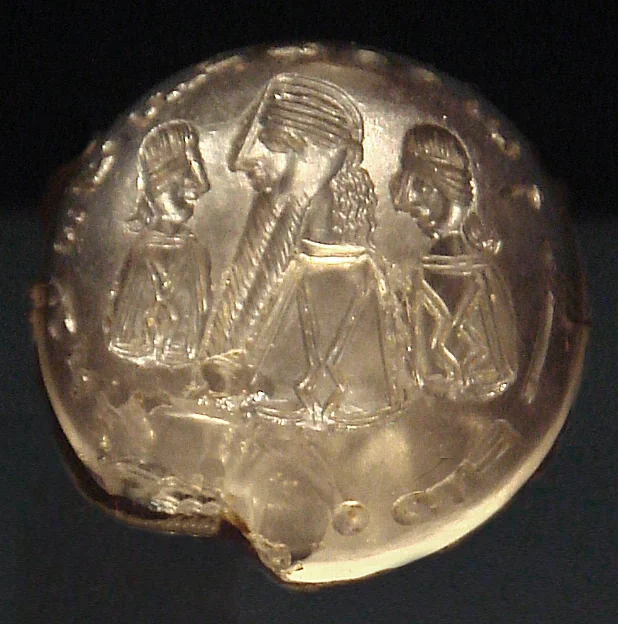
Manichaeism was founded by a single man who planned it that way. Mani was born in 216 CE near Ctesiphon (modern al-Mada'in, Iraq), in the Parthian Empire, to parents who belonged to the Elcesaites — a Jewish-Christian Gnostic baptismal sect. He grew up immersed in an already syncretic religious world: Jewish scripture, Christian ethics, Zoroastrian cosmology, and Babylonian ritual all coexisted in the Mesopotamia of his childhood.
According to biographies preserved by the Arab scholar ibn al-Nadim and the Persian polymath al-Biruni, Mani received his first revelation at age 12 and a second at 24 — both from a divine spirit he called his "celestial twin" (in Greek, Syzygos: "the one yoked alongside"). This twin, he said, taught him the truth that every previous religion had partially grasped but failed to preserve.
Mani concluded that Zoroaster, the Buddha, and Jesus had each been genuine prophets — but their followers had corrupted their messages by keeping them local, language-bound, and incomplete. His mission was to deliver the definitive, universal version. He declared himself the final prophet and the Paraclete promised by Jesus in the Gospel of John.
His end was violent. After losing the patronage of the Persian court under Emperor Bahram I — whose Zoroastrian high priest Kartir viewed Mani as a threat — Mani was imprisoned and died awaiting execution around 274 CE. His followers named his death "the Passion of the Illuminator," a deliberate echo of the crucifixion.
The Core Idea — Light vs Darkness
The entire Manichaean system rests on one absolute claim: two eternal forces — Light and Darkness — have always existed, and the material world is what happens when they collide. This is not the moderate dualism of most Gnostic creation myths, where matter results from a divine mistake. In Manichaeism, Darkness is a fully equal and independent principle — it was never created, never subordinate, and never going away.
In the beginning, Light and Darkness were separate realms. Darkness attacked the realm of Light. To defend it, a divine being called the Primal Man sacrificed himself, entering the darkness — and becoming partially absorbed by it. The material world was formed from this mixture: matter is the residue of Darkness, and the light particles scattered through it are fragments of the divine being, still trapped.
Every human soul is one of those trapped particles. The body is the prison. History is the long, slow process by which gnosis — direct knowledge of this situation — liberates those particles and returns them to the Kingdom of Light. Hans Jonas, in The Gnostic Religion (1958), identified this as Manichaeism's defining feature: salvation is not personal but cosmic — each liberated soul is a particle of light rescued from darkness, incrementally restoring the original order.
Unlike the Demiurge in Sethian Gnosticism — who is ignorant rather than malicious — the forces of Darkness in Manichaeism are genuinely, actively evil. This made Manichaeism's moral framework starker than any other Gnostic system: the world is not a mistake to be transcended but a war to be won.
Elect and Hearers — the Two-Tier Religion
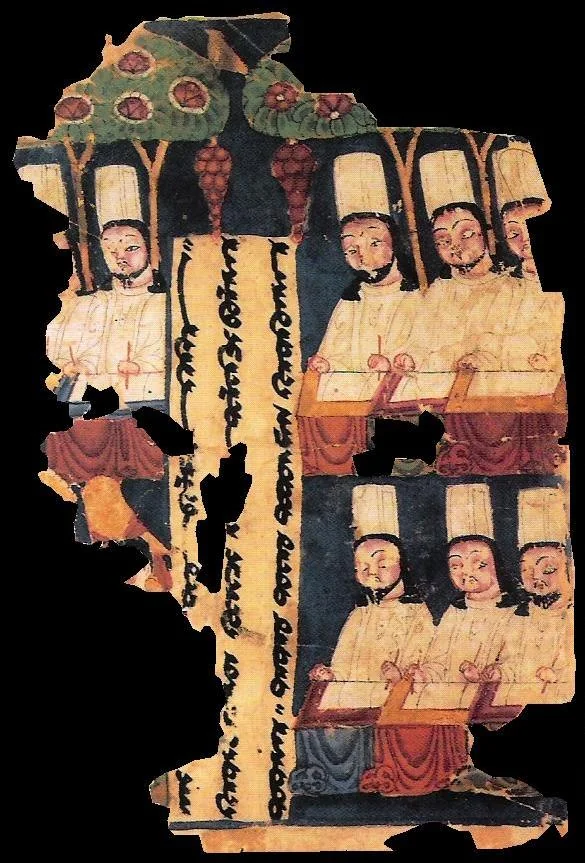
Manichaean society was divided into two clearly defined groups — and the gap between them was absolute. The Elect (electi) lived as full ascetics: no marriage, no sexual activity, no meat, no wine, no property, no farming, no harvesting. They spent their lives in prayer, fasting, missionary work, and the performance of rituals. Their strict regimen was the engine of cosmic salvation — each Elect person was actively liberating light particles from matter through the purity of their life.
The Hearers (auditores) were the second tier: ordinary members who could marry, own property, and eat meat. Their religious duty was to support the Elect — providing food, shelter, and alms. In return, they hoped to be reborn as Elect in a future life and eventually achieve liberation themselves.
The most famous Hearer in history was Augustine of Hippo. Before becoming Christianity's most influential theologian, Augustine spent nine years as a Manichaean Hearer in North Africa — a period he described in his Confessions with a mixture of nostalgia and repudiation. His later obsession with the nature of evil, free will, and original sin bears the unmistakable fingerprints of his Manichaean years.
The Sacred Texts — Written by Mani Himself
Mani did something no other founder of a major religion did: he wrote his own complete canon, personally, in multiple languages, during his lifetime. He composed seven canonical works — six in Syriac, one (the Shabuhragan) in Middle Persian, presented directly to Emperor Shapur I. He also illustrated a canonical book of pictures called the Arzhang, intended to communicate Manichaean cosmology visually across language barriers. According to the scholar Michel Tardieu, Mani even invented his own script — the Manichaean alphabet — to ensure his texts were copied consistently.
Most of the originals were destroyed during centuries of persecution. What survives comes from two archaeological windfalls:
- The Turfan texts — thousands of Manichaean manuscript fragments discovered in the Tarim Basin (Xinjiang, China) by German expeditions in the early 1900s, written in Middle Persian, Parthian, Sogdian, Old Uyghur, and Chinese.
- The Cologne Mani Codex — a tiny Greek parchment codex, just 4.5cm × 3.5cm, discovered in Egypt and published in 1969. It contains the earliest biography of Mani, written in his own community's words.
| Text | Language | Contents | Where found |
|---|---|---|---|
| Shabuhragan | Middle Persian | Cosmology, eschatology — presented to Shapur I | Turfan fragments |
| Arzhang (Picture Book) | Visual | Manichaean cosmology in illustrated form | Partially, Turfan |
| Cologne Mani Codex | Greek | Biography of Mani by his community | Egypt, 1969 |
| Turfan corpus | Multiple | Hymns, prayers, theology, missionary texts | Xinjiang, China, 1900s |
How Manichaeism Spread — From Persia to China
At its peak, Manichaeism stretched from the Atlantic coast of Spain to the Pacific coast of China — a spread no other Gnostic tradition came close to achieving. From the start, the Manichaean church was built for missionary expansion: texts were translated into every language of the Silk Road, and the Elect were sent as preachers across continents.
Under Shapur I (r. 240–270 CE), who tolerated religious diversity in the Sasanian Empire, Mani traveled freely across Persia, Mesopotamia, and into India. After his death, his followers spread westward through Aramaic-speaking communities into Syria, Egypt, and North Africa — where Augustine encountered them in Carthage around 373 CE. By the early 4th century, Manichaean communities existed across the Roman Empire.
Eastward, Manichaeism followed the Silk Road. It reached Tang dynasty China in the 7th century, where it flourished among merchants and eventually at court. In 762 CE, after a Manichaean Uyghur khan helped the Tang emperor suppress a rebellion, Manichaeism became the official religion of the Uyghur Khaganate — the first and only time a Gnostic religion held state power anywhere in the world.
Why It Was Destroyed — Persecution on Every Front
Every empire that Manichaeism entered eventually banned it — and the methods were remarkably consistent: burn the texts, execute the leaders, scatter the communities. Four separate civilisations reached the same conclusion independently.
In Persia, Mani himself was executed under Bahram I in 274 CE. In the Roman Empire, Emperor Diocletian issued an edict in 297 CE ordering Manichaean leaders burned alive along with their books. The Christian Roman Empire continued the persecution: Valentinian I (372 CE) and later emperors issued repeated laws against Manichaeans, and by the 6th century they had effectively disappeared from Roman lands.
In the Islamic world, Manichaeism survived into the early Abbasid period — Arab scholars like ibn al-Nadim wrote detailed accounts of it — but the later Abbasid Caliphate suppressed it in the 10th century. In China, the Tang court banned it in 843 CE (though Chinese communities continued covertly for centuries). When the Uyghur Khaganate collapsed in 840 CE, Manichaeism lost its last state protector.
Persecution alone does not fully explain the collapse. Structurally, Manichaeism was fragile: the Elect depended entirely on Hearer support. When Hearer communities were scattered by persecution, the Elect starved. Unlike Christianity, which could rebuild around a literate laity, Manichaeism's two-tier system had no middle ground.
The Last Traces — Augustine, the Cathars, and a Temple in China
Manichaeism died as an organised religion — but it left three traces that have never fully disappeared.
The first is Augustine of Hippo. His nine years as a Manichaean Hearer shaped his theology in ways he spent the rest of his life arguing against. His doctrine of original sin — the idea that human nature is fundamentally corrupted — echoes the Manichaean view that matter traps the soul. His intense focus on the problem of evil, his division of humanity into the saved and the damned, his suspicion of sexuality: all carry the shadow of Mani. Augustine's Against the Manichaeans is the most detailed early account of Manichaean belief precisely because he knew it from the inside.
The second trace is in medieval Europe. The Bogomils of Bulgaria (10th century), the Paulicians of Armenia, and above all the Cathars of southern France (12th–13th century) all preached a strikingly similar dualism: matter is evil, the material world was created by a lesser evil god, and the soul must escape through asceticism and gnosis. Whether this represents direct descent from Manichaeism or parallel development remains debated among scholars — but the structural resemblance is exact.
The third trace is the most tangible. In Jinjiang, Fujian province, China, the temple of Cao'an still stands. Originally built by Chinese Manichaeans, it was later absorbed into local Buddhist practice — and its main statue, donated in 1339, depicts Mani as the "Buddha of Light": straight-haired and serene, unlike the curly-haired Buddhist figures around him. It is the only surviving Manichaean place of worship in the world.

Manichaeism vs Other Gnostic Sects
Most Gnostic sects were small, secretive, and intellectually elite — communities of initiates passing gnosis among themselves. Manichaeism was the opposite: deliberately mass-market, missionary, and global. Three things set it apart from every other Gnostic tradition.
First, universal mission. Mani explicitly designed his religion to cross every cultural boundary. He had his texts translated into Syriac, Middle Persian, Parthian, Sogdian, Chinese, and Greek before his death. Valentinians and Sethians never launched systematic missionary campaigns. Mani did — and it worked for over a millennium.
Second, founder-written canon. No Gnostic text was written by the person it names as author — the Secret Book of John was not written by John, the Gospel of Thomas not by Thomas. Mani wrote his own texts himself, in his lifetime, and established a clear canonical boundary. This gave Manichaeism a doctrinal stability that other Gnostic groups lacked.
Third, institutional structure. The Elect and Hearer system gave Manichaeism something resembling a church — a professional clergy supported by a lay congregation. Other Gnostic groups had teachers and students, but no such clear institutional division. This structure allowed Manichaeism to organise, travel, and survive — at least until the Hearer base was destroyed.
Frequently Asked Questions
Is Manichaeism a form of Christianity?
Not exactly. Manichaeism incorporates Jesus as one of its prophets — the one who revealed gnosis to humanity — but it is not Christian in any orthodox sense. Mani placed Jesus alongside Zoroaster and the Buddha as partial predecessors whom he claimed to complete. The Church considered Manichaeism a heresy precisely because it used Christian language while rejecting core Christian doctrines like the resurrection, the goodness of creation, and the authority of the Old Testament.
What did Manichaeans believe about evil?
Manichaeism held that evil is not a corruption of good but an independent, eternal principle — the Kingdom of Darkness, which has always existed alongside the Kingdom of Light. This is stricter than most Gnostic positions, which treat matter and evil as the result of a divine mistake or fall. For Manichaeans, darkness was never created and can never be fully eliminated — only gradually defeated as particles of light are rescued from matter over the course of cosmic history.
Was Augustine really a Manichaean?
Yes — as a Hearer, the second tier of the Manichaean community. Augustine joined around age 19 in Carthage and remained a Hearer for approximately nine years before converting to Neoplatonism and then Christianity. He wrote extensively against Manichaeism after his conversion — but his later theology, particularly his treatment of evil, sin, and grace, shows the lasting influence of those nine years.
Does Manichaeism still exist today?
Not as an organised religion. The last Manichaean communities in China disappeared by around the 16th–17th century. The Cao'an temple in Fujian still stands and is still visited, but it operates as a Buddhist site, not a Manichaean one. No community practising Manichaeism as a living faith is known to exist today.
What does "Manichaean" mean in modern usage?
In modern usage, "Manichaean" describes any worldview that divides reality into two absolute opposing forces — good versus evil, light versus dark — with no middle ground or ambiguity. It is often used critically, to describe a way of thinking that refuses nuance. The term entered English from the theology debates of the early Church, where Manichaean dualism was the standard example of dangerous oversimplification.
How is Manichaeism related to the Cathars?
The Cathars of southern France (12th–13th century) shared striking structural similarities with Manichaeism: absolute dualism, rejection of the material world as evil, a two-tier community of perfect ascetics and ordinary believers, and the belief that the God of the Old Testament was a lesser, evil creator. Whether this represents direct historical descent from Manichaeism — transmitted through the Bogomils of Bulgaria — or independent parallel development remains debated. Most scholars today favour indirect influence rather than direct continuity.