
The Nag Hammadi discovery transformed the study of early Christianity by giving scholars direct access to texts that Gnostic Christians actually wrote — rather than the hostile descriptions of their opponents. The 52 texts found in 1945 showed that early Christianity was far more diverse than the orthodox narrative admitted, that Gnostic communities used many of the same scriptures as orthodox Christians, and that the "heresy" of Gnosticism was not a late deviation from original Christianity but a contemporary alternative form that competed on equal terms during Christianity's formative centuries.
Before the Discovery — Christianity Defined by Its Winners
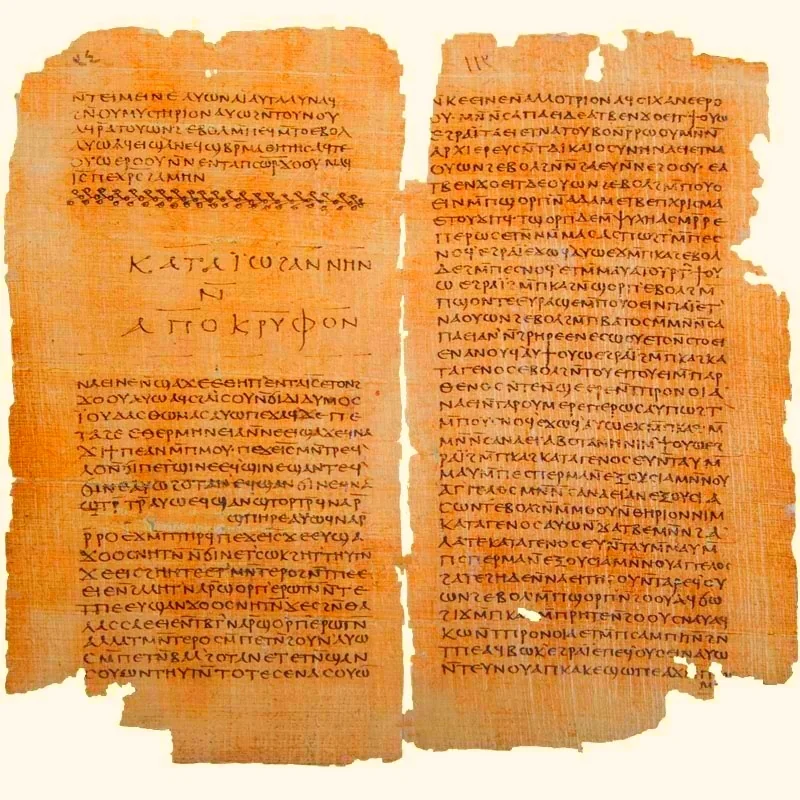
Before 1945, the study of Christian origins had a fundamental problem: almost everything known about Gnostic Christianity came from its enemies. Irenaeus of Lyon (Against Heresies, c. 180 CE), Tertullian (Against Marcion, c. 208 CE), Hippolytus (Refutation of All Heresies, c. 225 CE), and Epiphanius (Panarion, c. 375 CE) preserved extensive descriptions of Gnostic beliefs — but their purpose was polemical. They described Gnostic theology in order to demolish it, not to represent it accurately. Scholars had no way to check these accounts against primary Gnostic sources.
The Nag Hammadi discovery changed this entirely. For the first time, scholars could read what Gnostic Christians actually wrote, in their own words, without the filter of opponents' hostility. The discrepancy between the heresiologists' descriptions and the texts themselves was often striking: Gnostic theology was more sophisticated, more scripturally engaged, and more theologically coherent than the Church Fathers had suggested.
What the Texts Revealed About Early Christianity
The most significant scholarly conclusion drawn from the Nag Hammadi Library — argued most powerfully by Elaine Pagels in The Gnostic Gospels (1979) and Karen L. King in What Is Gnosticism? (2003) — is that early Christianity was not a unified movement from which Gnosticism deviated. In the 1st and 2nd centuries CE, before any council had fixed doctrine or canon, multiple forms of Christianity competed. The Gnostic forms were not marginal; they were sophisticated, widespread, and in many cities the majority position.
Several specific revelations from the Nag Hammadi texts transformed scholarly understanding:
- The Gospel of Thomas — 114 sayings of Jesus with no passion narrative, resurrection, or sacramental theology. It represents a form of Christianity entirely different from the synoptic model, possibly preserving early independent traditions.
- The Secret Book of John — a full Gnostic creation myth presented as a revelation to John after the resurrection. Its cosmological sophistication shows Gnostic theology as a developed system, not a crude parody.
- Women's leadership — texts like the Gospel of Mary and the Gospel of Philip show traditions of female spiritual authority that orthodox Christianity suppressed. Pagels argued this reflected actual community practice in early Gnostic churches.
- Alternative Christologies — Docetic, adoptionist, and spiritual-body Christologies in Gnostic texts show the range of early Christian thinking about Jesus before Nicaea fixed the "fully human and fully divine" formula.
The Pachomian Connection
The most intriguing question about the Nag Hammadi Library is who buried it and why. The strongest theory — supported by James M. Robinson, Hugo Lundhaug, and Lance Jenott — is that the codices belonged to the Pachomian monastery at Chenoboskion, a few kilometres from the discovery site. Monks of the Pachomian order — a major early Egyptian monastic movement — may have used these texts as part of a broader library before Athanasius's Festal Letter of 367 CE ordered the destruction of non-canonical texts.
Paul Linjamaa's 2024 study argues for a more nuanced picture: the Nag Hammadi texts may have been used by "a small intellectual monastic elite" within a Pachomian monastery — scholars who engaged with Gnostic ideas alongside canonical scripture, not as a separate Gnostic sect but as part of a broader intellectual Christian practice. If correct, this blurs the line between "Gnostic" and "orthodox" even within monasticism.
The Redefinition of "Heresy"
Alongside the primary texts, the Nag Hammadi discovery has transformed the study of what "heresy" means in early Christianity. The category of heresy was not pre-existing — it was constructed by the heresiologists as a tool of boundary-drawing. Karen L. King has argued that Irenaeus invented "Gnosticism" as a unified category in order to combat it: by grouping disparate traditions under one label, he could present them as a coherent enemy and construct an "orthodox" identity by contrast.
This argument has been enormously influential in New Testament studies. It suggests that the triumph of what became "orthodox" Christianity was not theologically inevitable but the result of social, political, and institutional processes — including the fixing of the biblical canon, the development of episcopal authority, and eventually the political power granted by Constantine's conversion.
Did the Nag Hammadi texts change what we know about Jesus?
They changed what we know about early Christianity's understanding of Jesus — which is not quite the same thing. The Gospel of Thomas preserves saying traditions that may be independent of the canonical Gospels and could be early. The Secret Book of John presents a Jesus who reveals Gnostic cosmology after the resurrection. These texts show the range of early Christian thinking about Jesus but do not provide new historical information about the historical figure.
Are the Nag Hammadi texts "lost books of the Bible"?
Not exactly. They are early Christian texts that were excluded from the biblical canon — but the canon was defined by a gradual process of community discernment and eventually by official decision, not by suppressing texts that belonged in the Bible. The phrase "lost books of the Bible" implies they were once in the Bible and removed; more accurately, they circulated in some early Christian communities but were never part of the canon that was eventually fixed. They are lost early Christian texts, not lost biblical books.