Sophia — Greek for "Wisdom" — is one of the highest divine beings (Aeons) in Gnostic cosmology. Her act of trying to create alone, without consent, accidentally produced the Demiurge and set the material world in motion. She repents, suffers in exile, and is ultimately redeemed by Christ. She is simultaneously the cause of the Fall and the symbol of every soul's longing to return to God — making her the most human figure in the entire Gnostic universe.
Who Is Sophia?
Sophia is the last and lowest of the divine Aeons — the beings who emanate from the true God and populate the Pleroma, the divine realm of Fullness. Her name is Greek for "Wisdom." In Hebrew scripture, her equivalent is Hokmah (חכמה), often translated as "Wisdom" as well.
In most Gnostic systems, Sophia is the most important figure in the cosmos after the true God and Christ. She is the hinge on which the entire story turns: without her act of independent creation, there would be no Demiurge, no material world, no Archons, no trapped divine sparks — and no need for gnosis. She is the cause of the problem and, through her eventual redemption, the promise of its solution.
Sophia's Origins — From Jewish Wisdom to Gnostic Aeon
Sophia did not begin with Gnosticism. She has roots in Jewish scripture that predate the Gnostic schools by centuries.
In the Jewish wisdom tradition — the books of Proverbs, Job, and Sirach — Wisdom is personified as a divine feminine figure who existed beside God before creation. Nicola Denzey Lewis, in her Introduction to Gnosticism (2013), describes her as "God's active feminine principle, at once a part of God but also separate from God." She acts; she speaks; she creates — while God himself simply is.
The Lord created me at the beginning of his work, the first of his acts of long ago. Ages ago I was set up, at the first, before the beginning of the earth... When he established the heavens, I was there... then I was beside him, like a master worker; and I was daily his delight, rejoicing before him always.
This Jewish Wisdom was not simply an abstract quality. She was a person — a divine being who spoke in the first person, who had been present before creation, and who mediated between God and the world. The Gnostics inherited this figure directly.
The bridge between Jewish Wisdom and Gnostic Sophia was largely built by Philo of Alexandria, a first-century Jewish intellectual who synthesized the Jewish scriptures with Platonic philosophy. David Brakke, in The Gnostics (2010), identifies Philo's work as a key step in transforming the Hebrew concept of divine Wisdom into the kind of semi-independent divine emanation that the Gnostics developed into Sophia.
The Fall — What Sophia Did and Why It Mattered
Sophia's mistake was not rebellion — it was passion.
The Greek word the Gnostic texts use is enthumēsis — a passionate desire, an impulse that exceeded its bounds. Sophia, watching the Father and Barbelo generate new beings together, felt the same desire to create. But she acted on it without involving her divine partner and without the Father's consent. The Secret Book of John is specific: she "brought forth something out of herself" — alone, incomplete, unauthorized.
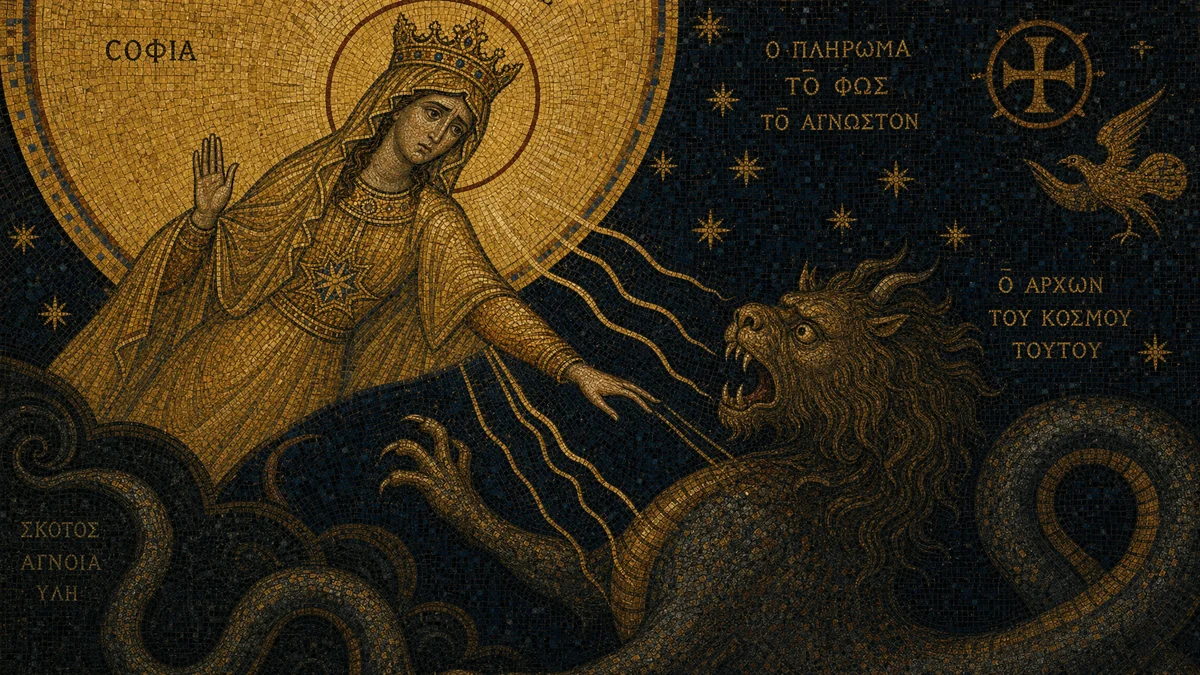
What emerged was nothing like the other Aeons. The Secret Book of John describes a being "like a snake with a lion's head, its eyes burning like lightning." Sophia was immediately horrified. She cast the creature out of the Pleroma, wrapped him in a luminous cloud, and placed him on a throne in the void — hoping none of the other divine beings would see what she had made. She named him Yaldabaoth, "child of chaos." He is also called Sakla ("fool") and Samael ("blind god").
Her act set three catastrophes in motion simultaneously: Yaldabaoth was created, the Pleroma was fractured by her deficiency, and a fragment of Sophia's own divine power was now trapped inside a being who had no idea what to do with it.
Sophia and the Demiurge — Mother and Monster
Sophia and the Demiurge share the most complicated mother-son relationship in the history of religion.
Yaldabaoth is her creation, but she rejects him. He contains her power, but he doesn't know it. She weeps above him from the Ogdoad — the eighth sphere, just beyond the Archons' seven heavens — watching as he creates a broken world out of the divine blueprint he dimly carries within him.
This is why Sophia's redemption is inseparable from humanity's. When Sophia is restored to the Pleroma, the divine sparks in human beings find their path home. Her story and ours are the same story.
Sophia After the Fall — Exile, Repentance, Redemption
The fall of Sophia is not the end of her story — it is the beginning of the most important arc in Gnostic theology: redemption.
After the fall, Sophia does not simply disappear. She is placed in the Ogdoad — the eighth celestial realm, above the seven Archon-governed heavens, below the Pleroma. From there she weeps and repents. The Father hears her pleas and promises to restore her once her "deficiency" is filled. But first she must wait — and atone.
The Pistis Sophia — a long, late Gnostic text found in a Coptic manuscript — expands Sophia's ordeal dramatically. She is seized by a demon called Authades, cast into chaos, stripped of her light, and forced to repent thirteen times in increasingly desperate psalms before Christ finally descends to rescue her. The text is the most detailed account of Sophia's suffering in all of Gnostic literature.
The Two Sophias — Upper and Lower (Valentinian)
In Valentinian Gnosticism — the most sophisticated and widespread of the Gnostic schools — there are not one but two Sophias.
Lower Sophia, called Achamoth (Ἀχαμώθ — the Greek form of the Hebrew Hokmah), is the portion of Sophia that fell into the void. She is the "world soul" — her suffering and longing generate matter and soul-substance. The material universe is, in this reading, literally built from Sophia's anguish. Eventually the Soter (Christ) descends to redeem Achamoth, and she becomes the mother of all pneumatic (spiritual) human beings.
Einar Thomassen, in his contribution to The Nag Hammadi Scriptures (2008), notes that this two-Sophia structure allowed Valentinians to maintain a complex theology of cosmic fall and redemption without compromising the perfection of the divine realm — the Upper Sophia never actually fell; only a portion of her longing did.
Thunder, Perfect Mind — Sophia's Voice in the Nag Hammadi Library
One of the most quoted texts in the Nag Hammadi Library has no named author — just a divine feminine voice speaking in a cascade of contradictions.
I was sent from the power, and I have come to those who contemplate me, and I have been found among those who seek after me. Look at me, all you who contemplate me, and you who hear, hear me. You who are waiting for me, take me to yourselves. And do not pursue me from your shadows. I am the first and the last. I am the honored one and the scorned one. I am the whore and the holy one.
The speaker of Thunder, Perfect Mind describes herself through paradoxes: she is both everything and nothing, honored and despised, prostitute and saint. Many scholars — including Marvin Meyer and Anne McGuire — read this voice as Sophia, or as a closely related divine feminine power. The poem captures something the systematic Gnostic texts don't: the raw experience of a divine being who has fallen, who contains everything, and who is seeking recognition from the souls who carry her spark.
The text has had an extraordinary afterlife. It was read aloud in the film Stigmata (1999), set to music by multiple composers, and cited by feminist theologians as evidence of a suppressed divine feminine tradition within early Christianity.
Why Is She Called "Wisdom" If She Made Such a Mistake?
Irenaeus of Lyons — the Church Father who wrote five volumes attacking Gnosticism — pointed out what seemed like an obvious contradiction: how could a being named "Wisdom" commit the founding act of cosmic foolishness?
The Gnostic answer, as gnosticismexplained.org identifies it, is that Sophia represents not fully realized wisdom but aspiring wisdom — the human intellect at its best, reaching beyond its capacity without the divine grace that would complete it. Her name is not descriptive of what she is but of what she is trying to become. "Fallen wisdom" is still wisdom — it is wisdom that has acted alone, cut off from the divine Fullness that would make its action complete and right.
The Gnostic who achieves gnosis arrives at what Sophia longed for: true Wisdom, reunited with the Pleroma. Sophia's fall is the path every soul is on. Her eventual restoration is the destination every Gnostic sought.
Sophia Today — Feminist Theology, Jung, and Modern Spirituality
Sophia did not stay in the 2nd century. She has had a continuous afterlife in theology, psychology, and popular spirituality.
Feminist theology: Theologians including Elisabeth Schüssler Fiorenza have recovered Sophia as evidence of a suppressed divine feminine in Christianity. The figure of Wisdom in Proverbs is read as a pre-patriarchal trace of goddess theology absorbed into monotheism.
Jungian psychology: Carl Jung identified Sophia with the anima — the feminine principle in the male unconscious — and with the archetype of divine wisdom. His late work Answer to Job (1952) engages directly with Sophia as a cosmic figure.
Modern Gnostic communities: The Ecclesia Gnostica and related communities maintain Sophia as a central liturgical figure — the feminine aspect of the divine, invoked in sacraments and prayer.
Frequently Asked Questions
Who is Sophia in Gnosticism?
Sophia is the last and lowest of the divine Aeons in the Pleroma — the realm of divine Fullness. Her name means "Wisdom" in Greek. She is the figure whose act of independent creation accidentally produced the Demiurge and set the material world in motion. She repents, suffers in exile, and is ultimately redeemed by Christ. Her story is the central drama of the Gnostic universe — the fall and recovery of divine Wisdom that mirrors every human soul's own journey.
What did Sophia do wrong?
Sophia attempted to create a new being on her own — without involving her divine partner and without the Father's consent. The Gnostic texts describe this as an act of enthumēsis (passionate desire) rather than malice. The result was Yaldabaoth — a monstrous, ignorant being who became the Demiurge, the creator of the material world. Sophia immediately recognized her error, cast Yaldabaoth into a void, and began repenting. Her mistake was not rebellion but overreach — wisdom acting without the divine grace that would have completed it.
What is the relationship between Sophia and the Demiurge?
Yaldabaoth is Sophia's son — born from her act of independent creation. She rejects him immediately, but a fragment of her divine power remains trapped within him. This is what the Demiurge breathes into Adam, creating the divine spark in human beings. So Sophia is both the accidental cause of humanity's imprisonment in matter and the source of the divine light that makes human salvation possible. Her story and humanity's are inseparable.
Does Sophia get saved in Gnosticism?
Yes. In most Gnostic traditions, Sophia's redemption is the central promise of the entire system. After her fall, she is placed in the Ogdoad — the eighth realm, just outside the Pleroma — where she repents and waits. In the Pistis Sophia, Christ is sent by the Father to rescue her after thirteen episodes of capture and repentance. Her eventual restoration to the Pleroma is both her personal salvation and the template for every human soul's return to God.
What is the Pistis Sophia?
The Pistis Sophia is a separate Gnostic text — not from the Nag Hammadi Library but from a Coptic manuscript known as the Askew Codex, acquired by the British Museum in 1785. It is one of the longest surviving Gnostic texts and gives the most detailed account of Sophia's suffering and redemption. The title means "Faith-Wisdom" — Sophia's full name in this tradition. The text describes her capture by evil cosmic forces, her thirteen repentances (each a psalm of anguish), and her eventual rescue by Christ.
Is Sophia mentioned in the Bible?
Not by name in Gnostic terms, but the concept draws directly from Jewish scripture. Proverbs 8 personifies Wisdom as a divine feminine figure beside God before creation. Proverbs 9, Job 28, and Sirach 24 continue this tradition. The Gnostics inherited this "Wisdom theology" directly, identifying the Jewish Hokmah with their divine Sophia. The Gospel of John's opening — "In the beginning was the Logos (Word)" — has also been read as drawing on this same Jewish Wisdom tradition, with Logos replacing (or overlapping with) Sophia.