Three steps: (1) spend 30 minutes reading the core concepts — gnosis, the Demiurge, the Pleroma, the divine spark, and the Archons; (2) read one good introductory book (Elaine Pagels's The Gnostic Gospels is the best starting point for most people); (3) read one primary text — the Gospel of Thomas if you want something accessible, the Secret Book of John if you want the full mythology. Total time to a solid foundation: 3–4 weeks.
Before You Start — Two Types of Gnosticism Students
Before recommending a single book, it helps to know which kind of student you are — because two very different audiences come to Gnosticism with different goals and need different paths.
The spiritual seeker has encountered Gnostic ideas through philosophy, psychology, or alternative spirituality and wants to explore them for personal meaning. This student may find the scholarly approach slow and prefer to start with the texts themselves.
Both paths are valid. The reading order below works for both — but know which one you are, because it affects how patiently you'll get through the introductory books.
Step 1 — Understand the Core Ideas First (30 Minutes)
Reading a Gnostic text without understanding five core concepts is like walking into a film forty minutes late. The story is happening, but you don't know the characters or the stakes.
Before opening any book or primary text, read the explanations of these five concepts — it takes about 30 minutes and makes everything else significantly clearer:
- What Is Gnosticism? — the overall framework and what distinguishes it from orthodox Christianity
- The Archons — the planetary rulers who govern the material world and keep souls in ignorance
- Sophia — whose fall produced the Demiurge and set the entire story in motion
- The Gnostic Creation Myth — the full story of how the material world came to be
- The Secret Book of John — overview of the most important Gnostic text before you try to read it
With those five pages read, you will understand what the Demiurge is, why Sophia matters, what the Archons do, what gnosis means, and why Gnostics interpreted Genesis the way they did. That is enough context to read any introductory book without confusion.
Step 2 — Read One Good Introduction (1–2 Weeks)
Two books have introduced more people to Gnosticism than any others. They are different books for different readers — and knowing which one suits you saves time.
| Book | Level | Best for | Caution |
|---|---|---|---|
| Elaine Pagels The Gnostic Gospels (1979) |
Beginner | Anyone new to Gnosticism. Readable, gripping, historically honest. Written for a general audience and won the National Book Award. | Published 1979 — some scholarship has moved on. Focuses on social/political dimensions of early Christianity more than the mythology itself. |
| Nicola Denzey Lewis Introduction to Gnosticism (2013) |
Beginner–Intermediate | Readers who want more rigour and more coverage of the actual texts. The most current general introduction available. Groups Nag Hammadi texts by theme. | Slightly more demanding than Pagels. Better for students than casual readers. |
| Hans Jonas The Gnostic Religion (1958) |
Intermediate | Readers interested in the philosophical dimensions — how Gnosticism relates to existentialism, Neoplatonism, and the problem of evil. | Older scholarship; predates the full Nag Hammadi translations. Read after Pagels or Lewis. |
| David Brakke The Gnostics (2010) |
Intermediate | Readers who want the current scholarly consensus on who the Gnostics were, how diverse the movement was, and what the texts actually say. | Academic in tone. Best read after Pagels as a complement, not a replacement. |
Recommendation for most readers: Start with Pagels. Read it in a week. If you want more after that, go to Denzey Lewis. If you want philosophy, go to Jonas. If you want current scholarship, go to Brakke.
Step 3 — Try One Primary Text (Your Choice)
After one good introduction, you are ready for a primary text — but which one depends on what drew you to Gnosticism in the first place.
📖 If you're drawn to wisdom sayings and mystical teachings:
Start with the Gospel of Thomas — 114 short sayings attributed to Jesus, no narrative, no mythology. You can read it in an afternoon. The sayings reward re-reading and are striking even without background knowledge.
🌀 If you want the full Gnostic story — creation, fall, salvation:
Start with the Secret Book of John — the most complete account of Gnostic cosmology. Read the overview on this site first, then the text itself. It takes 2–3 hours to read carefully.
✨ If you're drawn to philosophy and beautiful prose:
Start with the Gospel of Philip — a collection of meditations on the sacraments, the bridal chamber, and the nature of knowledge. The most quotable of the Gnostic texts; the source of the famous line "The world came into being through a mistake."
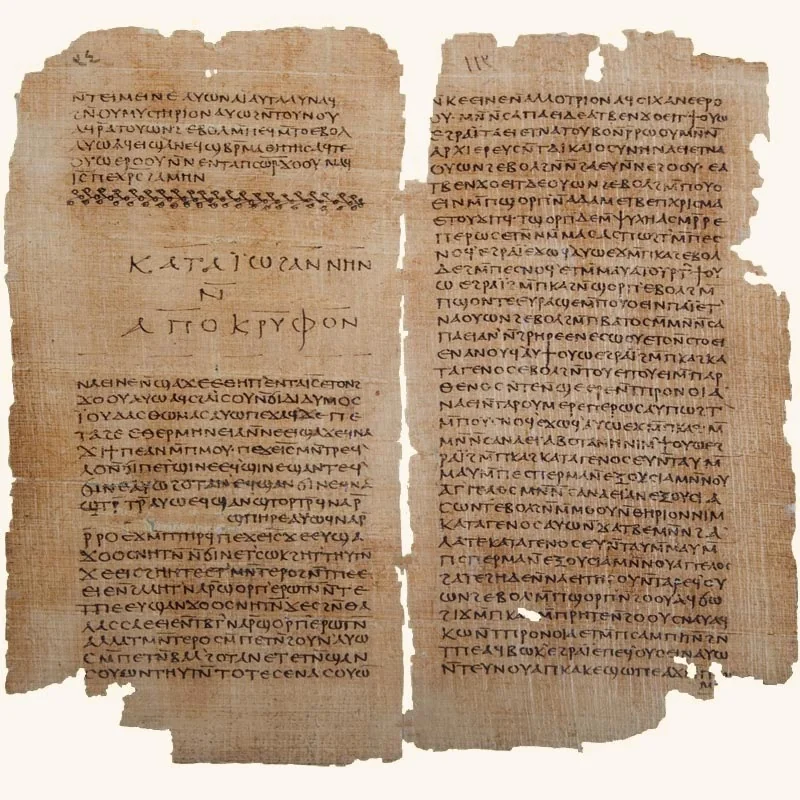
All three are available free online. The most readable English renderings are on gnosticismexplained.org, which bases its translations on Bentley Layton and Marvin Meyer. For the standard scholarly translation, use Marvin Meyer's The Nag Hammadi Scriptures (HarperOne, 2007).
What Not to Read First
Every enthusiastic beginner makes the same mistake: they try to read everything at once.
Pistis Sophia — One of the longest surviving Gnostic texts, running to over 350 pages of repetitive dialogue. Sophia repents thirteen times in nearly identical terms. Essential for advanced study; overwhelming as a first text.
Zostrianos — Highly technical Sethian Platonic philosophy. Even scholars find it difficult. It was reportedly so hard that Plotinus's students wrote a refutation of it.
The full Nag Hammadi Library in English (ed. James Robinson) — This is the standard complete translation and an essential reference work. But reading it cover to cover as a beginner is like learning to drive by reading an engineering manual.
The Church Fathers (Irenaeus, Tertullian, Hippolytus) — You will eventually need to read these, because much of what they quote from Gnostic texts is otherwise lost. But they wrote to condemn, not to explain. Reading them first gives a distorted picture.
A Warning About "Archons" Online
If you have already been searching "archons" or "Gnostic archons" online, you have probably encountered a version of Gnosticism that ancient Gnostics would not recognize.
How to tell the difference: Legitimate Gnostic scholarship cites actual ancient texts by name (Secret Book of John, Reality of the Rulers, etc.) and references academic sources. Conspiracy content about archons does not engage with the primary texts and makes claims that have no basis in the historical Gnostic literature. Historical Gnosticism was a religious tradition seeking spiritual liberation — not a political theory about who controls governments.
Free Resources to Get Started
You do not need to spend anything to begin studying Gnosticism. These are the best free resources available:
How Long Does It Take?
The honest answer depends on what "understanding Gnosticism" means to you.
| Level | What it covers | Time required |
|---|---|---|
| Basic understanding | Core concepts, one intro book, one primary text. You can hold a conversation about Gnosticism and understand what it was. | 3–4 weeks of casual reading |
| Solid foundation | 2–3 intro books, 4–5 primary texts (Gospel of Thomas, Secret Book of John, Gospel of Philip, Gospel of Judas, Pistis Sophia). You understand the main traditions and can navigate the scholarship. | 3–6 months |
| Scholarly familiarity | Full Nag Hammadi Library, secondary literature, Church Fathers, Valentinian and Sethian distinctions, academic debates. | 1–2 years of serious study |
Most people who ask "how do I study Gnosticism?" want level 1 or 2. That is entirely achievable. You don't need years of academic study to understand what Gnosticism was, what the texts say, and why people found it compelling — or still do.
Frequently Asked Questions
What is the best first book on Gnosticism?
For most people, Elaine Pagels's The Gnostic Gospels (1979, Vintage Books) is the best starting point. It is readable, historically rigorous, and available everywhere. For readers who want more academic depth from the start, Nicola Denzey Lewis's Introduction to Gnosticism (2013, Oxford University Press) is more current and covers more of the actual texts.
Is the Gospel of Thomas easy to read?
Yes — it is the most accessible primary Gnostic text. It contains 114 short sayings attributed to Jesus with no narrative, no mythology, and no theological system to decode. You can read it in one sitting. Many sayings are immediately striking without any background knowledge. It is the best primary text for a first encounter with Gnostic material. Free translations are available at gnosis.org.
Do I need to know about early Christianity to understand Gnosticism?
It helps significantly, but it is not required for a basic understanding. Most Gnostic texts engage with the same figures and narratives as early Christianity (Jesus, John, Adam, Eve, Genesis) but interpret them differently. If you know the basic Gospel story and the Genesis creation narrative, you have enough context. Deeper study benefits from familiarity with 2nd-century Christianity, Platonic philosophy, and Jewish wisdom literature — but beginners can read the introductory books and get a great deal without this background.
What's the difference between Gnosticism and New Age spirituality?
Historical Gnosticism is a specific set of 2nd-century religious traditions with datable texts, identifiable schools (Sethians, Valentinians), and a documented historical context. New Age spirituality is a modern, eclectic movement that borrows from many traditions including Gnosticism but is not historically continuous with it. Many New Age presentations of Gnostic ideas (the "divine spark," the "Matrix" analogy, "archons as controllers") draw on authentic Gnostic concepts but remove the original theological framework. Both can be interesting, but they are different things.
Can I read Gnostic texts for free online?
Yes. The full Nag Hammadi Library is available free at gnosis.org, which includes multiple translations of each text. EarlyChristianWritings.com provides scholarly introductions and links. GnosticismExplained.org has the most readable modern English renderings of the key texts, based on the Layton and Meyer translations.
Is Gnosticism a religion I can practice today?
Yes, in several forms. Mandaeism — an ancient Gnostic religion with an unbroken tradition — is still practiced by approximately 60,000–70,000 people, mainly in Iraq, Iran, and diaspora communities. Modern Gnostic churches also exist, including the Ecclesia Gnostica (founded 1959, Los Angeles), the Apostolic Johannite Church, and the Ecclesia Gnostica Catholica. These organizations offer sacraments, liturgy, and community in the Gnostic tradition. For a non-institutional approach, many people engage with Gnostic ideas through study, meditation, and the texts themselves.