
Valentinus (c. 100–165 CE) was the most influential Gnostic teacher in history — and for a period in the mid-2nd century, his theological school was not a fringe movement but a serious rival to what would become orthodox Christianity. Born in Egypt, educated in Alexandria, he arrived in Rome around 138 CE and spent the rest of his life there, attracting a wide following with a sophisticated system that combined Platonism, Paul's letters, and Gnostic cosmology into a coherent whole.
Life and Context
Epiphanius of Salamis reports that Valentinus was born in the Phrebonitis coastal region of Egypt, though the exact location is uncertain. He received a Greek education in Alexandria — then the intellectual centre of the Mediterranean world, where Platonic philosophy, Jewish allegory (in the tradition of Philo), and early Christian theology all intersected. Clement of Alexandria records that Valentinus's followers claimed he had studied under Theudas, a disciple of Paul, who transmitted to him secret wisdom that Paul had reserved for his inner circle.
He arrived in Rome during the pontificate of Pope Hyginus (c. 138–142 CE) and taught there for roughly two decades. According to Tertullian — admittedly a hostile source — Valentinus had expected to become a bishop but was passed over in favour of a man who had survived persecution. The disappointment, Tertullian claims, drove him to found his own school. This account is almost certainly polemical; there is no corroborating evidence. What is clear is that Valentinus attracted a substantial following and that his school divided into Eastern and Western branches after his death.
The Valentinian System
Valentinus developed the most intellectually sophisticated Gnostic theology of the 2nd century — a system so comprehensive that Tertullian called it "the most plausible heresy" and "the closest to paganism." Its central structure is the Pleroma: the divine fullness, a realm of 30 Aeons (divine emanations) arranged in 15 pairs (syzygies), all ultimately arising from an unknowable first principle called Bythos ("Depth" or "Abyss").
The system posits three classes of human beings: the pneumatics (spiritual people, who possess a divine spark and are capable of gnosis), the psychics (soul-people, capable of some spiritual development — ordinary Christians in Valentinus's reading), and the hylics (material people, fully dominated by matter and incapable of salvation). Only pneumatics — through gnosis — return to the Pleroma. Psychics attain a lesser salvation. Hylics perish with the material world.
Valentinus drew heavily on Paul's letters and on the Gospel of John, reading them as encoded Gnostic teaching. This was not rejection of scripture but reinterpretation: Valentinus argued that Paul himself was a Gnostic teacher who had transmitted an inner teaching alongside his public one.
Pneumatics — spiritual, possess divine spark, capable of gnosis → return to Pleroma
Psychics — ordinary Christians, capable of some salvation → lesser realm
Hylics — material, no divine spark → perish with matter
The Gospel of Truth
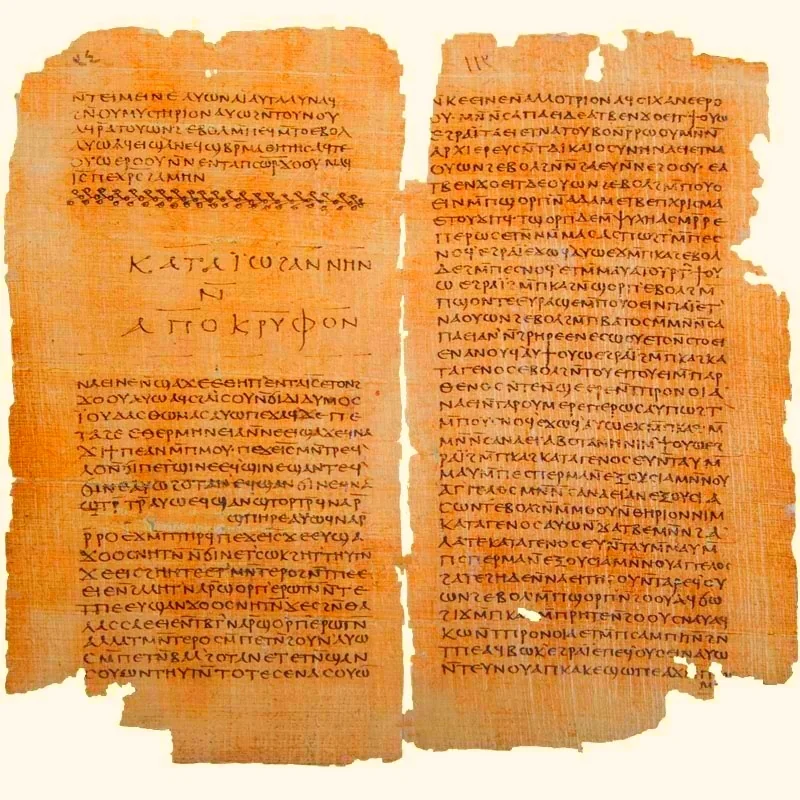
The Gospel of Truth, found in Nag Hammadi Codex I (the Jung Codex), is widely attributed to Valentinus himself — Irenaeus mentions a "Gospel of Truth" in the possession of the Valentinians and implies it was Valentinus's own composition. It is unlike most Gnostic texts: not a cosmological treatise but a meditative homily, almost lyrical in its language. Jesus hanging on the cross is compared to fruit hanging from a tree, nourishing those who reach up to eat. Knowledge is presented as the remedy for an error — a forgetfulness of divine origin that the soul carries into matter. The text is available in the Nag Hammadi Library collection.
The Valentinian School
After Valentinus's death (c. 165 CE, probably in Cyprus), his school became the dominant form of Gnostic Christianity across the Roman Empire. It divided into an Eastern branch (more speculative, emphasising cosmology) and a Western (Italian) branch (more focused on ethics and ritual). Notable Valentinians included:
- Ptolemy — the most systematic Western Valentinian; wrote a famous letter explaining Gnostic interpretation of the Law of Moses
- Heracleon — wrote the first known biblical commentary, on the Gospel of John
- Marcus — founder of the Marcosian sub-school; developed an elaborate numerological mysticism
- Theodotus — Eastern branch; fragments quoted by Clement of Alexandria
The Valentinian school generated more surviving texts in the Nag Hammadi Library than any other Gnostic tradition: the Gospel of Truth, the Gospel of Philip, the Tripartite Tractate, and others all reflect Valentinian theology. Irenaeus spent five books of his Against Heresies (c. 180 CE) refuting Valentinus, which — ironically — preserved more of the Valentinian system than any Gnostic source.
Legacy
Valentinus came closer to mainstream acceptance than any other Gnostic figure. His system was sophisticated enough that Tertullian called it the most persuasive of all heresies. The Christoph Markschies study (Valentinus Gnosticus?, 1992) argues that the "Valentinianism" known from heresiological sources may be more the creation of Valentinus's disciples than Valentinus himself — that the teacher was subtler than the school he spawned.
The Gospel of Thomas, the Gospel of Philip, and the Gospel of Truth — all texts with Valentinian connections — continue to influence modern theological scholarship. Elaine Pagels's The Gnostic Gospels (1979) drew extensively on Valentinian texts to argue that early Christianity was more diverse than the orthodox account admitted. Valentinus himself remains the most important Gnostic thinker whose work we can partially reconstruct.
Frequently Asked Questions
Was Valentinus a Christian?
Valentinus considered himself a Christian and interpreted Paul's letters and the Gospel of John as his primary scriptures. He did not see himself as departing from Christianity — he believed he was recovering its inner meaning. The Church declared him a heretic only after his death. During his lifetime, the boundaries between "orthodox" and "Gnostic" Christianity were not yet fixed.
Did Valentinus write any texts that survive?
Only fragments survive — mostly quotes preserved by his opponents Irenaeus, Clement of Alexandria, and Hippolytus. The Gospel of Truth (Nag Hammadi Codex I) is widely attributed to Valentinus himself, though direct authorship cannot be confirmed. His actual writings were lost to the same suppression that destroyed most Gnostic literature.
What is Valentinianism?
Valentinianism is the Gnostic school founded by Valentinus and continued by his disciples. It was the most widespread and intellectually sophisticated form of Gnostic Christianity, with communities across the Roman Empire from the 2nd to 4th centuries. It emphasised the Pleroma (divine fullness), the three types of human beings (pneumatic, psychic, hylic), and the Bridal Chamber as the highest sacrament. See our full article on Gnostic sects.